

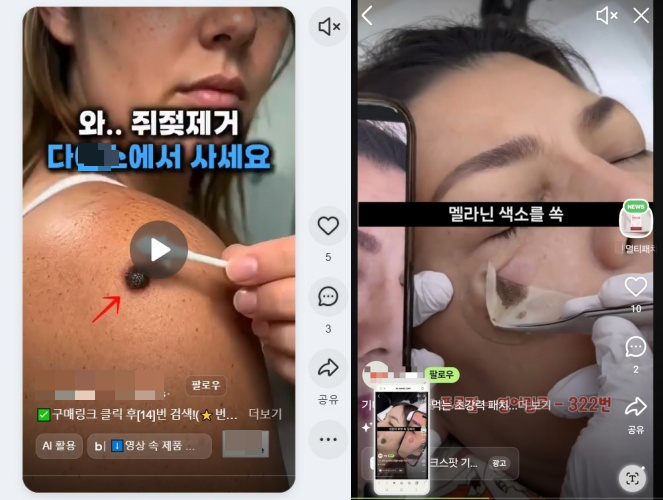
"Oral Wegovy," "cosmetics that remove age spots," "cream that removes gynaecomastia when applied."
These phrases, frequently seen on the internet, all constitute false advertising. Recently, such false advertising has proliferated online through "short-form" (short videos) and other formats, prompting a sharp increase in government crackdowns on unfair advertising. The number of detected cases of unfair advertising for general foods, health functional foods, cosmetics, and medical devices last year increased by nearly 40% compared to three years ago. In contrast, the recovery of unjust gains is almost nonexistent. Among approximately 60,000 cases of unfair food advertising, only two instances involved penalty surcharges imposed to recover unjust gains.
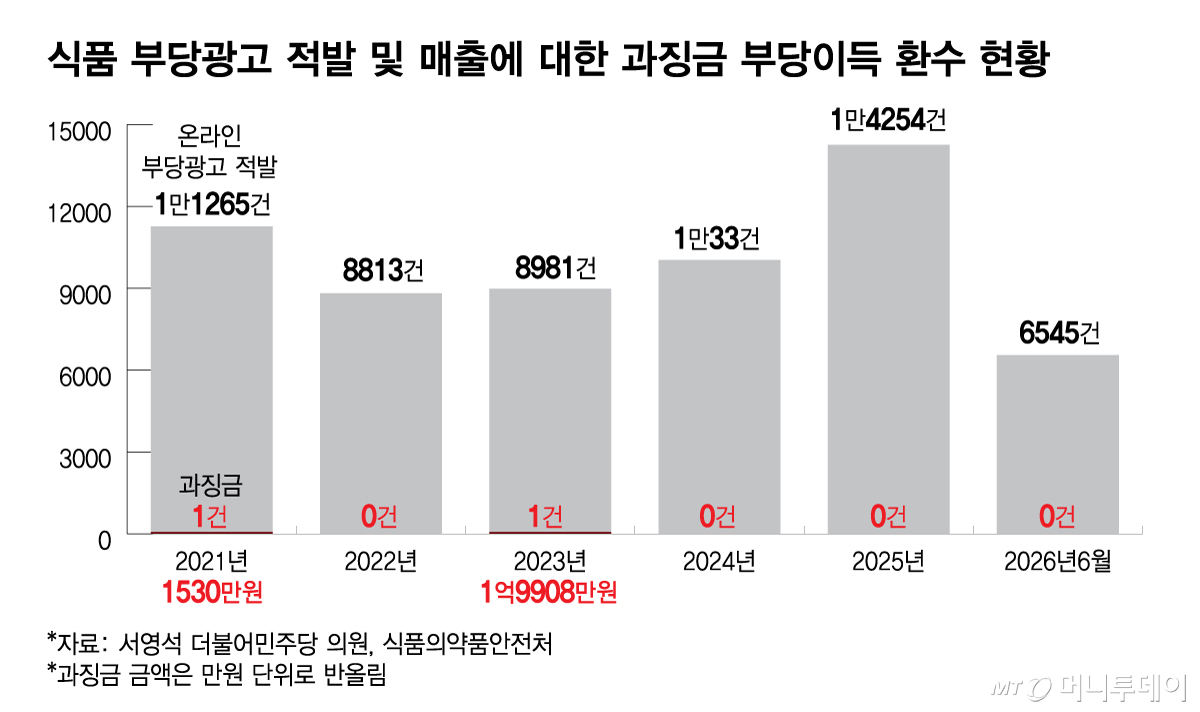
Unfair advertising up about 40% in three years... Penalty surcharges for recovering unjust gains are nearly nonexistent
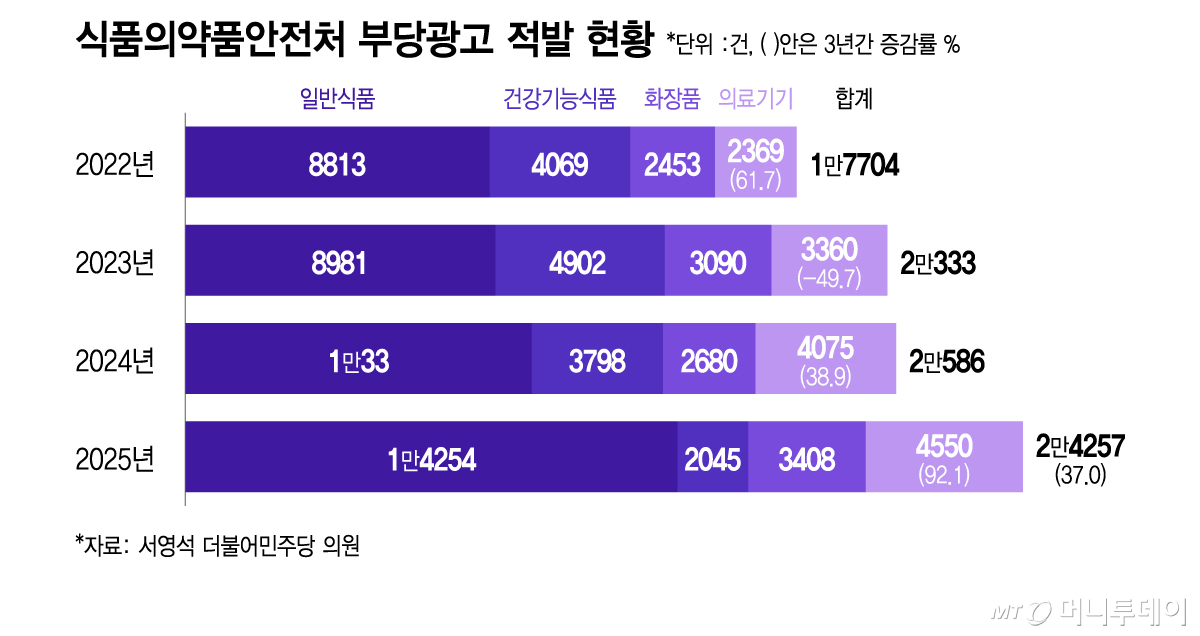
According to data obtained by Democratic Party of Korea lawmaker Seo Young-seok from the Ministry of Food and Drug Safety on the 15th, the number of detected cases of unfair advertising for general foods, health functional foods, cosmetics, and medical devices last year was 24,254, a 37.0% increase compared to 17,704 cases three years prior.
General foods accounted for the largest share of unfair advertising. The number of detected cases last year was 14,254, a 61.7% increase from three years ago. For medical devices, 4,550 cases of unfair advertising were detected, a figure that increased by 92.1% compared to three years ago. Excluding health functional foods, the number of detected unfair advertising cases increased significantly in most sectors, including cosmetics and medical devices.
However, even when detected, the recovery of profits from unfair advertising is not properly carried out. In the case of general foods, the number of online unfair advertising cases detected from 2021 through June this year reached 59,891, but only two cases involved penalty surcharges imposed to recover unjust gains, totaling just 213.48 million won.
Sales generated through false and exaggerated advertising can reach several billion to hundreds of billions of won. In July last year, the Ministry of Food and Drug Safety inspected food advertisements that marketed products as "oral Wegovy," presenting them as weight-loss pharmaceuticals. The inspection found that 26 entities violated the Act on Labeling and Advertising. The products sold by these entities numbered approximately 600,000 units, with sales reaching 11.5 billion won. However, the recovery of such unjust gains remains extremely limited in the current situation.
Need to track operators and strengthen post-hoc penalties such as recovery of unjust gains
Seo (Rep.) pointed out, "Unfair advertising increases every year, yet only two cases out of nearly 60,000 detections have resulted in the recovery of illegally earned sales revenue." He added, "This inevitably leads to the perception that it is fine as long as you can sell the product, even if detected." He emphasized, "We must improve the system to ensure that penalty surcharges for recovery function properly, while also developing measures to track actual operators and manage histories of repeat violations."
There are calls for urgent regulatory improvement and strengthened penalties. Jung Ji-young, Secretary-General of the Korea Consumers' League, stated, "Regulations have failed to keep pace with new types of media, making the problem of exaggerated advertising more severe." She added, "It is necessary to completely transform the regulatory framework to align with the characteristics and content of each medium." She further noted, "Among countries of a certain scale, only South Korea lacks a 'class action system.'" She continued, "From a post-hoc perspective, penalties must be strengthened so that there is a clear signal that engaging in illegal activities will lead to ruin. Otherwise, we will have no choice but to keep chasing them."
Attorney Kim Tae-min, President of the Food Advertising and Hygiene Law Research Institute, stated, "More than 90% of advertisements appearing on Reels or short-form videos can be considered exaggerated advertising." He pointed out, "It is difficult to detect exaggerated advertising, and even when detected, one can drag out a trial for two years by paying a fine of several million won." He added, "Since sellers can obtain unjust gains of hundreds of millions to billions of won over time, they do not fear having a criminal record." He asserted, "A system for recovering unjust gains is needed. Just as authorities have declared they will ruin those who play games with stocks, the Ministry of Food and Drug Safety, police, and all ministries must respond with full force to exaggerated advertising."

 in THEBIO


