

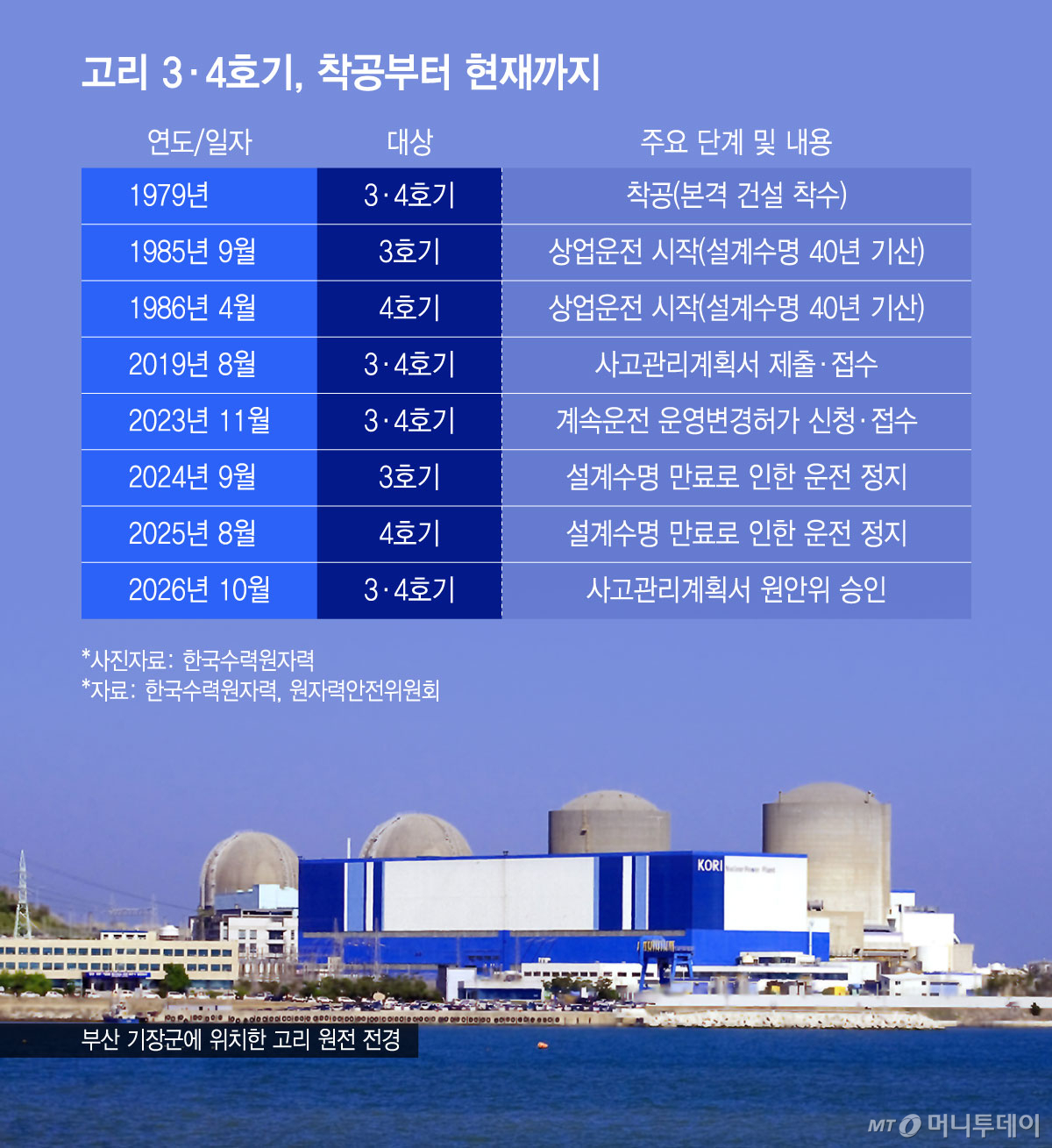
The decision on whether to continue operating Gori Units 3 and 4 in Gijang County, Busan, which have been halted for several months, is expected to be made within the year. This would mean restarting a 1,900-megawatt (MW) nuclear plant capable of meeting the annual electricity demand of a metropolitan city with a population of several million.
The Nuclear Safety and Security Commission, which approved the accident management plan documents for Gori Units 3 and 4 on the 15th, will subsequently begin reviewing the operating change permit application submitted by Korea Hydro & Nuclear Power for the continued operation of Gori Units 3 and 4. While the accident management plan document is a procedure to verify the safety and accident management capabilities of a nuclear plant, the operating change permit is the final procedure that approves the restart of the plant.
Industry sources expect the decision on whether to restart the units could be made as early as next month. Previously, in the case of Gori Unit 2 in Gijang County, Busan, which was approved for continued operation, the accident management plan document was passed in October 2025, and continued operation was approved at a meeting held the following month.
Gori Units 3 and 4 have been out of service since September 2024 and August 2025, respectively. This is because their 40-year design lifespans expired before receiving approval for continued operation. Gori Unit 3 began commercial operation in September 1985, and Gori Unit 4 began commercial operation in April 1986. The generation capacity of each nuclear plant is 950 MW, so restarting both units simultaneously would create an annual power source of 1,900 MW. This amount is sufficient to supply electricity for one year to a metropolitan city with a population of several million.
Korea Hydro & Nuclear Power submitted the accident management plan documents for Gori Units 3 and 4 to the Nuclear Safety and Security Commission in 2019. This was because the Nuclear Safety Act was amended following the Fukushima nuclear power plant accident in Japan in 2011, making it mandatory for nuclear operators to submit accident management plan documents. Subsequently, in November 2023, an application for an operating change permit to extend the lifespan of Gori Units 3 and 4 by 10 years was also filed.
The accident management plan documents passed the review of the Nuclear Safety and Security Commission after a seven-year wait. However, the process was not easy. Conclusions were not reached at two meetings held last month, leading to a third round of deliberation. As approval of the accident management plan document, the first hurdle for continued operation, continued to be delayed, speculation emerged both inside and outside the nuclear industry that approval for the restart of Gori Units 3 and 4 within the year might be difficult. Concerns grew as there are seven domestic nuclear plants (Hanbit Units 1 and 2, Hanul Units 1 and 2, Wolsong Units 2, 3, and 4) waiting for continued operation reviews, excluding Gori Units 3 and 4.
Criticism also continued in the National Assembly. At a state audit of the Nuclear Safety and Security Commission held on the 13th, Democratic Party of Korea lawmaker Hwang Jung-a stated, "The opportunity cost of electricity sales due to the shutdown of Gori Units 3 and 4 and Hanbit Units 1 and 2 is 2 trillion won," adding that "continued operation reviews should be conducted more quickly."
In particular, as domestic maximum power demand is expected to increase by 70% within 15 years due to the 'Three Mega Projects,' which focus on expanding infrastructure for semiconductors, physical AI, and AI data centers, voices are rising that the decision on whether to restart nuclear plants should be reviewed as quickly as possible while ensuring sufficient safety.
Meanwhile, the operating change permit application for the continued operation of Gori Units 3 and 4 was first placed on the agenda at a Nuclear Safety and Security Commission meeting on the 15th, alongside the accident management plan documents, formally beginning deliberations three years after the application. However, no conclusion was reached that day, so it will be rescheduled for a meeting to be held on the 29th of this month. If the agenda item is passed as proposed, the Nuclear Safety and Security Commission will verify whether Korea Hydro & Nuclear Power has carried out follow-up measures before approving the restart.

 in TECH
