

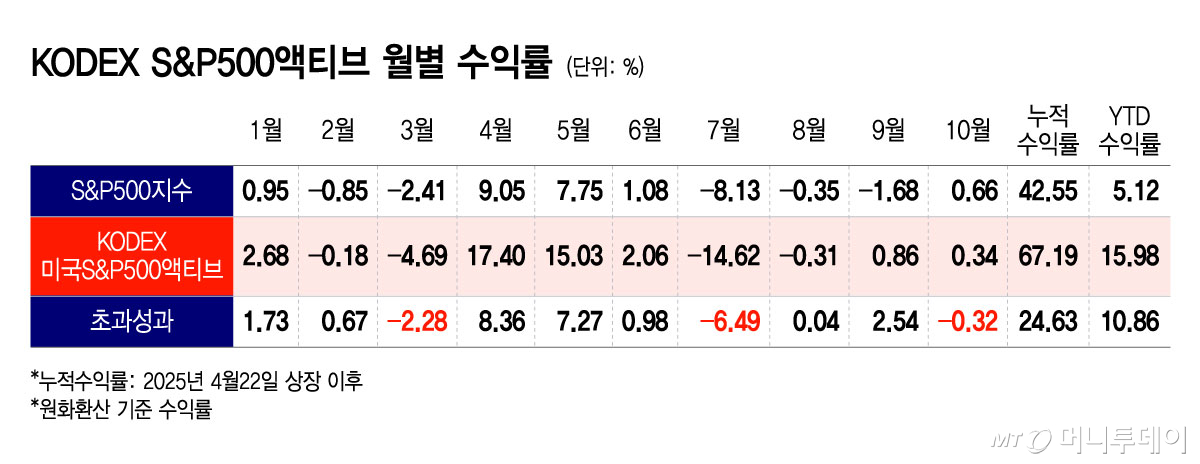
As active exchange-traded funds (ETFs) that pursue excess returns through flexible management continue to increase, the S&P 500 Active, which tracks the representative U.S. index, is drawing attention for consistently outperforming its underlying index. With the listing of an active ETF based on SCHD, a representative dividend growth ETF, scheduled for next week, interest is building over whether this streak of active fund success will continue.
The return of the KODEX US S&P 500 Active ETF, which invests in the U.S. S&P 500 index using an active strategy, has reached 15.9% year-to-date, significantly outpacing the S&P 500 index's return of 5.1% (on a won-converted basis). Since its listing in April last year, its cumulative return has also reached 67.2%, achieving excess returns of 24.6 percentage points compared to the index. The KODEX US S&P 500 Active is an ETF that invests in the representative U.S. index. It seeks excess returns by applying active management to the U.S. S&P 500 index, which includes a diverse range of industries.
Based on the strong performance of this active ETF tracking the representative U.S. index, Samsung Asset Management will list the KODEX US Dividend Dow Jones Active on the 20th. It is an ETF that applies active management to 'US Dividend Dow Jones (SCHD),' a leading U.S. dividend product. It appears to fill the void left after TIME US Dividend Dow Jones Active, which previously operated the US Dividend Dow Jones index actively, was delisted in August due to failing to meet listing criteria.
In particular, a key advantage is that the US Dividend Dow Jones index has a relatively long regular rebalancing period of one year, allowing for more flexible market response compared to existing passive ETFs. The US Dividend Dow Jones index conducts its regular rebalancing once a year in March. There are concerns that it may struggle to keep up with rapidly changing market trends. For example, stocks with strong growth potential whose share prices have risen sharply may be excluded from the US Dividend Dow Jones index due to lower dividend yields, yet continue their upward trend afterward. Conversely, stocks included because their dividend yields increased due to falling share prices may subsequently underperform due to deteriorating fundamentals.
Samsung Asset Management highlighted that for the KODEX US Dividend Dow Jones Active, it frequently swaps out stocks where changes in the macroeconomic environment or deteriorating individual company fundamentals are anticipated, featuring management tailored to market conditions. This approach goes beyond simply tracking the index, seeking excess returns compared to the benchmark by incorporating the expertise of fund managers. It manages a portfolio that considers recent performance of individual stocks while maintaining the characteristic of the US Dividend Dow Jones index of not being concentrated in specific stocks or sectors. Notably, the management team behind the KODEX US S&P 500 Active, which has consistently delivered excess returns compared to its underlying index, will also manage the US Dividend Dow Jones Active.

 in STOCK
