

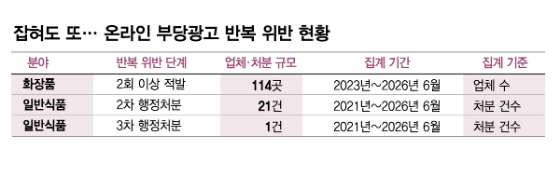
Companies that have been detected for unfair advertising or received administrative sanctions online continue to re-enter the market with exaggerated advertisements without cease. Over the past three years and six months, 114 companies have been detected at least twice for unfair cosmetic advertising, while cases of third-time administrative sanctions have emerged in the general food sector, raising questions about whether current sanctions are sufficient to prevent repeat violations.
114 companies detected twice or more for cosmetics... Third administrative sanction also issued for general foods
According to data received from the Ministry of Food and Drug Safety by Seo Young-seok, a Democratic Party of Korea lawmaker on the National Assembly's Health and Welfare Committee, 114 companies were detected at least twice for unfair cosmetic advertising from 2023 through June this year. The main violations by these companies involved advertisements that could cause cosmetics to be mistaken for pharmaceuticals.
Administrative sanctions for repeat violations have also continued in the general food sector. From 2021 through June this year, there were 21 cases of second-time administrative sanctions and one case of a third-time sanction due to unfair advertising. Second-time sanctions totaled three cases in 2021, 10 cases in 2022, two cases in 2023, and three cases each in 2024 and last year. The third-time sanction case occurred in 2021.
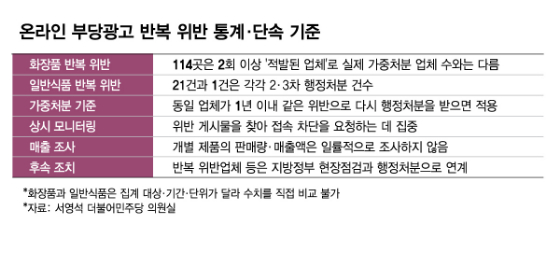
However, the 114th cosmetics companies represent the "number of companies detected" at least twice, while the 21st and one general food cases represent the "number of administrative sanctions" for second and third times, respectively, making direct comparison of the figures impossible. Not all detections of unfair advertising lead to administrative sanctions. Aggravated penalties in the cosmetics sector apply when the same company receives an administrative sanction again within one year for the same violating act. The data submitted by the Ministry of Food and Drug Safety did not include the number of companies among the 114th repeat-detected cosmetics firms that actually received aggravated penalties.
Repeat violations continue as only "access blocking" is requested... Verification and sanctions on sales from unfair advertising are not being properly carried out
Pointers indicate that a fragmented enforcement structure, where detection of online unfair advertising and subsequent sanctions are separated, contributes to the continuation of repeat violations. The Ministry of Food and Drug Safety's regular monitoring focuses on identifying violating posts among the vast number of advertisements posted on online marketplaces (open markets), social networking services (SNS), and online shopping malls, and requesting access blocking. It does not involve conducting on-site inspections and administrative sanction procedures for all detected companies.
In general online monitoring, sales volumes and revenue for individual products are not uniformly investigated. As a result, the structure makes it difficult to comprehensively grasp how many products were sold through unfair advertising and how much revenue companies generated.
A Ministry of Food and Drug Safety official explained, "The purpose of regular monitoring is to quickly block violating advertisements to reduce consumer exposure," adding, "For repeat violators or items that have become social issues, we link them with local government on-site inspections or planned inspections to verify sales amounts and carry out administrative and criminal measures in parallel."
In fact, a significant sales scale related to unfair advertising was confirmed during planned inspections. The Food Unfair Behavior Emergency Response Team inspected unfair advertisements claiming to improve tinnitus and vertigo last June, finding that the related revenue of 11 companies amounted to approximately 19.2 billion won.
The Ministry of Food and Drug Safety requested administrative sanctions from the relevant local governments for seven food business registration companies among these, and has sanctioned four so far. Of the cases referred for investigation or reported against the 11th companies, three were transferred to the Prosecution Service, while related procedures are ongoing for the remaining companies and cases.
Measures to verify and recover economic benefits generated by unfair advertising are also limited. From 2021 through June this year, 59,891 cases of online unfair advertising for general foods were detected, but only two cases involved surcharges for recovering unjust gains linked to sales amounts. However, these surcharges can only be imposed by local governments for serious violations equivalent to business suspensions of two months or more, and do not include general surcharges that substitute for business suspension.
Experts point out that merely blocking posts and increasing the number of detections is difficult to prevent repeat violations. They argue that procedures are needed to verify and recover economic benefits returned to companies, as well as personnel to monitor whether sales continue after detection.
Lee Eun-hee, a professor in the Department of Consumer Studies at Inha University, said, "It is reported that some cases continue selling under their existing names without regard even after being detected," adding, "Regulations should be established to treat revenue generated after detection as unjust gains and recover them, and monitoring personnel should be reinforced to ensure actual enforcement."
The fact that post-detection procedures are divided among multiple institutional investors is also cited as a factor reducing the effectiveness of sanctions. Kim Tae-min, representative lawyer at the Food Advertising Hygiene Law Research Institute, said, "Even if the Ministry of Food and Drug Safety detects violations, administrative sanctions are carried out by local governments, investigations by the police, and post blocking by relevant review institutional investors," adding, "It is difficult to respond if related ministries do not move together."
The Ministry of Food and Drug Safety maintains that it links local government on-site inspections and administrative sanctions for repeat violating companies. In the cosmetics sector, it is also considering measures to strengthen the responsibility of responsible sellers who repeatedly engage in unfair advertising.

 in THEBIO

