

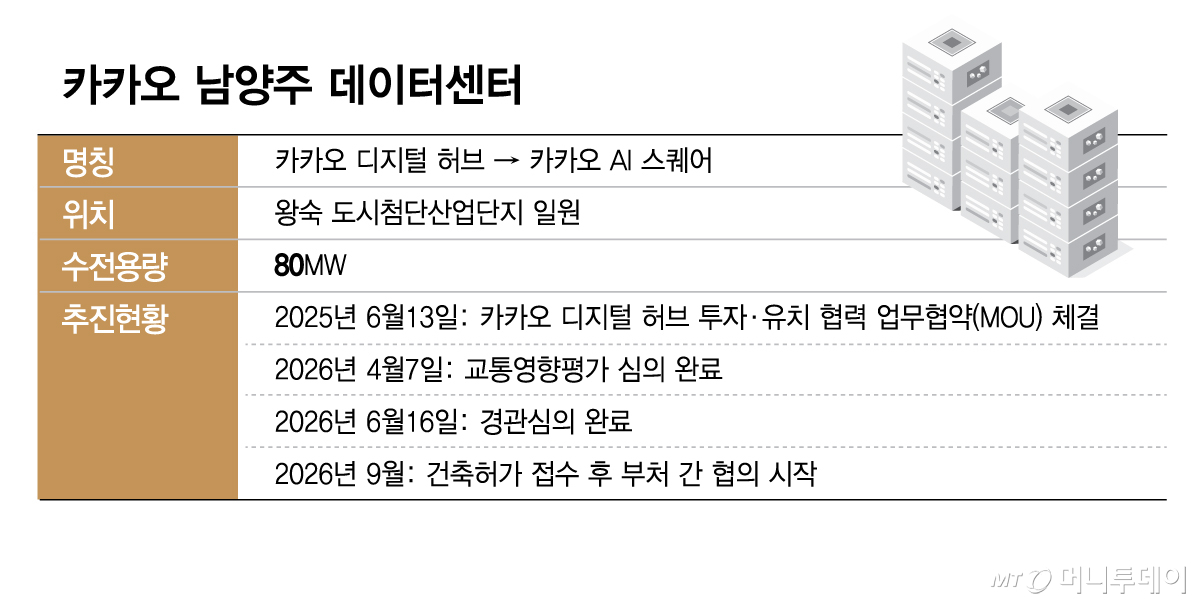
The establishment of Kakao's 80-megawatt Namyangju data center, known as the first major investment under the Lee Jae-myung administration, is on the verge of being delayed for more than a year due to administrative procedural issues. Although the city of Namyangju has accelerated its efforts, the original goal of breaking ground within this year has effectively been lost. Uncertainty has also grown as Namyangju Mayor Choi Hyeon-deok, who took office this year, ordered a "re-examination from scratch."
According to relevant government ministries on the 15th, at the end of last month, the city of Namyangju received Kakao's application for building permits for a data center within the Wangsuk Urban Advanced Industrial Complex and began internal consultations among related ministries. Notably, Kakao has not yet secured the "land" to build the data center. Since securing land ownership or usage rights is an essential requirement for building permits, it is unusual to have begun the review process without having secured them.
The city of Namyangju reversed the order, starting administrative procedures before securing the land. This was because the schedule slipped after the Capital Region Planning Committee of the Ministry of Land, Infrastructure and Transport postponed the development project for the Wangsuk Urban Advanced Industrial Complex in June due to insufficient plans for power and water supply. Although the review was eventually passed in late August after supplementary measures were taken, if normal procedures are followed, groundbreaking will only be possible in the second half of next year.
The city of Namyangju is calculating that it can proceed with building permit procedures in advance to a level where only land acquisition remains. At the end of last month, the city sent an official document titled "Request for Cooperation Regarding the Construction of Kakao AI Square within the Wangsuk Urban Advanced Industrial Complex" to the Korea Land and Housing Corporation, the land owner, requesting a prompt calculation of the development cost. The development cost refers to the expenses incurred in developing and preparing land purchased for construction into a state where buildings can be erected; however, it has not yet been calculated due to the postponement of the Capital Region Planning Committee procedures.
Nevertheless, groundbreaking within this year is effectively off the table. Kakao's data center is expected to break ground as early as February next year. Even that would only be possible in the second half of next year if normal procedures are followed.
There are other variables. Mayor Choi, who took office in July, declared a re-examination from scratch of the data center construction project. The position is that to strengthen the self-sufficiency function of the Wangsuk New Town, the Wangsuk Urban Advanced Industrial Complex must create high-quality jobs, but data centers have limited employment effects and are therefore unsuitable. Another reason is that, unlike when the data center was first attracted, there is significant negative public opinion due to issues such as electromagnetic waves, environmental pollution, and water usage.
Kakao faces an urgent crisis. If the delay becomes prolonged without a proper alternative, it could hinder its next growth engine, the AI business. Kakao CEO Jeong Shin-ah stated in a conference call in the second quarter of last year, "We plan to build a data center in Namyangju capable of accommodating high-density servers for AI and future technologies," adding, "We expect two effects from operating our own data center: reducing infrastructure costs and enhancing service stability."

 in TECH
