

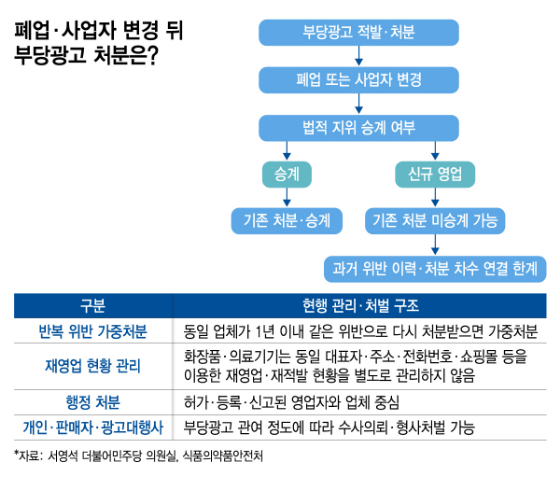
Pointers have emerged that a "blind spot in sanctions" exists because businesses can continue operating even after being caught and punished for unfair advertising, simply by closing down and changing the business owner's name. Administrative penalties for online unfair advertising are inherited based on the legal status of the licensed, registered, or reported company, rather than the actual operator. Consequently, even if the same person continues to conduct business, if they are recognized as a separate new business entity after closing down, their record may not be linked to the previous company's penalty history.
According to materials received from the Ministry of Food and Drug Safety by Seo Young-seok, a member of the Democratic Party of Korea on the National Assembly's Health and Welfare Committee, on the 15th, existing administrative penalties for cosmetics and medical device companies are passed on to new business operators when legal status is inherited through business transfers, inheritance, or corporate mergers. On the other hand, if it is determined to be a new business operation rather than an inheritance of status, the previous company's administrative penalties do not apply.
Existing penalties continue only with legal status inheritance…Can be severed in case of new business operations
Closing down or changing the business registration number does not automatically erase existing penalties. If legal status is inherited, the effect of the penalty extends to the new business operator, and if administrative penalty procedures are in progress, they can continue against the operator who inherited the status. The key lies in whether the relationship between the existing company and the new business operator is recognized as an inheritance of legal status.
Aggravated penalties for repeat violations are also applied based on the penalty history of the same company. If the same company receives another administrative penalty within one year for the same violation, the severity of the penalty increases, but if it is determined to be a separate new business entity, it is difficult to link past violation records and penalty levels. Even if the actual operator is the same, the structure requires separately verifying the relationship with the existing company if different representatives, corporations, or business registration numbers are presented.
The problem is that there is insufficient statistical data to grasp the scale of such re-operations and re-detections. The Ministry of Food and Drug Safety does not separately manage cases where cosmetics and medical device companies have been detected for resuming operations using the same representative, address, phone number, or shopping mall after closing down. Therefore, it is difficult to determine how many actual operators have continued business by changing their business entity or repeated unfair advertising based on current materials alone.
No statistics on re-operations using same representative and address…Management of actual operators needed
The targets of administrative penalties and criminal liability are also distinguished. The Food Labeling and Advertising Act stipulates that not only business operators but anyone must refrain from unfair labeling or advertising. Individuals such as representatives, sellers, and advertising agencies can also be subject to investigation referrals, indictments, and criminal punishment depending on their degree of involvement in unfair advertising.
On the other hand, administrative penalties such as business suspension and product advertising suspension are centered around licensed, registered, or reported business operators and companies. Administrative penalties against business entities and criminal liability for actual individual operators proceed through separate procedures. It is pointed out that if a company closes down or changes its name, the effectiveness of administrative sanctions such as business suspension may diminish, necessitating procedures to track individuals who led intentional and repeated violations.
The materials submitted by the Ministry of Food and Drug Safety did not separately present the status of representatives, sellers, or advertising agencies being referred for investigation, indicted, or punished for unfair advertising. Accordingly, it is difficult to determine how many investigation referrals, indictments, and criminal punishments have been carried out against actual individual operators separately from administrative penalties against companies.
Experts recommend establishing a system to check past violation records at the registration, reporting, and licensing stages of new business operators, along with strengthening punishments. They argue that it is necessary to verify whether the same operator is continuing business by comprehensively considering not only the representative but also the products handled, contact information, shopping malls, etc.
Lee Eun-hee, a professor in the Department of Consumer Studies at Inha University, said, "Along with raising the level of punishment, past violation records must be checked when registering as a new business operator or receiving reporting and licensing." She added, "It is necessary to check whether people detected for unfair advertising are changing their names to resume business, and if they are the same business operator, measures such as restricting their operations are needed."
Criteria are also needed to identify cases where the nominal representative differs from the actual operator. It is pointed out that it is necessary to judge the substantive connection with existing companies by comprehensively considering multiple factors such as products handled, phone numbers, and shopping malls, rather than just checking the representative or business registration number.
Professor Lee emphasized, "There are parts that are difficult to verify if someone else is presented as the representative," while adding, "We must do our utmost to check whether the person who caused the problem is resuming business based on multiple factors such as products handled, phone numbers, and shopping malls."
Claims also emerge that criminal liability and recovery of criminal proceeds for actual operators should be strengthened along with administrative penalties against companies. Kim Tae-min, a representative lawyer at the Food Advertising Hygiene Law Research Institute, said, "When repeatedly detected, there are cases where business owners change to the name of family members or others, or present so-called 'frontmen' to continue operations." He added, "There are limits to just business suspension or fines against companies, so investigations and confiscation and forfeiture must follow for actual operators."

 in THEBIO
