

As Adel challenges for a KOSDAQ listing through the technology exemption, it has secured a corporate valuation of up to 566.5 billion won. It is drawing attention as a major new drug development biotech (biotechnology company) in the IPO (initial public offering) market. It is being evaluated as a leader in neurodegenerative disease therapeutics that has already succeeded in technology export deals worth over 1 trillion won with global big pharma (large pharmaceutical companies).
Adel announced on the 15th that it will accelerate commercialization, including global technology transfers of its major pipeline (new drug candidate compounds), through its KOSDAQ listing. Adel was established as a spin-off from Seoul Asan Hospital at Ulsan University College of Medicine in 2016.
Adel’s representative pipeline is the Alzheimer’s disease therapeutic ‘ADEL-Y01.’ It is an antibody therapy targeting the ‘Tau’ protein, a core pathogenic factor closely linked to cognitive decline in Alzheimer’s disease. Tau pathology is known to have a direct correlation with neuronal damage and symptom worsening. It is used as a key diagnostic indicator for gauging the progression stage of Alzheimer’s disease.
Previously, Adel independently discovered and researched ADEL-Y01 and received IND (Investigational New Drug application) approval from the U.S. FDA (Food and Drug Administration). Following the completion of Phase 1a clinical trials, it transferred the technology to Sanofi in December 2025 while preparing for Phase 1b. The total contract size reaches $1.04 billion (approximately 1.39 trillion won), making it a large-scale deal. In particular, the upfront payment, considered a core element of technology transfer deals, is $80 million (approximately 110 billion won), the highest level among domestic biotech technology transactions. This can be interpreted as meaning that Sanofi highly evaluates the competitiveness and potential of ADEL-Y01.
Adel emphasized that through the technology transfer of ADEL-Y01, it has demonstrated comprehensive development capabilities including △candidate compound discovery and target selection strategies for neurodegenerative disease new drugs △process establishment △mechanism of action △non-clinical efficacy and toxicity evaluation △clinical design, and more. Based on this, it is advancing the commercialization of its follow-on pipelines ‘ADEL-Y04’ and ‘ADEL-Y03.’
ADEL-Y04 is a pipeline being developed with a differentiated approach capable of modulating various pathological mechanisms. It is explained to have potential not only as a monotherapy but also in combination therapy. Currently, technology transfer negotiations are underway with global big pharma. Adel believes that a technology transfer contract for ADEL-Y04 is possible next year.
ADEL-Y03 is an Alzheimer’s disease therapeutic with a unique mechanism, and it is estimated that technology transfer will be possible in 2028. It is also projected to enter Phase 1 clinical trials in early 2029 after being transferred at the non-clinical stage.
The global Alzheimer’s disease therapeutic market across 68 countries is projected to grow from approximately $3.3 billion (approximately 4.41 trillion won) in 2023 to approximately $24.5 billion (approximately 32.74 trillion won) by 2033.
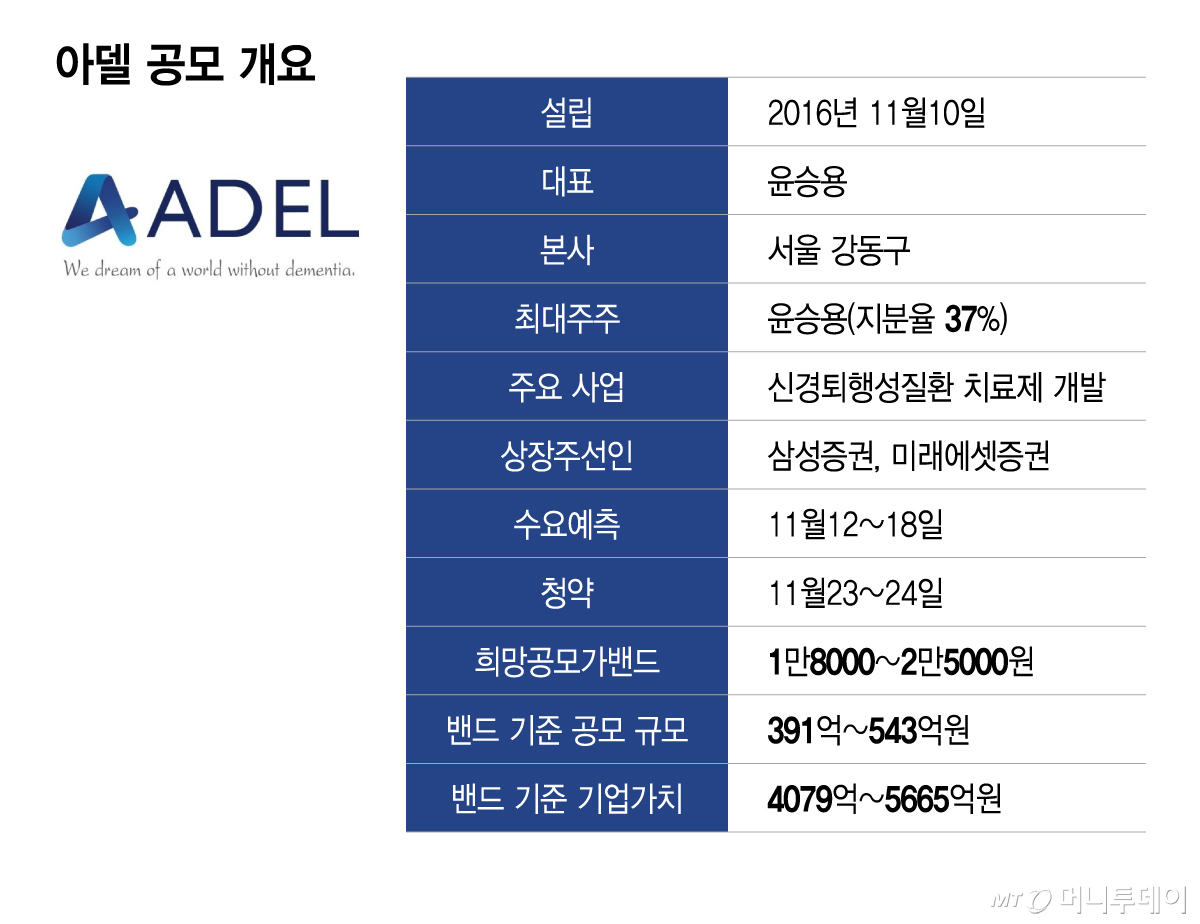
Adel’s desired IPO price band is 18,000 to 25,000 won. Based on the band, the offering size is 39.1 billion to 54.3 billion won, and the corporate valuation (including stock options, etc.) is 407.9 billion to 566.5 billion won. Although it does not have a pipeline in Phase 2 clinical trials or beyond, this is interpreted as reflecting expectations for ADEL-Y01, which has succeeded in large-scale global technology transfers. It is also evaluated that the possibility of technology transfer deals for follow-on pipelines is noteworthy.
An Adel official stated, “Based on the success experience of ADEL-Y01, we are focusing on the commercialization of our follow-on pipelines,” adding, “We possess pipelines with such outstanding potential that technology transfer deals under sufficiently favorable conditions are possible even at the non-clinical stage.”

 in THEBIO
