

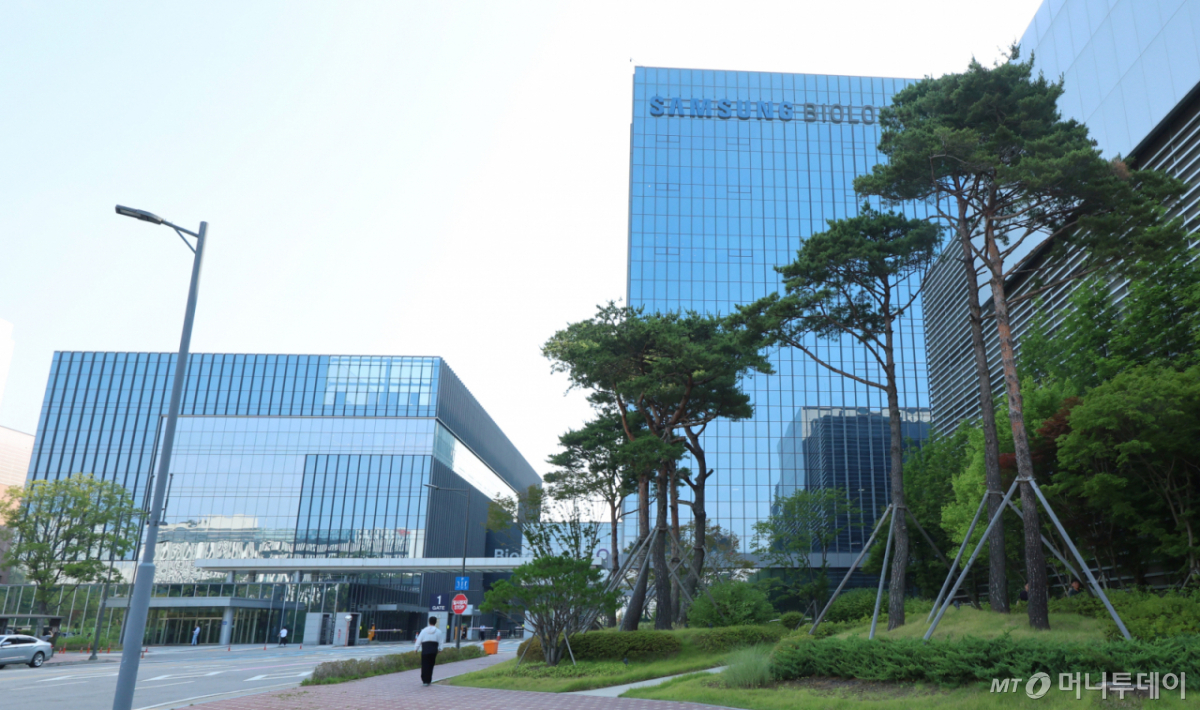
The Samsung Biologics labor union has launched a partial strike scheduled to last three weeks. The company said production has not been disrupted so far and that it will work to minimize the impact of the walkout.
The union's second strike has raised concerns that it could further complicate Samsung Biologics' growth strategy as the company seeks to strengthen its competitiveness in the global contract development and manufacturing organization (CDMO) market.
The union said that it began a strike at 0:00 on the 6th, with participation from approximately 400 union members.
According to the union, the departments targeted by the strike so far include the Raw Material Testing Part, Microbiology Group, FM Testing Part, Logistics Group and its subordinate departments, MFG QA Groups 1 through 3, Operations Planning Team, Production GS Job Function, Sample Management Group, and MES Group. These are primarily indirect support roles.
Previously, the Incheon Division of the Seoul High Court ruled in favor of the company on all nine processes for which it had filed an appeal against a preliminary injunction prohibiting labor disputes, which had been initiated by Samsung Biologics. As a result of this ruling, the union is effectively in a situation where a general strike is difficult to carry out.
The union said, “We requested negotiations with the company but have not received a response to date,” adding, “We plan to continue requesting negotiations, and if they do not respond, we intend to expand the action sequentially to include process-specific strikes.”
Following a first general strike conducted from the 1st to 5 last month, Samsung Biologics continued a law-abiding struggle. According to the union, approximately 2,800 people participated in the first strike. The estimated losses resulting from the first strike were approximately 150 billion won.
With approximately 400 participants in this second strike, this represents about 10% of all union members. This is roughly one-seventh of the number of participants during the first strike.
The key issue going forward will be whether dialogue between management and labor at Samsung Biologics will resume and whether a breakthrough in negotiations can be achieved.
The company side at Samsung Biologics said, “There have been no production disruptions caused by the union’s strike so far,” adding, “It is still difficult to estimate the specific scale of expected losses resulting from the union’s second strike.”
It added, “We will strive to formulate an emergency personnel operation plan within the scope of legal provisions to minimize disruptions to the production schedule.”
There are also significant concerns that a prolonged union strike could negatively impact Samsung Biologics’ global growth. This is because labor-management conflict inevitably acts as a burden on Samsung Biologics’ execution of its growth strategy.
Amid fierce competition in the recent global CDMO market, Samsung Biologics must enhance its competitiveness through measures such as expanding production at its fifth plant and U.S. plant, increasing orders from global customers, and breaking ground on its sixth plant.
Researcher Kim Hyun-seok of Hyundai Motor Securities analyzed, “Customer inquiries regarding orders have decreased due to tariff-related uncertainties since last year.” He added, “While customer order inquiries are showing a recovery trend after April this year as uncertainties ease, the uncertainty surrounding (the union’s) strike could still act as a burden on customers.”
He further diagnosed, “Considering that it typically takes one year for order discussions to translate into actual orders, a recovery in new orders can be expected starting next year.” He added, “Accordingly, there is a possibility that the groundbreaking for the sixth plant, originally scheduled for the end of this year, may be delayed to early next year.”

 in THEBIO
