

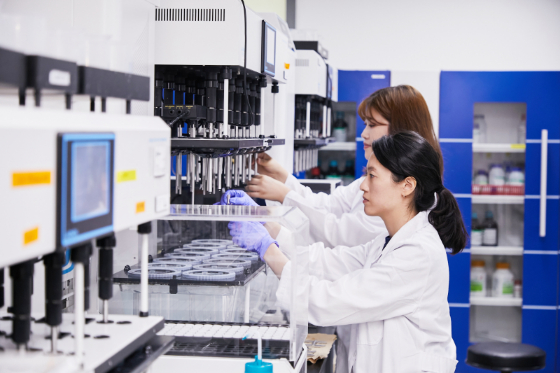
Boryung Pharmaceutical is pushing to enter U.S. clinical trials for its chronic myeloid leukemia (CML) drug candidate, BR1500. With government support, the company is proceeding with raw material synthesis and the manufacturing of investigational new drugs, and plans to conduct Phase 1 trials before launching a Phase 1 trial in the United States as well.
According to Boryung on Friday, BR1500 was selected in August as a joint development project for a new drug pipeline under the Ministry of SMEs and Startups' 'Pharmaceutical Bio-Venture Collaboration-Based Technology Development Project.'
Accordingly, Boryung will receive research and development funding necessary for raw material synthesis and the manufacturing of investigational new drugs.
BR1500 is a third-generation targeted therapy candidate discovered by ImmunoForte, a specialized new drug development company. It inhibits the BCR::ABL1 kinase involved in the onset of chronic myeloid leukemia and Philadelphia chromosome-positive (Ph+) acute lymphoblastic leukemia (ALL).
Since signing a technology transfer agreement with ImmunoForte last year, Boryung has continued its development efforts. The goal is to develop a Best-in-Class new drug that reduces the risk of cardiovascular toxicity while enhancing therapeutic efficacy, targeting patients who show resistance to existing treatments.
Another blood cancer drug candidate under Boryung's in-house development, 'Bosmolisib' (BR101801), has completed patient enrollment for its domestic Phase 2 clinical trial.
Bosmolisib, being developed as a treatment for relapsed/refractory peripheral T-cell lymphoma (PTCL), is a First-in-Class candidate that simultaneously inhibits three targets: PI3K gamma/delta and DNA-PK, which are involved in cancer cell growth, survival, and DNA damage repair.
PTCL is a rare blood cancer characterized by rapid progression and frequent relapse or lack of response to treatment, for which an effective standard second-line therapy has not been established.
Bosmolisib has been designated as a Rare Drug by the U.S. Food and Drug Administration (FDA) and as a development-stage Rare Drug by Korea's Ministry of Food and Drug Safety.
In the preceding Phase 1 trial, objective responses were confirmed in six out of 19 patients evaluated for efficacy. Among them, four showed complete responses and two showed partial responses.
After administering the drug to the first patient in the Phase 2 trial in March this year, Boryung recruited its target number of 44 patients from 17 domestic institutional investors in approximately seven months. The company plans to complete the Phase 2 trial by 2028 through patient follow-up and then apply for marketing approval.
Boryung CEO Kim Jung-gyun announced the completion of Phase 2 patient enrollment for Bosmolisib, saying, "Boryung's sense of responsibility in stably supplying essential medicines is the starting point for developing new anticancer drugs. We will expand the competitiveness built up in cytotoxic anticancer agents to next-generation fields such as targeted anticancer therapies."
Although Bosmolisib and BR1500 differ in their acquisition methods and development stages, they share a common focus on blood cancer patients who find it difficult to achieve sufficient efficacy with existing treatments. Boryung is proceeding with the development of both candidates by combining in-house development with external technology introduction.
According to the Korea Clinical Trial Support Foundation, among the 783rd clinical trials approved domestically last year, the anticancer field accounted for 304 cases, or approximately 39%. It was the largest category by efficacy group, representing an increase of about 10% from 276 cases in the previous year.
The Korea Health Industry Development Institute analyzed that, while reviewing the achievements of 25 years of domestic new drug development this year, a strategy of differentiating in diseases with high unmet medical needs rather than highly competitive major indications and supplementing capabilities through external partnerships is realistic.
After independently developing and obtaining approval for its hypertension drug 'Kanab' and establishing it in the domestic market, Boryung expanded its product lineup to include combination drugs. In the anticancer field, the company has built a specialized sales organization and a network of tertiary general hospitals, securing global original brands such as Gemzar, Alimta, and Taxotere.
Based on its experience in drug development and commercialization and its existing anticancer business foundation, Boryung is expanding its business scope to include the development of new anticancer drugs for patients with limited treatment options.
The development of new anticancer drugs also aligns with Boryung's vision of becoming a 'Life Science Infrastructure Company,' presented ahead of its 70th anniversary in 2027. Boryung identified production/R&D, commercial operations, and space life science R&D as its three core infrastructure pillars.
Among these, the production/R&D sector uses the capability to research, develop, produce, and supply essential medicines as a growth foundation. Boryung is adding new drug development capabilities to its existing production base, which includes high-activity cytotoxic drug manufacturing facilities, aseptic processes, and global quality certifications acquired through its current anticancer business.

 in THEBIO
