

Hanmi Pharmaceutical’s drug candidate for metabolic dysfunction-associated steatohepatitis (MASH), “epinopegduotide,” has yielded positive Phase 2b clinical trial results.
It is also being evaluated as showing superior efficacy compared to the existing MASH treatment, Wegovy. The securities industry has raised its valuation of Hanmi Pharmaceutical and predicted further potential for value appreciation.
According to the pharmaceutical industry on Tuesday, MSD recently disclosed the global Phase 2b clinical trial results for epinopegduotide (MK-6024), which it licensed from Hanmi Pharmaceutical, at the American Association for the Study of Liver Diseases (AASLD 2026).
The study was conducted on 381 patients confirmed to have MASH via biopsy and corresponding to liver fibrosis stages F2 and F3. Patients were divided into groups receiving epinopegduotide at doses of 4, 7, and 10 mg, a placebo, or semaglutide at 2.4 mg, and received treatment for 52 weeks.
Notable results emerged in the 7th mg dosing group. The primary endpoint, “MASH resolution rate without worsening of liver fibrosis,” was recorded at 63%. The placebo group showed a rate of 13%.
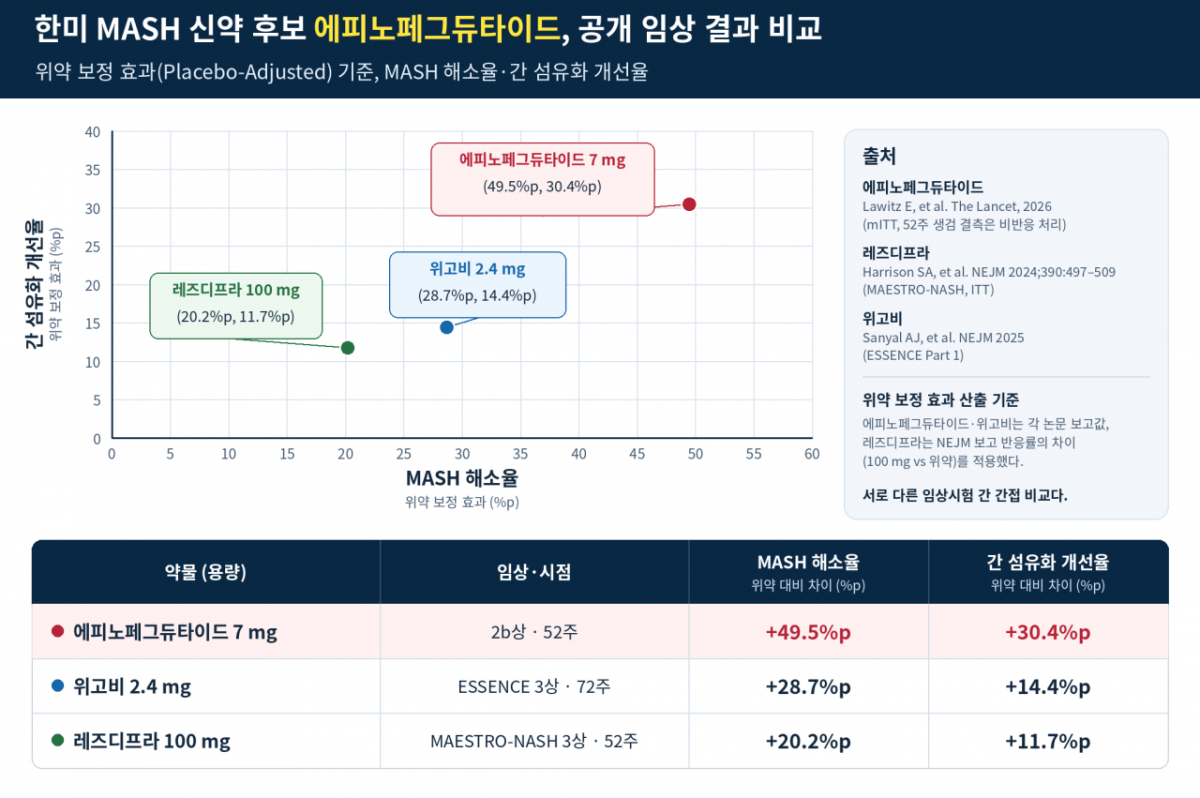
The placebo-corrected treatment effect, accounting for the improvement in the placebo group, was 49.5 percentage points.
The key secondary endpoint, “rate of improvement by one stage or more in liver fibrosis without worsening of MASH,” also recorded 52%.
The placebo group showed 21%, and the placebo-corrected treatment effect was 30.4 percentage points. This means statistical significance was secured for both core endpoints: MASH resolution and liver fibrosis improvement.
Eliav Bar, Senior Vice President of Global Clinical Development and Chief Medical Officer (CMO) at MSD Research Laboratories, evaluated the results as “very encouraging” because they provide further evidence that epinopegduotide, a differentiated glucagon-like peptide-1 (GLP-1)/glucagon receptor dual agonist, has the potential to offer clinically meaningful responses in MASH resolution and fibrosis improvement.

It also showed improved efficacy compared to competing drugs approved by the U.S. Food and Drug Administration (FDA) for the MASH indication.
Wegovy, approved as an MASH treatment, recorded a 62.9% MASH resolution rate and a 36.8% liver fibrosis improvement rate at 72 weeks in its global Phase 3 clinical trial. The placebo-corrected effects were 28.7 percentage points and 14.4 percentage points, respectively.
Another MASH treatment, Rezdiffra (active ingredient: resmetirom), showed a 29.9% MASH resolution rate and a 25.9% liver fibrosis improvement rate at 52 weeks in the 100th mg dosing group in its global Phase 3 clinical trial. The placebo-corrected improvement effects were 20.2 percentage points for MASH resolution and 11.7 percentage points for liver fibrosis improvement.
Based on placebo-corrected effects, an indirect comparison shows that epinopegduotide at 7 mg demonstrated higher figures than the published clinical results of competing drugs in both MASH resolution rate (49.5 percentage points) and liver fibrosis improvement rate (30.4 percentage points).
While there are limitations to interpretation due to the indirect nature of comparisons between different clinical trials, it is evaluated that this confirms the possibility of superiority over competing drugs on key metrics.
Wi Jae-hoo, a researcher at Korea Investment & Securities, stated, “The Phase 2b results for epinopegduotide were better than expected,” adding, “They were also better compared to Wegovy, an MASH treatment.”
He added, “It is necessary to reassess the possibility of entering Phase 3 trials, as concerns previously raised about the return of the pipeline (drug candidate) have been alleviated.” Lee Ji-soo, a researcher at Daol Investment & Securities, analyzed that “the Phase 2a results for F4 patients in 2027 and whether MSD enters Phase 3 are key variables.”
Based on positive clinical results, the securities industry has raised its valuation of Hanmi Pharmaceutical’s new drugs. Hana Securities raised the value of epinopegduotide from 278.8 billion won to 513.3 billion won. It judged that further upward revisions are possible depending on entry into Phase 3 trials.
NH Investment & Securities suggested that Hanmi Pharmaceutical’s total new drug value could be revised upward from the current 4.551 trillion won to over 6 trillion won next year, depending on technology exports and data performance.
It valued epinopegduotide at 524 billion won and raised the probability of entering Phase 3 trials from the previous 20% to 28%, based on conservative estimates.
According to Hanmi Pharmaceutical, MSD is currently reviewing the epinopegduotide program.
It plans to share additional information regarding follow-up development plans, including Phase 3 development, at an appropriate time in the future. The securities industry expects that whether entry into Phase 3 trials will occur will be decided in the first half of next year.

 in THEBIO

