

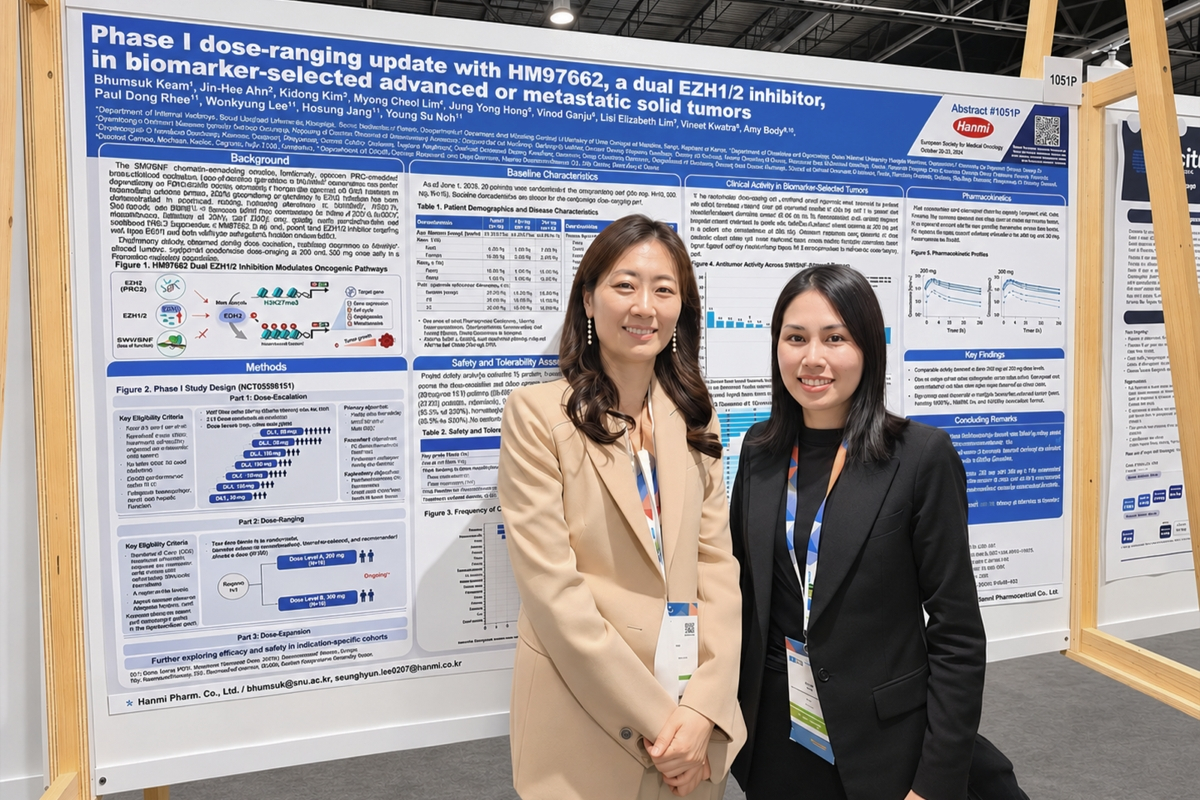
Hanmi Pharmaceutical announced the results of global Phase 1 clinical trials for its targeted anticancer drug candidate 'EZH1/2 dual inhibitor (HM97662)' and immunotherapy anticancer drug candidate 'BH3120.' The results were assessed as having secured initial antitumor activity and an excellent safety profile, respectively.
On Tuesday, the company said that it participated in the European Society for Medical Oncology Congress (ESMO Congress 2026), held in Madrid, Spain from the 23rd to the 27th of last month, and presented Phase 1 clinical research results for HM97662 and BH3120 via posters.
HM97662 is being developed as a next-generation dual-inhibitor targeted therapy that simultaneously suppresses EZH1 and EZH2 proteins. The EZH1 and EZH2 proteins, referred to as 'gene regulatory switches,' are core catalytic proteins of the 'Polycomb Repressive Complex 2 (PRC2),' which epigenetically regulates gene expression.
It is known that simultaneous inhibition of these two proteins can more comprehensively block PRC2 function, potentially suppressing cancer cell growth and survival.
Hanmi Pharmaceutical presented results evaluating the safety, pharmacokinetics, and antitumor activity in the 200mg and 300mg dosing groups during the randomized dose-determination phase of HM97662's global Phase 1 trial.
In the dose-determination phase, an overall manageable safety profile was observed in both dosing groups. Antitumor activity was observed in patients with clear cell ovarian carcinoma harboring ARID1A mutations and chordoma with SMARCB1 loss.
Following initial clinical results from the dose-escalation phase disclosed by Hanmi Pharmaceutical last year, antitumor activity was also observed in patients with mesothelioma and SMARCA4-deficient uterine sarcoma, further confirming the potential of HM97662 for antitumor activity across various solid tumors.
A company official said, "The research results are significant as they support the possibility of additional clinical development of HM97662 in patients with solid tumors harboring SWI/SNF or related chromatin regulatory abnormalities, while providing a clinical basis for further evaluation of safety and antitumor activity in future dose-expansion phases."
4-1BB×PD-L1 Bispecific Antibody BH3120: First Clinical Data Revealed
BH3120 is an anticancer drug candidate applying the bispecific antibody platform technology 'PentaBody,' which allows a single antibody to bind simultaneously to two different targets. Through this, it simultaneously achieves selective targeting of cancer cells and immunotherapy effects that activate immune cells.
BH3120 is designed to target PD-L1 on the surface of cancer cells and 4-1BB on the surface of immune cells simultaneously, enabling it to perform a 'bridging' role that allows immune cells to easily recognize tumor cells and induce cell death. In particular, it aims to activate T-cell function and amplify antitumor immune responses through 4-1BB stimulation.
Existing antibody candidates targeting 4-1BB have faced limitations in anticancer efficacy as well as safety issues including hepatotoxicity, leading to the discontinuation or restriction of clinical development for some candidates.
In contrast, BH3120 has demonstrated excellent anticancer efficacy along with clear decoupling of immune activation between the tumor microenvironment (TME) and normal tissues through various preclinical studies, presenting its potential as a therapy that can induce selective immune activation within tumors while minimizing systemic immune activation and associated toxicity risks.
At this congress, Hanmi Pharmaceutical presented dose-escalation study results from a global Phase 1 trial of BH3120 monotherapy conducted in 45 patients with advanced solid tumors.
BH3120 was confirmed to have a favorable safety profile across all dosing groups. No dose-limiting toxicity (DLT) was observed, and the maximum tolerated dose (MTD) was not reached. In particular, no Grade 3 or higher severe toxicity was observed regarding hepatotoxicity, including elevated liver enzyme levels (transaminases), which is a known major safety issue with existing 4-1BB agents.
This result is analyzed as showing the potential of BH3120's differentiated mechanism of action, designed to selectively activate 4-1BB signaling in PD-L1-expressing environments, to reduce toxicity in non-tumor tissues, which has been pointed out as a limitation of existing 4-1BB agents.
Additionally, initial antitumor activity was observed in various solid tumor patient groups, earning the assessment that evidence for subsequent clinical development of BH3120 has been secured.
Lee Moon-hee, clinical team leader at Hanmi Pharmaceutical, said, "We have confirmed differentiated competitiveness in the Phase 1 clinical data for HM97662 and BH3120. We plan to develop them as therapies that can improve clinical outcomes for patients in areas with high unmet needs."

 in THEBIO
