

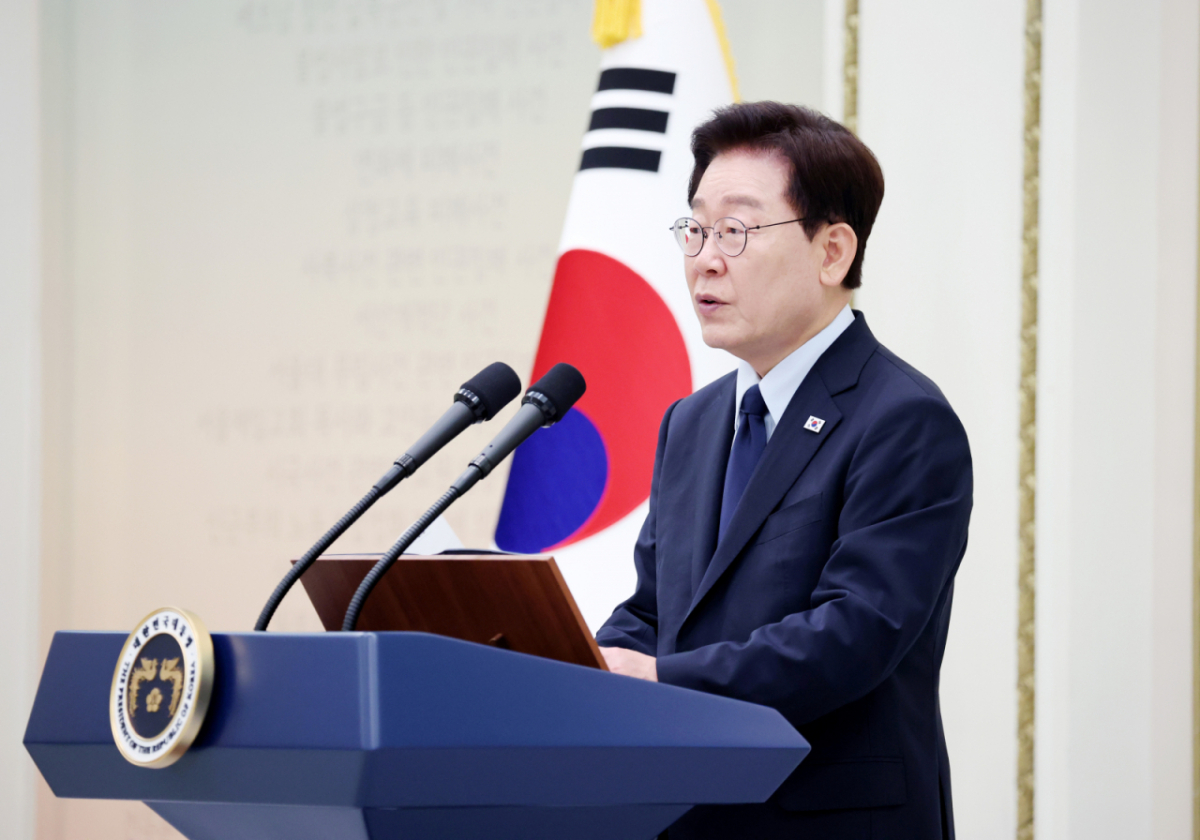
The 'marriage penalty' in the tax sector proposed by President Lee Jae-myung can be broadly summarized into six areas.
△Expansion of exemption from acquisition tax for first-time home buyers across their lifetime △Expansion of acquisition tax exemption for purchasing homes after the birth of a newborn △Expansion of exclusion from heavy taxation on acquisition tax for couples owning two homes after marriage △Expansion of exclusion from heavy taxation on acquisition tax for temporary two-home owners △Expansion of income tax deduction for mortgage interest payments △Improvement of disadvantages related to tax credits for marriage, among others.
The content mainly revolves around 'housing,' which is the biggest reason young people hesitate to get married.
Currently, when purchasing a home priced at 1.2 billion won or less, first-time buyers can receive an acquisition tax exemption of up to 3 million won regardless of income. However, this benefit applies only once per couple combined. If either the husband or wife has already used this benefit before marriage, it means they will be excluded from receiving the benefit after registering their marriage.
Given that President Lee Jae-myung mentioned expanding the acquisition tax exemption for first-time home buyers across a lifetime, policy improvements may be considered to provide greater acquisition tax exemptions at the time of marriage.
Expanding the acquisition tax exemption for purchasing homes after the birth of a newborn is also on the government's review table. Currently, parents who have given birth can receive an acquisition tax exemption of up to 5 million won regardless of income when purchasing a home for residential purposes. This applies only to one household owning one home priced at 1.2 billion won or less and requires actual residence for at least three years. If the house is sold or moved within three years, the exempted tax amount must be returned.
Both systems may consider raising the acquisition tax exemption limit at the time of marriage as a review target. Additionally, given recent increases in housing prices, it may be possible to relax the 120th million won cap exclusively for newlywed couples.
Cases where men and women who already own homes become two-home owners upon marriage are also cited as representative examples of the 'marriage penalty.'
If registered before marriage, a general acquisition tax rate of 1-3% applies to each individual; however, after registering the marriage, they are classified as a one-household two-home owner, subjecting them to a heavy tax rate of 8% based on regulated areas.
In cases where individuals become temporary two-home owners due to marriage, plans to exclude them from heavy taxation on acquisition tax if they dispose of one home within a certain period are also under consideration.
Furthermore, disadvantages related to tax credits for marriage are expected to be improved.
Currently, the government provides a lifetime tax credit benefit of 500,000 won each to couples who register their marriage in the same year.
This system is scheduled to end by the end of this year, and the government plans to shift from a tax-based support method to a fiscal (budget) support method. The current tax expenditure approach has limitations where taxpayers with no income tax liability are excluded from benefits, meaning low-income taxpayers who pay little or no tax cannot fully receive support. Additionally, the fiscal support method offers the advantage of providing assistance at an earlier stage compared to post-year-end settlement refund methods.
Given that President Lee Jae-myung mentioned improvements to relevant systems, it is assessed that there is a high likelihood of expanding the scope of beneficiaries for marriage tax credit support beyond the current level. There is also a possibility that the combined support amount for couples, currently 1 million won, may be further expanded.
The government is expected to announce plans for improving relevant systems in next year's budget proposal, which is scheduled for release at the end of this month.

 in ECONOMY
