

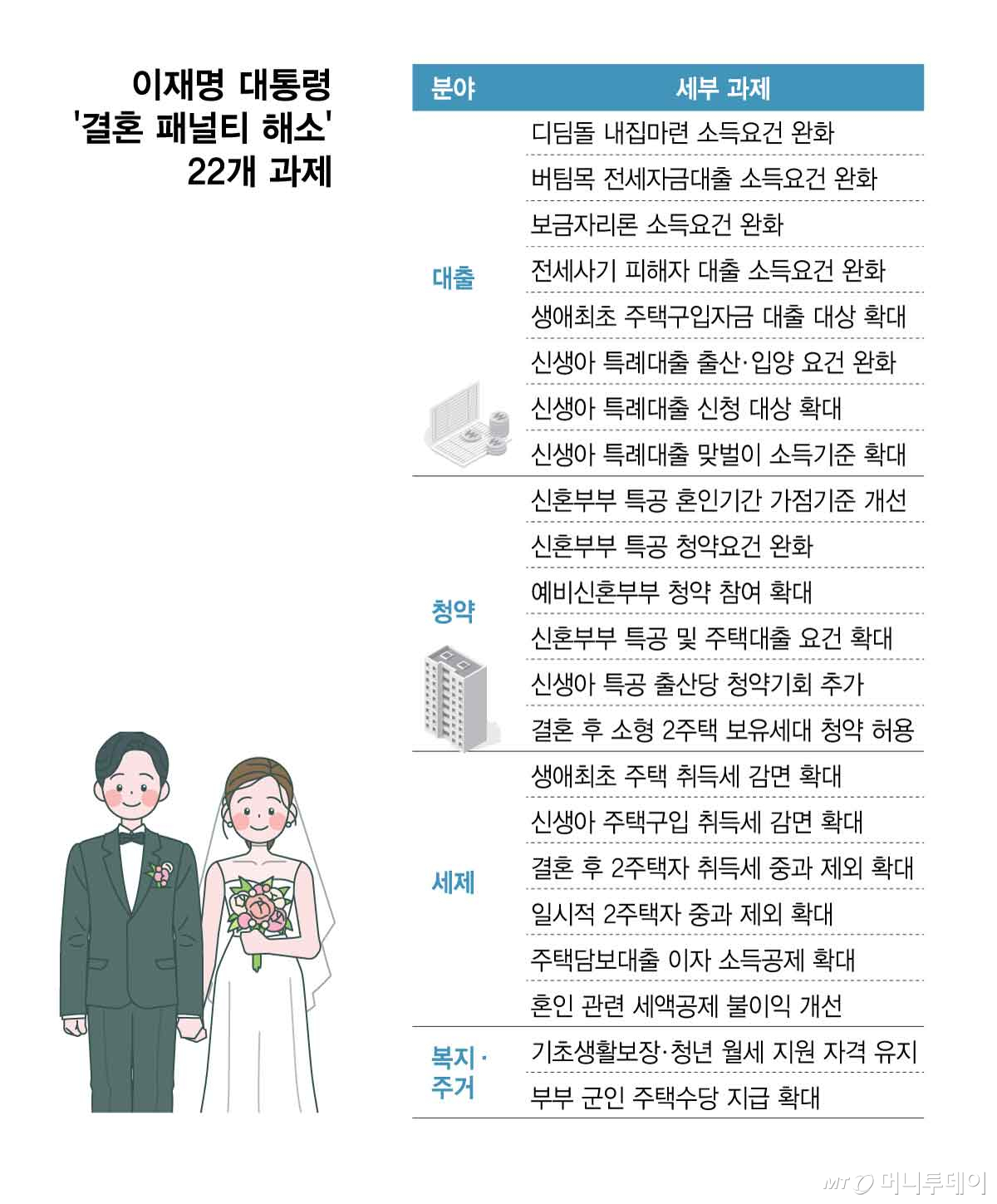
As President Lee Jae-myung formalizes efforts to resolve the 'marriage penalty,' policy relaxation across loans, housing subscriptions, and tax systems is expected. The focus will be on reducing disadvantages from income and asset aggregation upon marriage and improving financial and housing access for dual-income middle-class families.
According to political sources on the 9th, President Lee proposed a total of 22 tasks to improve the marriage penalty.
The most significant changes are expected in loan regulations. The initiative aims to lower barriers that prevent actual homebuyers from obtaining various loans despite increased combined spousal income upon marriage.
For example, under the 'Stepstone Loan,' the annual income limit for newlywed couples is set at 85 million won, which is up to 25 million won higher than the criteria for first-time homebuyers (70 million won), multi-child households with two or more children (70 million won), and general households (60 million won). Similarly, the 'Housing Security Loan' sets the annual income limit for newlyweds at 85 million won. While unmarried individuals can qualify with an annual income of up to 60 million won, marriage raises this threshold to 85 million won, sparking complaints about a 'marriage penalty.'
Requirements for jeonse (rental deposit) loans are also expected to be relaxed. Currently, newlywed couples must meet an annual income requirement of 75 million won or less to qualify for the 'Supportive Jeonse Loan,' which is 25 million won higher than the pre-marriage condition of 500 thousand won or less. To eliminate this penalty, income thresholds would need to be lowered by tens of millions of won. Additionally, income criteria for housing loans available to victims of jeonse fraud are expected to be further relaxed beyond the current limits of 130 million won for jeonse and 70 million won for Stepstone Loans.
Given that the average price of Seoul apartments far exceeds 1 billion won, measures such as raising the property value cap for first-time home purchase loans for newlyweds and lowering the combined spousal annual income threshold may be introduced.
To address low birth rates, criteria for childbirth and adoption, applicant eligibility, and income requirements for the government's newborn special loan are expected to be relaxed.
The housing subscription system is also anticipated to undergo structural changes. The principle of 'one household, one housing subscription,' which reduces subscription opportunities upon marriage, may be eased by allowing individual subscriptions within a certain period.
Special allocations for newlywed couples are expected to improve by relaxing the marriage duration requirement and expanding participation for prospective newlyweds.
Additionally, policies to strengthen tax support upon marriage are under review.
Currently, when purchasing a home priced at 1.2 billion won or less, first-time buyers can receive up to 3 million won in acquisition tax reduction regardless of income. However, this benefit applies only once per couple. If either spouse received this benefit before marriage, they become ineligible after registering their marriage.
Expansion of acquisition tax reductions for newborn home purchases is also under consideration. Currently, parents who have given birth can receive up to 5 million won in acquisition tax reduction when purchasing a home for residence purposes, regardless of income. This applies only to one household owning one property priced at 1.2 billion won or less and requires actual residence for at least three years. If the home is sold or moved within three years, the reduced tax amount must be repaid.
Both systems may consider raising the acquisition tax reduction cap upon marriage. Given recent housing price increases, another possibility is loosening the 120th million won support limit exclusively for newlywed couples.
The marriage tax credit system will also change. This program provides a one-time lifetime tax credit of 500,000 won per spouse in the year of marriage registration. The system is scheduled to end by the end of this year, with the government planning to shift from tax-based support to fiscal (budget) support. The current tax expenditure approach excludes non-taxpayers who do not pay income tax, limiting full support for low-income taxpayers with minimal tax liabilities. Additionally, fiscal support offers the advantage of earlier assistance compared to post-year-end settlement refunds.
The system is expected to improve by expanding eligibility beyond the current marriage tax credit. The total support amount of 0.1 billion won per couple may be further increased.
The government is expected to announce related policy improvements in next year's budget proposal, scheduled for release at the end of this month.

 in ECONOMY
