

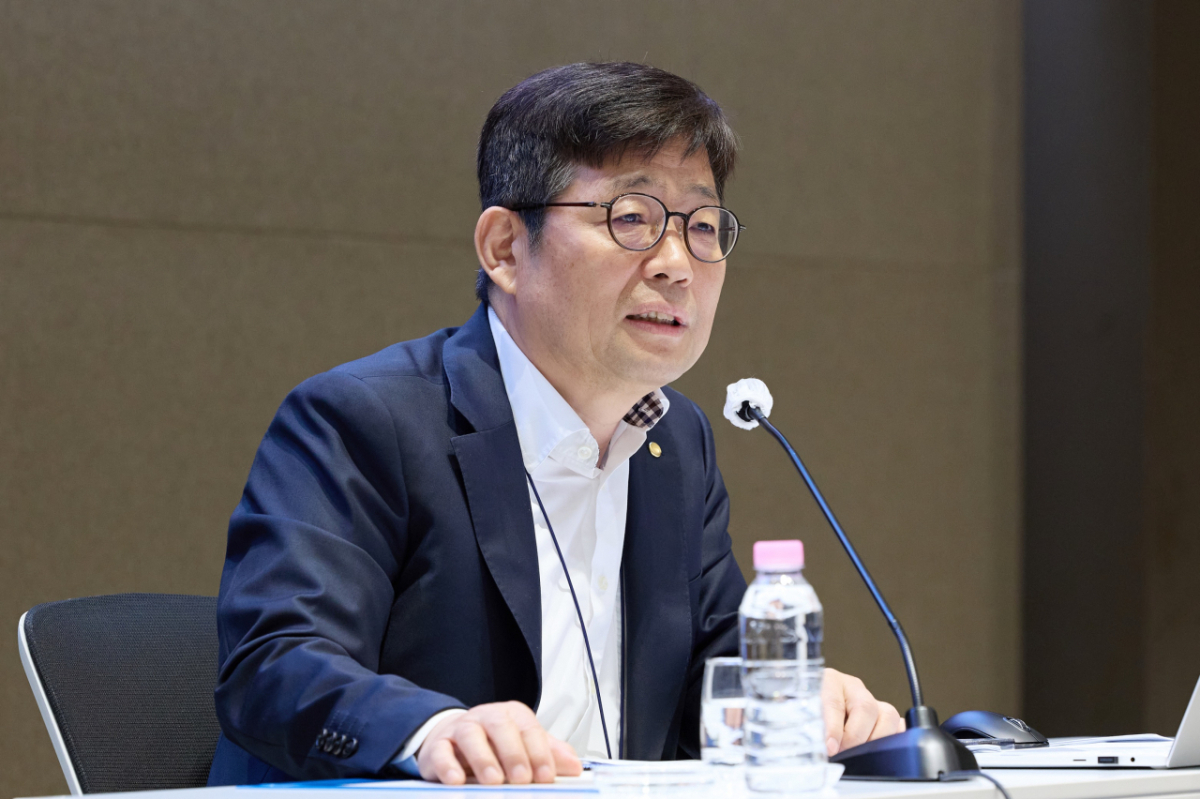
On the 11th, Yoo Sang-dae, Deputy Governor of the Bank of Korea, stated regarding the future trend of the won/dollar exchange rate: "While temporary factors such as supply and demand or market sentiment remain, we do not expect a rapid decline. However, the overall direction will be downward."
During the press conference held at the Bank of Korea's annex building in Jung-gu, Seoul, Deputy Governor Yoo added, "Although there may be some volatility, the exchange rate is expected to stabilize."
He explained, "From late last year through early this year, temporary and short-term factors had a far greater impact on the exchange rate than fundamentals or long-term influences. Factors such as supply conditions—more accurately described as Korea's current account surplus, trade balance surplus, interest rate differentials between domestic and foreign markets, and growth rates—played a more significant role than true fundamentals, driving the exchange rate significantly higher."
He further noted, "As supply-side factors gradually lose influence and the Bank of Korea raises interest rates, the impact of true fundamentals such as current account and trade balance surpluses is expected to grow. Additionally, there is growing expectation that the domestic-foreign interest rate differential will narrow further. With the government's clear commitment to stabilizing the exchange rate market, fundamental and medium-to-long-term factors are becoming more influential than temporary ones."
Regarding the 'FIMA Repo' (Foreign Currency Swap Facility), recently used by the United States and Japan for joint intervention in Japan's foreign exchange market, he explained that there is currently a low likelihood of FIMA Repo being deployed to stabilize Korea's domestic foreign exchange market.
The Federal Reserve System's FIMA Repo facility allows foreign central banks holding U.S. Treasury securities to temporarily deposit those securities with the Federal Reserve and borrow dollars as collateral, without selling the Treasuries in the open market. Korea also signed a $60 billion FIMA Repo agreement with the United States in 2021.
Deputy Governor Yoo stated, "Unlike Japan, Korea is not in a situation where it cannot borrow foreign currency up to its desired limit or must do so at high interest rates. We do not have a shortage of dollars sufficient to intervene in the foreign exchange market through borrowing. As such, we have never used the FIMA Repo facility, and there will be no need to use it in the near future to borrow dollars from the Bank of Korea for lending to domestic institutional investors or for foreign exchange market intervention."
The Bank of Korea is expected to maintain its base rate hike stance for the foreseeable future. Earlier, in July, the Bank of Korea raised the base rate from 2.5% annually to 2.75%, an increase of 0.25 percentage points. This marked the first rate hike since May of last year, ending a 14-month period of holding the rate at 2.5% and ushering in a tightening cycle for the first time in three and a half years.
Deputy Governor Yoo explained, "Unless there are special shocks or factors, the likelihood of further rate hikes is high. The timing and pace of any additional increases will be determined based on data."
Following last month's base rate hike, the reported consumer price inflation rate stood at 2.8%, still exceeding the Bank of Korea's price stability target of 2%. Meanwhile, Korea's second-quarter GDP grew by 0.6% compared to the previous quarter, continuing a strong growth trend that surpassed market expectations.
With high inflation and robust economic growth, the likelihood of further monetary tightening by the Bank of Korea has increased. The Bank of Korea is scheduled to convene its Monetary Policy Board on the 27th to decide whether to implement another base rate hike.
Deputy Governor Yoo elaborated, "The most important point is that base rate policy decisions are made proactively and preemptively. Therefore, we will determine whether additional rate hikes are necessary by monitoring forecasts for growth and inflation paths."
Meanwhile, Deputy Governor Yoo is set to retire on the 20th after completing his three-year term. Born in 1963, he graduated from Seoul National University's Department of Economics. He joined the Bank of Korea in 1986, serving in various departments including Financial Markets Division, International Affairs Division, and International Cooperation Division. Since May 2018, he has served as Deputy Governor responsible for international finance and cooperation. During his tenure as Deputy Governor, he led efforts such as concluding the U.S.-Korea currency swap agreement to respond to the spread of COVID-19.
He later assumed the role of Vice President at the Korea Housing Finance Corporation in July 2021 before returning to the Bank of Korea in August 2023, where he has served as Deputy Governor since then.

 in ECONOMY
