

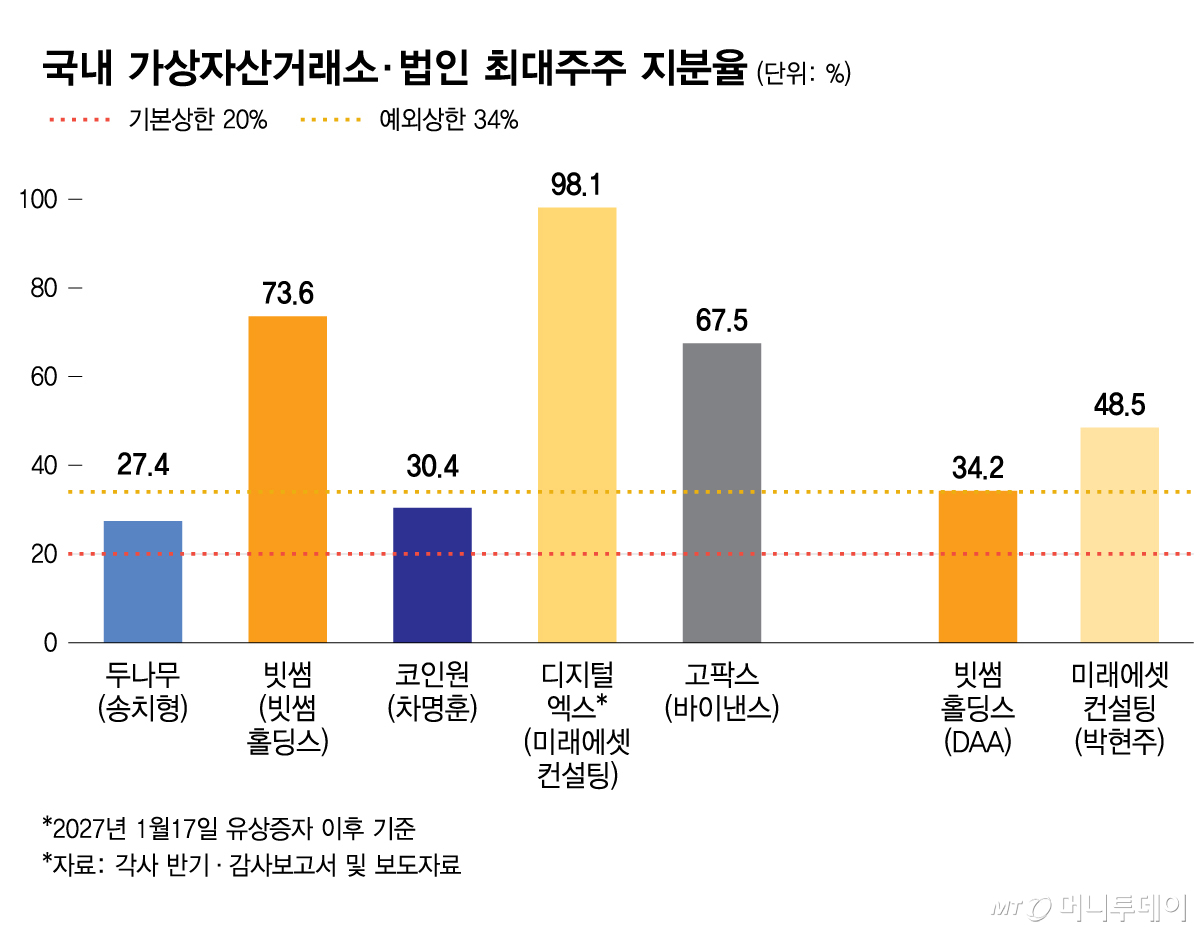
The five major domestic virtual asset exchanges face the prospect of a complete overhaul of their governance structures. The government’s second-stage virtual asset legislation, released on the 24th, includes a provision mandating that the shareholding ratio of major exchange shareholders be limited to 20% in principle as part of ownership diversification rules.
Consequently, all five exchanges currently have major shareholders exceeding this cap. In particular, Upbit and Bithumb will be required to divest a portion of their major shareholders’ stakes within three years of being designated as licensed exchanges.
The draft bill on the “Act on Innovation in the Digital Asset Industry and Protection of Users (tentatively titled the Basic Digital Assets Act prior to public release),” unveiled by the Financial Services Commission at a virtual asset committee meeting chaired by Chairman Lee Eog-weon on the same day, defines virtual asset exchanges as “digital asset platform operators” requiring licenses for trading, brokerage, and custody services.
The bill stipulates that ownership diversification standards equivalent to those applied to alternative trading systems (ATS) in the capital market—currently Nexttrade—will be enforced. Under exceptional approval procedures based on enforcement decree criteria, holdings may reach up to 34%. Small and medium-sized exchanges will receive an additional three-year grace period, allowing them to defer compliance for up to six years.
Bithumb’s largest shareholder, Bithumb Holdings, holds a 73.6% stake, meaning it must reduce its holding by 53.6 percentage points. Even if the regulatory target is considered to be Bithumb Holdings, given that the exchange has partially become a holding company, the major shareholder of Bithumb Holdings, DAA, holds a 34.2% stake, making divestment unavoidable.
Some analysts predict that because Bithumb operates under a multi-tiered corporate structure headed by Chairman Lee Jung-hoon, the extent of required shareholding reduction could increase depending on the financial authorities’ judgment.
For Upbit’s operator, Dunamu, the combined shareholding ratio of special relationships with Chairman Song Chi-hyung stands at 27.4%, exceeding the basic cap. Vice Chairman Kim Hyeong-nyeon, a business partner, also holds a 13.1% stake, meaning the scale of required divestment may vary depending on the criteria for calculating special relationships. Changes in shareholding ratios resulting from a comprehensive stock exchange with Naver Financial are also cited as a variable.
Analysts suggest that if Coinone’s largest shareholder, CEO Cha Myung-hoon (30.4%), fails to obtain exceptional approval and divests shares to align with the basic cap, his stake could fall below that of the second-largest shareholder, Com2uS Holdings (24.5%).
If Com2uS Holdings also adjusts its holdings to meet the cap, its shareholding ratio would drop to the level of the joint third-largest shareholders, Korea Investment & Securities and OKX Ventures (each holding 19.6%). For GoPax’s operator, Streamy, the stake held by Binance Island entity reaches 67.5%.
Mirae Asset Group, which acquired Digital X (formerly Coinbit) in July, also faces a situation where it must consider selling its shares if the legislation becomes reality.
Mirae Asset Consulting, a core affiliate of the group, is on the verge of effectively making Digital X a wholly-owned subsidiary by securing a 98.1% stake through a rights offering (paid-in capital increase) scheduled for January 17 next year. Mirae Asset Consulting is an entity in which Chairman Park Hyun-ju holds a 48.5% stake.
Criticism is fierce within the virtual asset industry, with many arguing that forcing private companies to restructure their shareholdings after they have taken risks to build exchanges constitutes an infringement of property rights. Complaints also continue regarding the difficulty of finding buyers willing to absorb large volumes of existing shares amid volatile virtual asset market conditions.
Professor Kang Hyeong-gu, who teaches in the Department of Finance and Business Administration at Hanyang University, stated, “The ‘exceptional approval allowing up to 34%’ under the enforcement decree could lead to administrative discretion-driven government intervention and rent-seeking, as well as a shift in control from technology entrepreneurs to existing financial institutions.”
He added, “The public interest and neutrality of exchanges should be achieved not by merely adjusting shareholding percentages, but through promoting competition via open market entry and enhancing internal controls.”
Considerable friction is expected during the legislative process. This is because more than 10 bills have been submitted to the National Assembly while the government’s draft, originally scheduled for release last year, has been delayed by over a year. With highly sensitive provisions largely included in the government’s bill, fierce debates are anticipated during the National Assembly’s consolidated review process.

 in STOCK
