

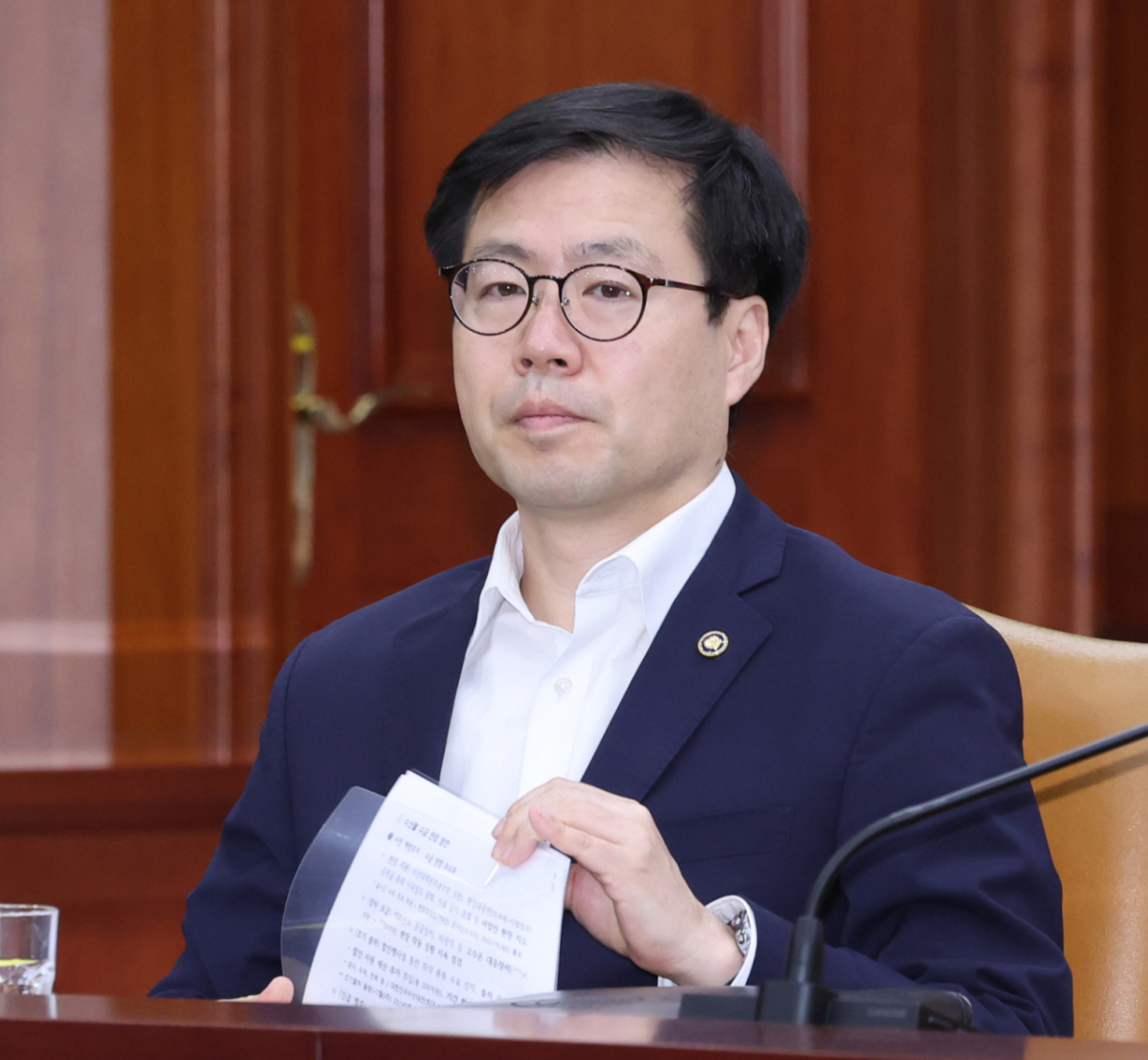
Yeo Han-gu, Chief Trade Negotiator at the Ministry of Trade, Industry and Energy, who has been responsible for major trade issues including tariff negotiations with the United States, was abruptly dismissed on the 15th.
On that day, the Ministry of Trade, Industry and Energy stated that "Yeo Han-gu (Head) was removed from office by authority." The ministry explained, "Personnel decisions for political appointees fall within the authority and political judgment of the appointing power," adding that it is taking all necessary measures to ensure no disruption in handling key trade issues following the personnel decision by the appointing authority.
Appointed as the first Chief Trade Negotiator under the Lee Jae-myung government last June, Yeo has been handling major trade issues since his appointment, including tariff negotiations with the Trump administration of the United States. Through multiple rounds of negotiations with the U.S., he succeeded in reducing tariffs from 25% to 15% and also secured a $350 billion Korea-U.S. Strategic Investment Agreement.
Recently, he has continuously communicated with the U.S. side to convey the South Korean government's position and concerns regarding the U.S. Trade Act Section 301 tariff measures. He also sustained efforts to dispel misunderstandings and concerns from the U.S. side related to Coupang.
In line with the trend toward trade diversification, he has promoted Comprehensive Economic Partnership Agreements (CEPAs) with Mongolia, Bangladesh, Serbia, and other countries. He also began serious consideration of joining the Comprehensive and Progressive Agreement for Trans-Pacific Partnership (CPTPP), a cooperative framework in the Asia-Pacific region.
Regarding concerns that the vacancy at the head of trade could disrupt progress on key trade issues, the Ministry of Trade, Industry and Energy stated, "Negotiation teams led by the Vice Minister for Trade are responding steadily to key trade issues such as U.S.-related trade issues and CPTPP," adding, "Negotiations with countries including the United States will proceed continuously, and practical and high-level consultation channels remain fully operational as before."

 in ECONOMY
