

The Ministry of Planning and Budget is pushing hard for a reform of the Local Education Fiscal Grant (hereinafter "Education Grant"). This drive stems from concerns that, with massive additional tax revenues expected due to the semiconductor boom, the Education Grant could be mismanaged if it continues to grow without limits. While the school-age population shrinks, the Education Grant has been increasing year after year. The structure linking the grant to domestic tax revenue, which creates volatility based on tax collections, and the "partitioned" structure that prevents its use for early childhood, high school, and lifelong education have also played a role.
According to government ministries on the 16th, the Planning Bureau is reportedly in final negotiations with the Ministry of Education to abolish the linkage between the Education Grant and domestic tax revenue. The fixed linkage structure of "20.79% of domestic taxes" for the Education Grant is finally set for reform.
The discussion to abolish the linkage structure began with criticisms that the continuously increasing Education Grant is inappropriate despite the shrinking school-age population. Park Hong-geun Gi Hoek-cheo (Minister) pointed out on Facebook on the 13th, "While the school-age population has decreased by 1.75 million over the past 10 years, the Education Grant has increased by about 40 trillion won, or 78%."
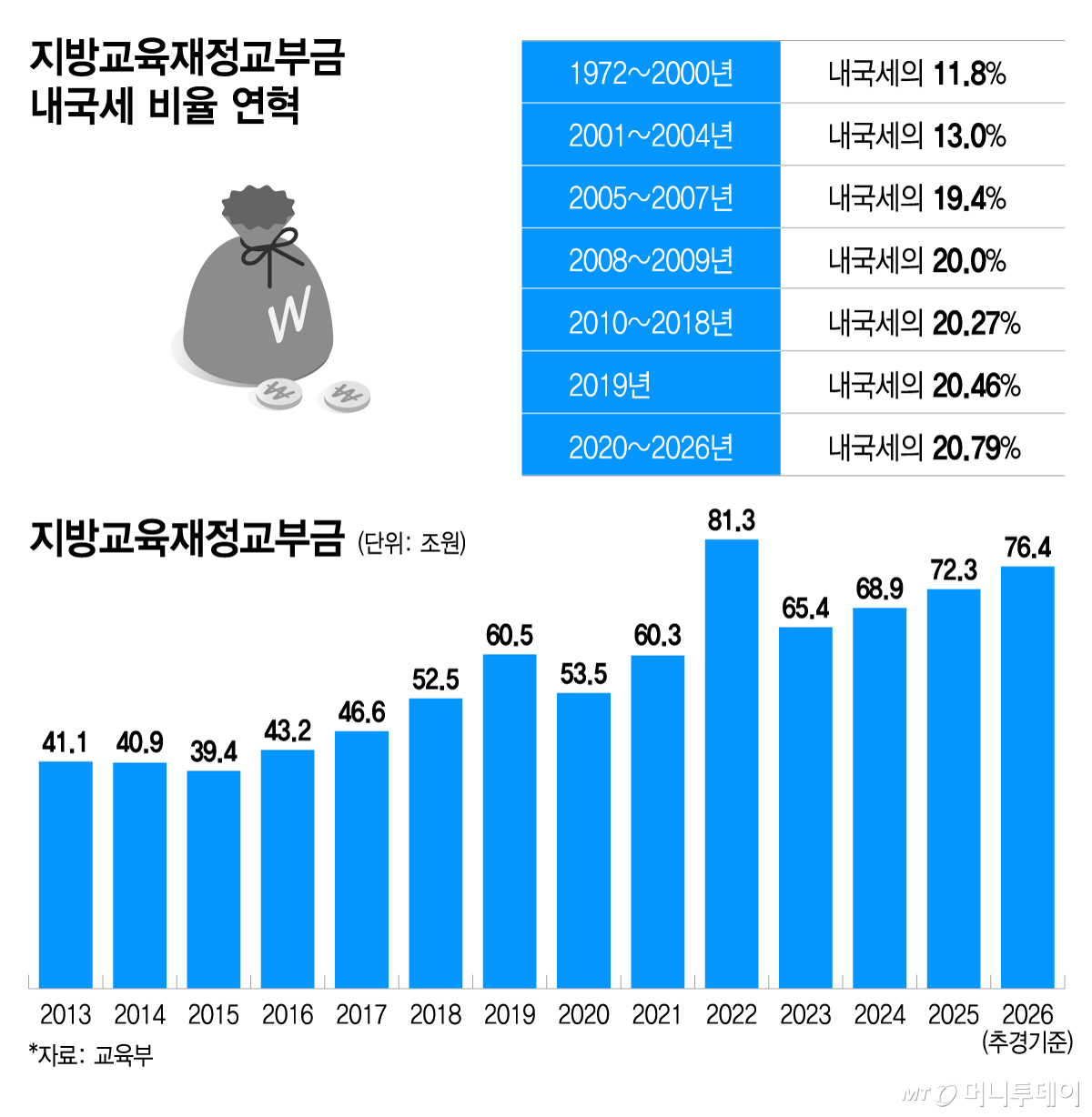
In fact, the school-age population (ages 6–17), which was 10.73 million when introduced in 1972, has dropped to 4.922 million this year (based on the median population projection by the National Data Agency). Meanwhile, the Education Grant increased from 43.2 trillion won in 2016 to 76.4 trillion won as of this year's supplementary budget proposal, a rise of about 76.8%.
The reason the scale of the Education Grant has been maintained despite population decline lies in its domestic tax linkage structure. The Local Education Fiscal Grant Act, enacted in January 1972, stipulates that 11.8% of domestic taxes be paid as Education Grants. This was necessary to provide funding to increase schools and teachers after the implementation of the non-examination system for middle schools in 1969, which allowed all students wishing to advance to enter middle school. This is the background for mandating a fixed percentage of domestic taxes to be allocated to the Education Grant.
Subsequently, due to various reasons such as the implementation of free compulsory education in middle schools and the strengthening of autonomy and accountability in local education finance, the linkage ratio has continued to increase. The linkage ratio has steadily risen: 11.8% from 1972 to 2000; 13.0% from 2001 to 2004; 19.4% from 2005 to 2007; 20.0% from 2008 to 2009; 20.27% from 2010 to 2018; 20.46% in 2019; and 20.79% from 2020 to 2026.
The structure linked to tax revenue has also caused volatility in the Education Grant. The Education Grant decreased compared to the previous year twice, in 2020 and 2023. In 2020, this was due to a shortfall in tax revenue caused by the shock of COVID-19, and in 2023, due to a semiconductor downturn. Particularly in 2023 (65.3637 trillion won), the Education Grant decreased by about 24% compared to 2022 (81.2976 trillion won).
The partitioned structure of the Education Grant is also cited as a background for its abolition. The Education Grant, funded at 20.79% of domestic taxes, is sent to local education offices and is a so-called "partitioned" budget used only for kindergarten, elementary, and secondary education.
While the Education Grant increases annually due to rising domestic tax revenue, the number of beneficiaries is shrinking as the school-age population declines due to low birth rates. To address this, special accounts were created for early childhood education (Special Account for Early Childhood Education) and high school/lifelong education support (Special Account for High School and Lifelong Education Support), which are used for programs like Nurikuri and university support. However, these measures have been criticized as merely temporary fixes. Criticism of excessive cash-based support is also not unrelated to the situation where beneficiaries decrease while the grant amount increases.
Repeatedly failed "Education Grant reform": "The right time for reform has already passed"
Discussions on reforming the Education Grant have been led by fiscal authorities in the past. The Ministry of Education has mostly taken a defensive stance. Past conflicts regarding the Education Grant were repeatedly derailed by opposition from the education sector.
In 2016, during the Park Geun-hye administration, conflict arose when attempts were made to fund the Nurikuri program budget using the Education Grant. The same was true for creating the Special Account for High School and Lifelong Education Support to support higher education (universities). In 2022, the Ministry of Economy and Finance attempted to revise the domestic tax linkage structure but shifted course to establishing a new Special Account due to opposition from the education sector.
However, this time, fiscal authorities appear to be taking the lead in the reform. With tens of trillions of won in additional tax revenue expected due to the semiconductor boom, it seems difficult to convince stakeholders that the significantly increased Education Grant should be entirely retained by them. The education sector argues that securing funding is urgent for basic academic support, childcare, AI (artificial intelligence) education, and school facility improvements, even as student numbers decline.
Currently, the Planning Bureau is reportedly reviewing a proposal to abolish the domestic tax linkage structure of the Education Grant with the Ministry of Education and establish a new Future Response Fund using additional tax revenue as a source. Within this fund, an "Education Account" would be created for talent and education sectors. This is intended to respond to future education demands such as high school/lifelong education, early childhood education, and AI education. Park (Minister) also promised that the total Education Grant and per capita grant would not decrease, and that savings would be reinvested in education.
Yang Jun-seok of Catholic University of Korea Gyeong Je-hak-gwa (Prof.) stated, "It seems the right time for reforming the Education Grant has already passed." He added, "If left unaddressed, government spending could increase indefinitely, so reform must happen quickly, but it is also important to specifically determine how these funds will be used."

 in ECONOMY
