

The government is preparing support measures for vulnerable borrowers such as small business owners and ordinary citizens to reduce the burden of financing for companies and households due to rising long-term interest rates in major countries. Although the won/dollar exchange rate recently fell back into the 1,300-won range for the first time in 11 months, uncertainty remains due to geopolitical tensions in the Middle East and monetary policies in major countries, so the government has decided to actively respond to volatility in the foreign exchange market as well.
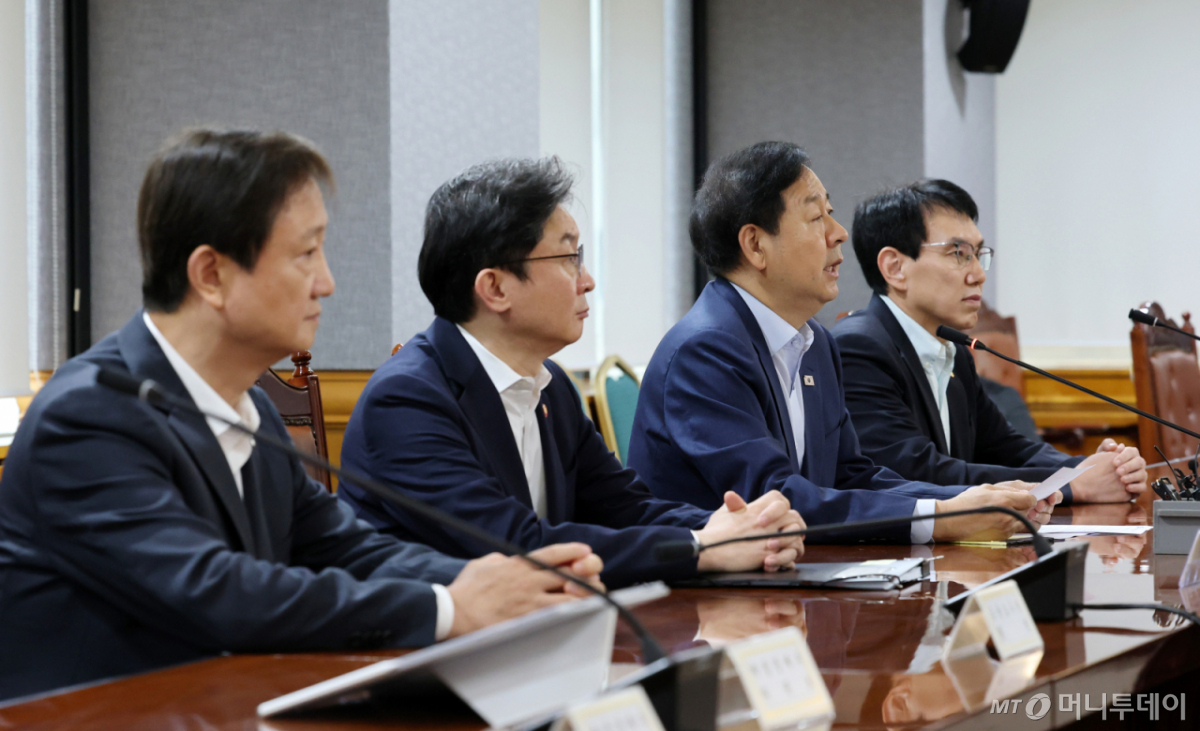
Vice Prime Minister Koo Yun-cheol held a market situation monitoring meeting with Lee Eung-won, Chair of the Financial Services Committee; Lee Chan-jin, Chairman of the Financial Supervisory Service; and Park Jong-woo, Senior Executive Vice Governor of the Bank of Korea, at the Bankers' Hall in Seoul on the morning of the 21st to discuss trends in financial and foreign exchange markets and response directions.
Attendees diagnosed that interest rates are rising, particularly for ultra-long-term bonds, due to a complex combination of factors including increased government bond issuance by various countries, expanded corporate bond issuance by global artificial intelligence (AI) companies, and uncertainty over geopolitical developments in the Middle East.
The yield on 30-year U.S. Treasury bonds rose from 4.61% at the end of February to 5.28% at the end of July. As of the 19th, it stood at 5.19%. On the same day, yields on 30-year government bonds in Japan and the United Kingdom also reached high levels of 4.09% and 5.79%, respectively.
Vice Prime Minister Koo said, "Long-term government bond yields in major countries such as the United States, Japan, and Europe have risen to multi-decade highs," adding, "Our domestic bond market is also seeing rising yields centered on ultra-long-term bonds."
The government will closely monitor trends in the domestic bond market and continue to assess the impact of rising long-term interest rates on financial markets, financing costs for companies and households, and the real economy.
In particular, the government believes that household and self-employed debt burdens, which increased during the process of overcoming the COVID-19 crisis, could grow due to rising interest rates, and plans to announce support measures for vulnerable borrowers as soon as possible. It will activate debt restructuring to support the recovery of struggling small business owners and individuals, and expand financial support targeting SMEs (small and medium-sized enterprises), ordinary citizens, and vulnerable borrowers.
Vice Prime Minister Koo stated, "We will continuously monitor issuance and circulation conditions in the national treasury bond market while ensuring that spillover effects on the real economy, such as corporate financing costs and household interest burdens, are minimized."
Regarding the recent rapid decline in the won/dollar exchange rate, he assessed that downward pressure on the won has eased. The exchange rate had risen to the 1,550-won range at the beginning of last month but fell to 1,390 won on the 19th, aided by a record-breaking current account surplus and reduced foreign investor rebalancing of domestic stocks. This marks the first time in 11 months that the exchange rate has entered the 1,300-won range.
Attendees noted that both upward and downward factors affecting the exchange rate remain, including geopolitical conflicts in the Middle East and monetary policies in major countries, so they agreed to maintain vigilance and respond to market volatility without lowering their guard.
The government also emphasized that there is no problem with external financial stability despite a significant decline in net foreign financial assets in the second quarter. The decrease in net foreign financial assets is not due to an increase in external borrowing but rather reflects a substantial rise in the value of domestic stocks held by foreigners, driven by improved corporate performance and rising stock prices among domestic companies.
In fact, net foreign bonds and loans, which show definitive external asset-liability relationships, increased by 2.3 billion dollars to 367.8 billion dollars at the end of the second quarter compared to the previous quarter. The current account balance for the first half of this year also reached a record high surplus of 191 billion dollars. Vice Prime Minister Koo said, "There is no doubt that our economy's external stability is more robust than ever."
Although household credit recently surpassed 2,000 trillion won, the household debt-to-GDP ratio fell from 89.1% in the first quarter of last year to 85.3% in the first quarter of this year when adjusted for economic size. The government plans to manage the rising trend of household debt ratios, which remain relatively high compared to major countries, while ensuring that genuine borrowers face no difficulties in securing financing.
Supplementary measures targeting single-stock leverage products are assessed to have significantly calmed investment demand. Daily trading volume for single-stock leverage products dropped from 12.4 trillion won on the day before the policy implementation (the 30th of last month) to 1.1 trillion won on the 20th of this month.
Vice Prime Minister Koo stated, "We will activate an integrated management system covering financial and foreign exchange markets as well as government bond and real estate markets to proactively check risk factors by sector and respond appropriately when necessary."

 in ECONOMY
