

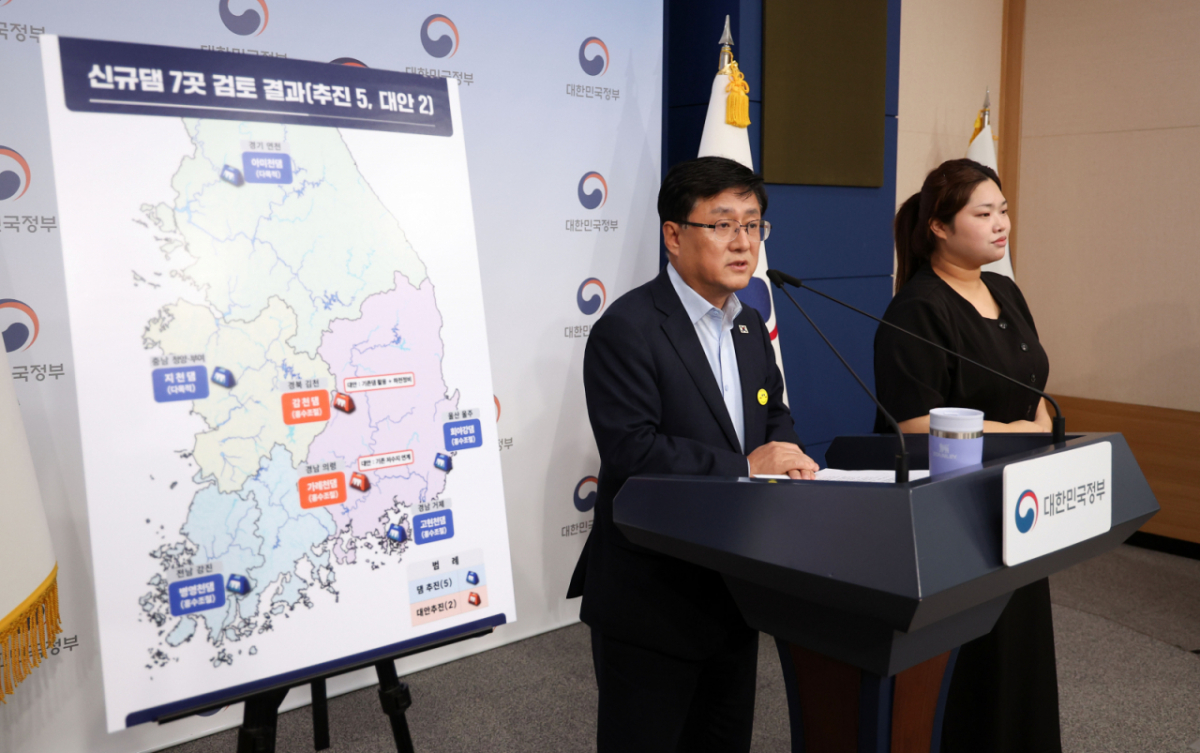
The government decided to reduce its plan for constructing new dams from 14 sites to five, taking into account factors such as local community acceptance. This move has drawn criticism that it could weaken the nation's capacity to respond to climate crises and rising water demand.
Recent years have seen increasingly frequent extreme floods and droughts occurring once every several hundred years, while new water demands from mega-projects and other large-scale initiatives are also growing, heightening concerns about the need to secure additional water storage capacity. In response, the government has stated that it will consider building additional dams if necessary.
According to the Ministry of Climate, Energy and Environment on the 27th, a review of the 14th new dam projects previously promoted by the Ministry of Environment during the Yoon Suk-yeol administration concluded that five sites will proceed with construction as planned. Seven were canceled in September last year, and two will be evaluated for alternatives rather than new construction.
The five sites approved for new dam construction are Jicheon Dam (Cheongyang/Buyeo), Amicheon Dam (Yeoncheon), Byeongyeongcheon Dam (Gangjin), Huiyanggang Dam (Ulsan), and Gohyeoncheon Dam (Geoje). Their combined storage capacity totals 128 million tons. Alternatives are being considered for Gamcheon Dam (Geumcheon) and Garyecheon Dam (Uiyeong).
This represents a significant reduction from the original plan, which aimed to secure a total water storage capacity of 318 million tons through the construction of 14 new dams. At the time, the Ministry of Environment had planned that these new dams would provide flood control capacity capable of absorbing rainfall of 80–220 mm at once and ensure water supply sufficient for 2.2 million people annually. However, following a change in administration, the new dam plans were subjected to a comprehensive review due to strong local opposition and ongoing debates over their effectiveness in preventing floods and droughts.
The Ministry of Climate, Energy and Environment decided to substantially scale back its original dam construction plan after assessing the necessity of building dams and gathering public opinions. Nevertheless, given the increasing frequency of extreme floods and droughts and rising water demands from mega-projects, experts argue that additional dam construction should also be carefully considered.
According to the "First River Basin Water Resource Management Plan" (Water Resource Management Plan) established by the Ministry of Environment in March last year, the projected national water shortage based on past drought data is approximately 740 million tons annually. The primary causes identified were increased new water demand due to the growth of industrial facilities such as the Yongin Semiconductor Cluster and insufficient reserve capacity in existing dams. These factors prompted the Ministry of Environment to pursue the construction of new dams at that time.
Following a comprehensive review, the Ministry of Climate, Energy and Environment plans to strengthen water management functions by identifying underutilized water storage options such as agricultural reservoirs, hydropower dams, and tidal gates, while also expanding existing water resource linkages. However, concerns remain that these measures may fall short in addressing extreme climate crises.
Recent extreme droughts and floods in the Yeongnam region serve as representative examples. Until last month, rainfall in Daegu and Gyeongbuk regions was only 70.8% of the long-term average, pushing Unmun Dam into a severe drought stage. Milyang Dam, located in the Nakdong River basin, also entered a drought warning level this year as its rainfall reached only half of the usual amount. However, on the 17th, the opposite situation occurred, with record-breaking heavy rains exceeding 100 mm per hour hitting Geoje and Tongyeong in Gyeongsangnam-do. This rainfall event was assessed as an unprecedented natural disaster occurring once every 200 years.
The decision to proceed with five new dam projects this year was largely driven by the need to strengthen preparedness for extreme floods. The plan aims to secure water storage capacity capable of handling floods that occur once every 100 years, but recent events like the flooding in Gyeongsangnam-do have highlighted the growing necessity to also prepare for disasters occurring once every 200 years.
Rising water demand from mega-projects must also be taken into account. While the Water Resource Management Plan accounted for the water needs of the Yongin Semiconductor Cluster, the announcement of three additional mega-projects has led to a sharp increase in new water demand. Both semiconductor plants and AI (artificial intelligence) data centers being developed as part of these mega-projects require large volumes of water.
The Jicheon Dam was approved for construction after considering new water demands from the Chungcheong region's mega-project. In the case of the Yongin Semiconductor Cluster, the initial plan was to secure water supply through the construction of Susumcheon Dam, but due to strong local opposition, the project was canceled in September last year. Instead, the government plans to supply water to Yongin by establishing a new integrated intake facility near Paldang Dam and increasing wastewater recycling.
The Honam Semiconductor Industrial Complex also requires large volumes of water. To address this, the Ministry of Climate, Energy and Environment considered restarting Dongbokcheon Dam, which had previously been canceled, but ultimately decided to resolve the issue by expanding the capacity of the existing Dongbok Dam.
As the need to secure new water storage capacity grows, the government also plans to consider additional dam construction if necessary. Kim Sung-hwan, Gi Hu-bu (Minister), stated during a briefing on the new dam promotion plan today that "(additional dam construction) is something that should be done depending on whether it is necessary."

 in ECONOMY
