

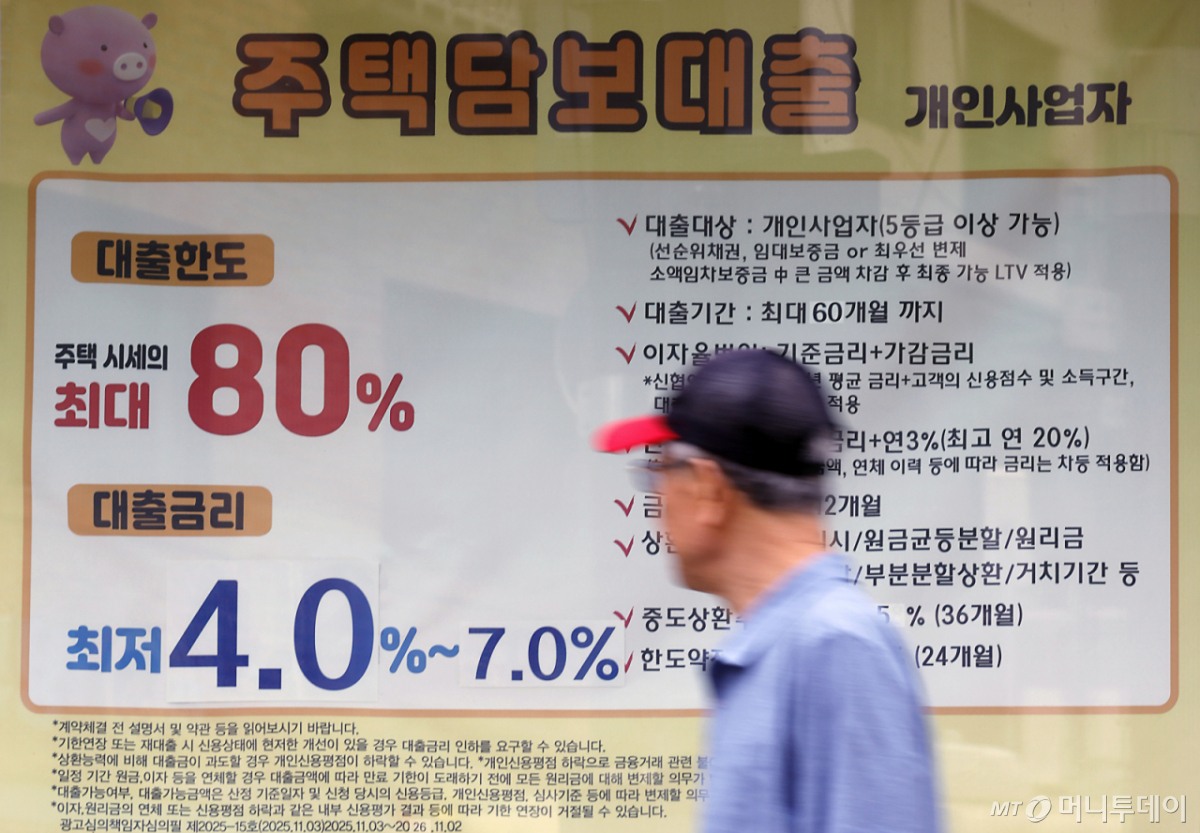
'Households that took on significant debt relative to their income when purchasing homes saw delinquency rates rise by 0.81 percentage points if interest rates increased by 1 percentage point. In these households, if one member defaults, the likelihood of another household member defaulting within a year is twice as high as in typical homeowning households.
'According to the Bank of Korea's Economic Research Institute's BOK Issue Note titled "Assessment of Household Debt Risks Using Household DB," released on the 7th, it is estimated that if interest rates rise by 100 basis points (1 percentage point), the delinquency rate among high-debt homebuyers will increase by 0.81 percentage points after 12 months.
'High-debt homebuyers refer to households that purchased new homes between 2023 and 2025, whose principal and interest repayment amounts relative to income rose in the top 10 percent. The increase in their delinquency rates exceeded the average of 0.56 percentage points for all homeowning households. This was also higher than existing homeowning households (0.52 percentage points) or households that purchased homes but did not take on excessive debt (0.64 percentage points).
'About 71 percent of high-debt homebuyers belonged to middle- and high-income groups in the third income quartile or above. Nevertheless, the increase in delinquency rates due to interest rate shocks was similar to that of low-income households in the second quartile (0.83 percentage points). This indicates that even with relatively higher incomes, sharply increasing debt during home purchases can make households vulnerable to interest rate hikes.
'There was also a high probability that delinquency risks would spread across all household members. Among high-debt homebuyers, the likelihood of another household member defaulting within 12 months after one member defaults was recorded at 8.8 percent. This is 1.9 times higher than the 4.6 percent for existing homeowning households and also exceeded the 5.4 percent for typical homebuying households.
'The researchers explained, "A 100-basis-point increase is a stress test assumption to examine how much interest rate shock high-debt homebuyers can withstand; it does not reflect future interest rate forecasts."
'The interest rate shock experienced by all borrowing households was relatively limited. If interest rates rise by 25 basis points, the delinquency rate is estimated to increase by 0.27 percentage points from the existing level of 3.35 percent.
'However, low-income households and those headed by self-employed individuals or corporate executives were relatively sensitive to interest rates. Delinquency rates for households in the first and second income quartiles increased by 0.48 percentage points and 0.40 percentage points, respectively, 12 months after an interest rate hike. Households headed by self-employed individuals or corporate executives also saw a rise of 0.32 percentage points.
'The researchers explained that while rising interest rates increase repayment burdens for existing borrowers, they also help moderate the growth trend of household debt, which has a positive effect on financial stability.
'It was also confirmed that household debt suppresses consumption. The researchers analyzed that when the ratio of actual principal and interest repayments relative to income (DSR) exceeds 46 percent, consumption begins to decline. As of 2025, 11.1 percent of households with debt exceeded this threshold.
'In particular, the proportion of households in the first income quartile exceeding a DSR of 46 percent rose from 11.4 percent in 2021 to 14.5 percent last year. Although the overall proportion of households exceeding the threshold decreased slightly compared to 2024, the upward trend continued among low-income groups.
'The researchers stated, "Consistent policy measures must be maintained to prevent excessive expansion in housing price increases." They added, "Repayment burdens for low-income households should be closely monitored, and selective policy support for vulnerable households should be considered if necessary."

 in ECONOMY
