

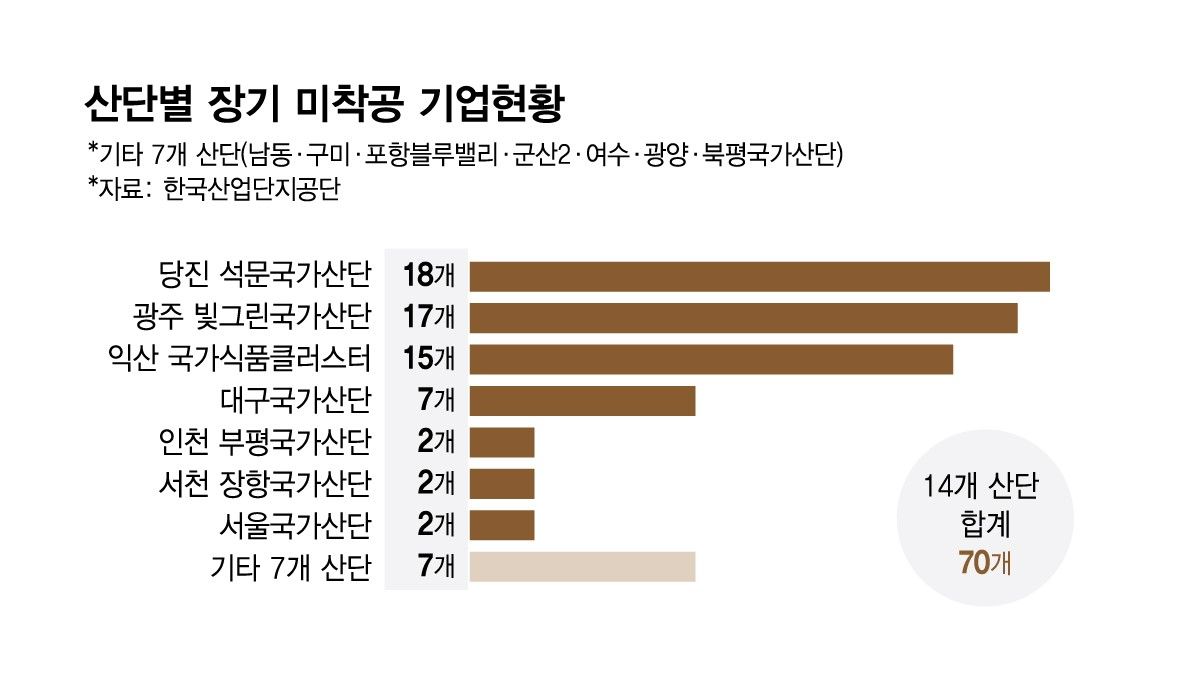
It was revealed that 70 tenant companies in national industrial complexes have not begun construction on their factories for more than three years. Among these, 12 have exceeded the 10th-year mark, and about half remain at a stage of merely urging construction, prompting criticism regarding the effectiveness of managing industrial complex land.
According to documents submitted by the Korea Industrial Complex Corporation (KIND) to the National Assembly on the 14th, it was confirmed that 70 tenant companies across 14 of the 36th national industrial complexes managed by KIND have been in a state of non-construction for more than three years.
By complex, the Dangjin Seokmun National Industrial Complex in Chungnam had the highest number with 18 sites. Gwangju Bitgreen National Industrial Complex followed with 17, the Iksan National Food Cluster in North Jeolla Province with 15, and the Daegu National Industrial Complex with 7. These four complexes accounted for 57 of the non-construction companies, representing 81.4% of the total.
Companies in a state of long-term non-construction were identified based on February 2011 for the Yeosu National Industrial Complex, February 2014 for the Dangjin Seokmun Complex, and March 2017 for the Daegu Complex.
The most common reason for non-construction was business deterioration. Among the 35th companies excluding those undergoing land disposal procedures, 27 were classified as having deteriorated business conditions. Three had changes in their business plans, four were scheduled to begin construction, and one company was making installment payments on the purchase price.
Out of the 70th non-construction cases, 25 are currently undergoing procedures to recruit demand-side companies, such as purchase applications, and 10 have issued re-sale announcements. The remaining 35 remain at a stage of urging construction through official document dispatches and corrective orders. While about half have entered land disposal procedures, it remains an issue whether actual buyers will be secured to lead to the utilization of the land.
The complexes where non-construction companies are concentrated also had relatively high unsold rates. As of August 2026, the average unsold rate for national industrial complexes was 1.5%, but it was 20.1% for the Iksan National Food Cluster, 17.1% for the Dangjin Seokmun Complex, 15.8% for the Gwangju Bitgreen Complex, and 9.3% for the Daegu Complex. KIND explained that securing companies interested in purchasing is difficult because 57 of the 70th non-construction companies are concentrated in these four complexes.
Tenant conditions by complex were also cited as obstacles to attracting companies. KIND identified insufficient transportation and residential environments, uncertainty in the electric vehicle market, restrictions on tenant industries, and labor supply issues as major factors.
KIND stated that it is carefully considering administrative measures such as terminating tenancy contracts, taking into account companies' business burdens and the possibility of industrial land becoming vacant. While continuing to urge construction and provide on-site consultations for non-construction companies, KIND plans to secure new demand by expanding tenant industries and also examine the necessity of terminating tenancy contracts for companies with long-term construction delays.

 in ECONOMY
