

The strong performance of K-Beauty exports is establishing itself as a new growth driver for the air cargo market. This comes amid a surge in high-value cargo bound for the Americas, driven by expanded artificial intelligence (AI) investments in semiconductors and data center equipment, while air exports of cosmetics to Europe have also spiked sharply.
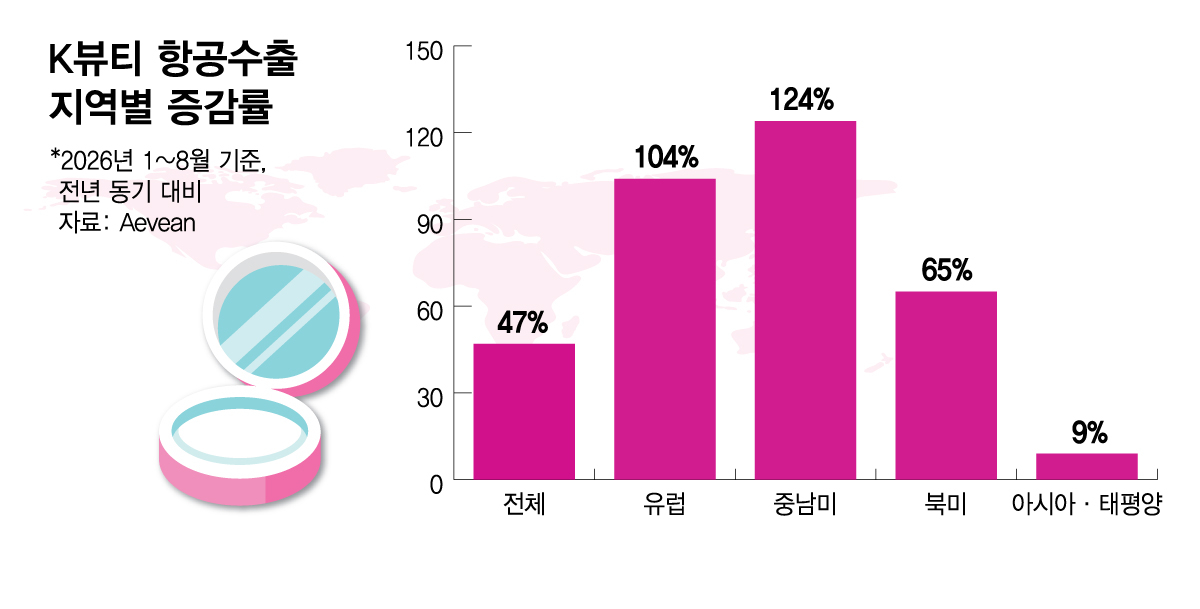
According to Aevean, a Dutch aviation and logistics strategy consulting firm, beauty and personal care products exported from Korea via air freight between January and August this year totaled 57,000 tons, a 47% increase compared to the same period last year.
The growth in K-Beauty shipments bound for Europe was particularly notable. Air exports to Europe reached approximately 19,000 tons, more than doubling with a 104% year-on-year increase. As a result, Europe has overtaken the Asia-Pacific region to become the largest air export market for Korean beauty and personal care products.
Shipments to North America also grew by 65%, serving as a “second growth pillar.” While the Asia-Pacific region saw only a 9% increase, shipments to Latin America surged by 124%. As demand for K-Beauty expands beyond the existing Asian market to the United States, Europe, and Latin America, the regions driving air cargo demand are becoming more diversified.
This contrasts with the recent slowdown in China-origin e-commerce air cargo. In August last month, China-origin e-commerce air cargo volumes decreased by 16% compared to the same month last year, marking the largest decline since related statistics began being compiled. Shipments to Europe in particular fell by 40%. High-value Korean cargo is effectively filling the void left by the stagnation of China-origin e-commerce freight.
This is due to the impact of the European Union (EU) strengthening regulations on low-cost small parcels, which has hurt demand for low-priced China-origin e-commerce cargo. While volumes of low-cost consumer goods heading from China to Europe have decreased, the range of growing items in Korean air cargo is expanding, with K-Beauty joining AI and semiconductor equipment.
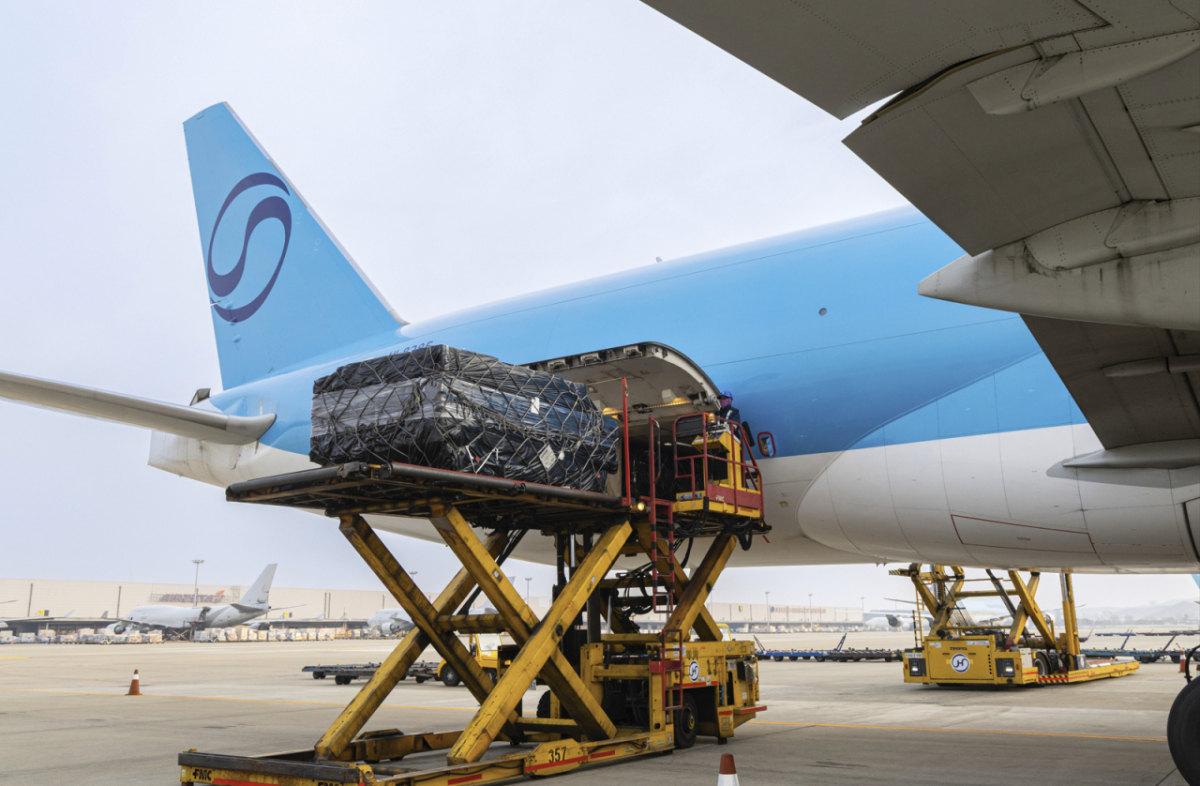
These changes are also reflected in the performance of Korean Air, the country’s largest air cargo operator. Korean Air cited the expansion of global AI-related investments and strong K-Beauty exports as key factors behind increased air cargo demand in its second quarter.
Korean Air’s Q2 cargo business revenue was 1.5419 trillion won, a 46.1% increase from the same period last year. The growth rate of the cargo segment was faster even when compared to the 26th% increase in total revenue.
Forecasts suggest that the high growth in the cargo segment will continue in Q3 results, which are scheduled to be released on the 15th. According to Sangsangin Securities, Korean Air’s standalone Q3 revenue is expected to be in the range of 5.1 trillion won, an increase of approximately 28% to 29% from the same period last year. Operating profit is projected to rise by 30% to 32% to between 490 billion and 500 billion won.
In particular, Q3 cargo revenue is estimated at approximately 1.4973 trillion won, representing a year-on-year increase of around 40%. The cargo yield is also expected to be higher by 38% to 39% compared to the same period last year, at a level of 682 to 685 won per FTK (freight ton-kilometer).
Global air freight rates are also maintaining high levels. In fact, the global Baltic Air Freight Index (BAI00), tracked by the TAC Air Freight Index published in Hong Kong, recorded a level 24.3% higher than the same period last year as of the 12th. Despite the decrease in China-origin e-commerce volumes, demand for high-value AI-related cargo and high fuel costs appear to be supporting freight rates.

 in INDUSTRY

