

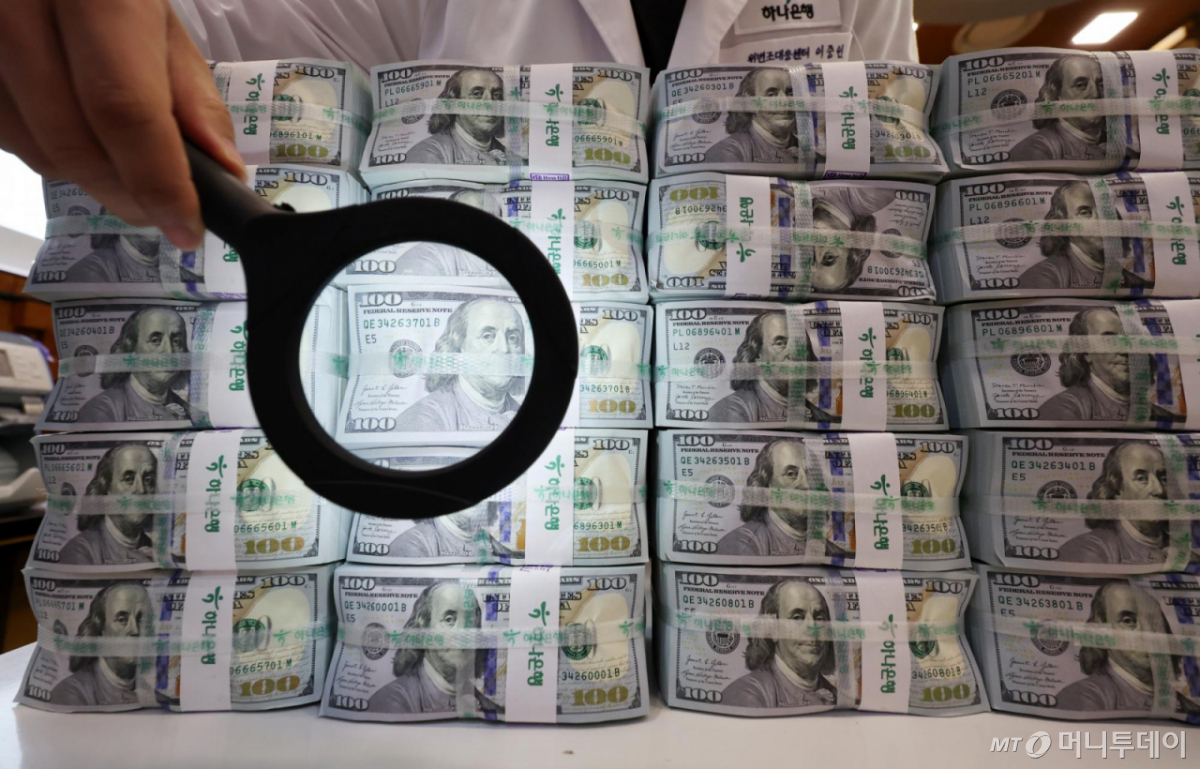
Foreign currency deposits held by domestic residents increased for the sixth consecutive month. Driven by large corporations receiving current account payments and securities firms seeing inflows of investor escrow funds, deposits grew by more than $10 billion for the third straight quarter.
According to the "Trends in Foreign Currency Deposits of Residents in September 2026" released by the Bank of Korea on the 28th, foreign currency deposits at domestic foreign exchange banks stood at $154.71 billion as of the end of last month, an increase of $14.09 billion from the end of the previous month.
Foreign currency deposits of residents refer to foreign currency deposits placed with domestic foreign exchange banks by Korean nationals, domestic corporations, foreigners who have resided in Korea for more than six months, and foreign companies operating in Korea.
After a decrease of $15.37 billion in March, foreign currency deposits of residents increased for six consecutive months from April through September. In particular, following increases of $15.01 billion in July and $12.28 billion in August, deposits rose by more than $10 billion again in September. The magnitude of the increase also expanded by $1.81 billion compared to the previous month.
By currency, U.S. dollar deposits increased by $12.99 billion from a month earlier to $132.9 billion. Dollar deposits accounted for 92.2% of the total increase in foreign currency deposits.
The Bank of Korea analyzed that factors such as large corporations receiving current account payments, inflows of investor escrow funds at securities firms, and inflows of proceeds from foreign bond issuances by public enterprises contributed to the rise. Dollar deposits accounted for 85.9% of total foreign currency deposits.
Japanese yen deposits also recorded $9.49 billion, an increase of $550 million from the previous month, driven in part by increased travel-related currency exchanges due to the weak yen.
Euro deposits rose by $370 million during the same period, from $9.16 billion to $9.53 billion, largely due to corporate current account receipts. Chinese yuan deposits were also recorded at $1.27 billion, an increase of 0.3 billion won.
By depositor type, corporate deposits increased by $13.11 billion from the previous month to $136.6 billion, accounting for 93% of the total increase in foreign currency deposits. Individual deposits rose by $980 million, from $17.12 billion to $18.11 billion.
By bank type, foreign currency deposits at domestic banks increased by $9.18 billion from the previous month to $120.04 billion. Foreign currency deposits at branches of foreign banks in Korea rose by $4.91 billion to $34.67 billion.

 in ECONOMY
