

Non-regular workers make up 43.8%, yet you're told to "work hard"? Why did the angry generation of their 20s become depressed?
The streets of France are seething with anger. Protests that began with unrest among high school students in response to poor educational conditions have spread into a massive blaze as young people and lower-income residents facing financial hardship joined in. The weight of the movement is distinct, as it marks the beginning of future generations directly cracking open a stagnant structure.
In contrast, the resistance of young Koreans follows a different trajectory. Rather than taking to the streets, they give up on job hunting and quietly withdraw from the labor market. They even postpone or abandon marriage and childbirth, which are developmental tasks of their life stage. The youth are depicted as cycling through negation, anger, compromise, and depression, only to ultimately be driven into resignation.
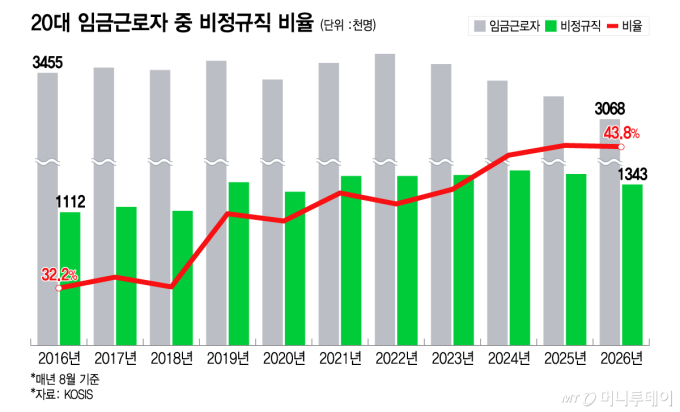
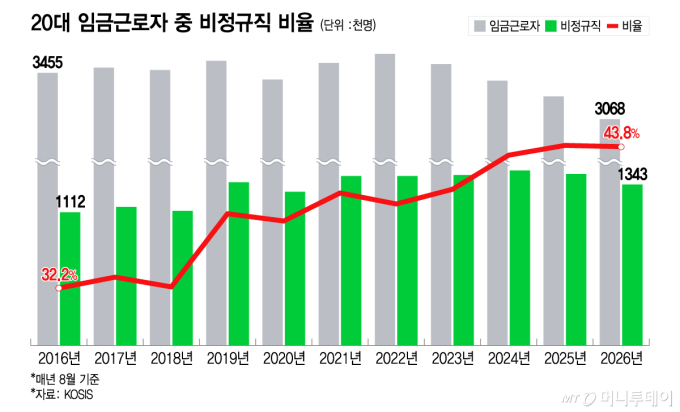
According to the Korea Statistical Information System (KOSIS), as of August this year, there were 1.343 million non-regular workers in their 20s. This means that more than four out of every 10 wage and salary earners in their 20s (43.8%) are non-regular workers, out of a total of 3.068 million wage and salary earners in that age group. This figure exceeds the overall share of non-regular workers across all age groups, which stands at 38.5%.
Five years ago, in 2021, the non-regular worker ratio across all age groups was 38.4%, showing little difference from the current level. However, during the same period, the non-regular worker ratio for those in their 20s rose relatively significantly from 40.0% to 43.8%. Compared with a decade ago, while the number of wage and salary earners in their 20s decreased by 387,000, the number of non-regular workers increased by 231,000.
The issue of non-regular employment among people in their 20s is not a temporary phenomenon. As companies have abolished regular recruitment drives and shifted toward a preference for experienced hires, young workers have been left exposed to a severe shortage of jobs. They are trapped in a vicious cycle: unable to enter the workforce due to a lack of experience, and unable to gain experience because they cannot secure entry-level positions.
The barriers to housing are just as high as those to employment. The dream of owning a home is, quite literally, confined to the realm of dreams. Many young people struggle even to pay their immediate monthly rent. As of 2023, 31.6% of young households spent more than 30% of their monthly income on rent. This is more than double the overall average of 15.8%.
Angered by a bleak reality, young people lower their expectations and seek alternatives such as investing in virtual assets, attempting private compromises with the status quo. Yet they become frustrated when the reality remains unsatisfying. This frustration leads to depression, which in turn results in exclusion from the labor market, manifesting in groups such as the "inactive" population.
Guo Jin-ju, a professor at Seoul National University, stated, "Korean youth tend to internalize their frustration through depression and apathy rather than expressing dissatisfaction and anger outwardly through violence or protests." She added, "The state of Korean youth is one in which they are angry, but the form that anger takes is depression and withdrawal."
China lies down, France takes to the streets... Why are young people feeling frustrated and angry?
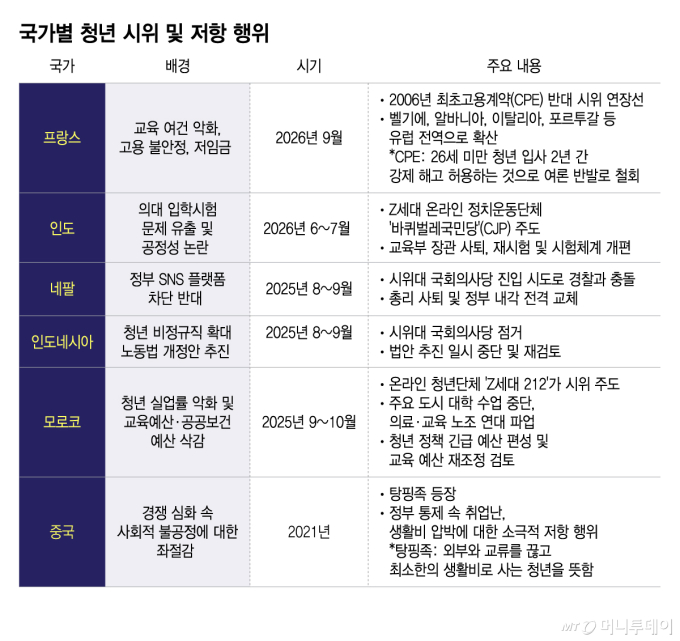
In France, student protests against poor educational conditions expanded into an expression of young people's anger over living costs and the deprivation of opportunities. In India, controversy over the fairness of medical school entrance exams led to large-scale demonstrations. The realities faced by young people in each country, the triggers for their anger, and the ways they express it vary widely. In China, youth exhausted by fierce competition have chosen "tangping" (lying flat), opting to step away from competition altogether.
Underlying these movements is a shared sentiment that the belief in being rewarded for one's efforts has wavered and that it has become increasingly difficult to trust the future promised by existing society. As the "betrayal of education"—where highly educated individuals still struggle with employment difficulties—combined with the inheritance of privilege and soaring living costs, young people have fallen into a deep sense of despair, feeling that their futures have been stripped away. This has led to a distrust that social opportunities and institutions no longer function fairly, ultimately erupting into collective resistance.
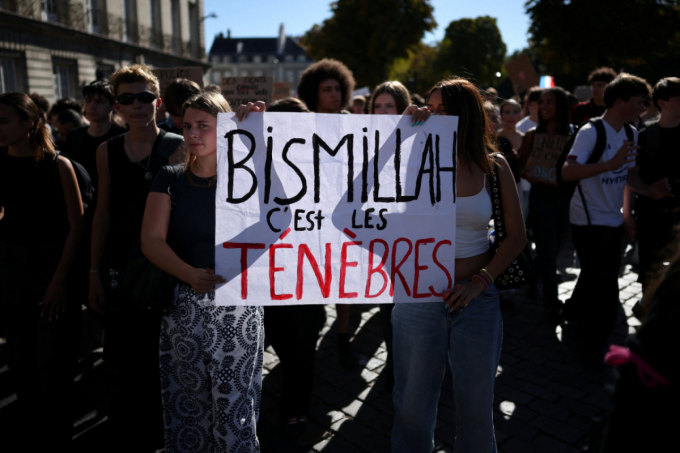
Recent protests in France are the clearest example of this anger among young people. In September, students at a high school in northern Paris took to the streets in protest against deteriorating educational conditions, including teacher shortages and aging school facilities. The demonstrations spread across Paris as university students and workers struggling with job insecurity and low wages joined the movement, escalating into public service strikes and incidents of looting and arson in the city center.
This is a continuation of the protests against the first employment contract (CPE) in 2006. At that time, the French government sought to introduce the CPE, which allowed for relatively easy dismissal within two years of hiring for young people under the age of 26. While the measure was intended to reduce youth unemployment, students and labor unions protested that it would create "disposable workers." Large-scale protests and strikes against the CPE continued across France for approximately six weeks, ultimately leading the government to withdraw the bill.
The French daily Le Monde noted, “If the CPE protests were a rejection of a specific employment system, this resistance is intertwined with young people’s structural anxieties about the problems and future of France’s entire education system,” diagnosing that, unlike in the past when the issue was resolved by the withdrawal of the CPE, the current situation is unlikely to be easily quelled.
The British newspaper The Guardian noted that, unlike past protests, this demonstration in France was driven by high school students who acted spontaneously without the backing of central organizations such as student unions. Analysts observe that Generation Z (born between the mid-1990s and early 2010s), who have grown up amid the spread of the internet and social media, express their anger and mobilize in a far freer and more immediate manner through digital networks, unbound by specific organizations such as political parties or labor unions.
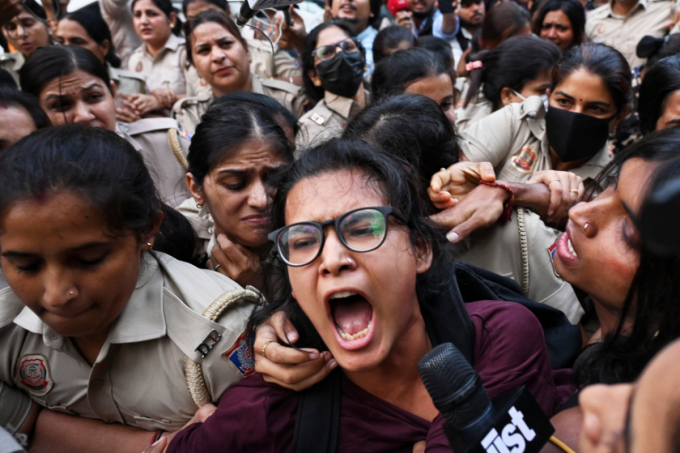
These characteristics of Gen Z were even more dramatically evident in emerging markets. In India last June, large-scale protests erupted following a scandal involving the leak of medical school entrance exam questions. The demonstrations, led by an online political movement group called the "Cockroach People's Party" (CJP), which was formed on social media by young people angry at entrenched corruption, forced the resignation of the Minister of Education and drove reforms to the medical school entrance examination system.
In August 2025 in Nepal, young people who were angry about the government's social media blocking policy and the hereditary employment of children from privileged classes gathered through encrypted platforms such as Discord and launched large-scale anti-government protests, which led to the resignation of Lee Neun (Prime Minister) and a cabinet reshuffle. Around the same time, Indonesian youth held protests against a labor law amendment bill that would expand "youth non-regular employment," triggered by the death of a 21-year-old former motorcycle taxi driver who was struck by a police car, resulting in a temporary suspension of the bill's advancement.
In September of the same year, in Morocco, protesters outraged by worsening youth unemployment and cuts to education budgets staged anti-government demonstrations centered around the online youth group "Gen Z 212," securing an emergency budget allocation for youth policies and a review of education budget reallocation.
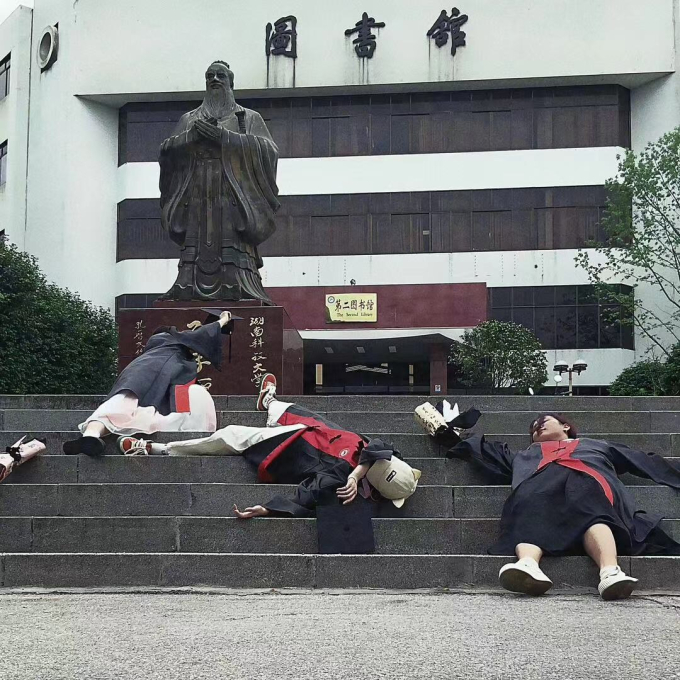
Chinese youth have chosen a different path. Rather than taking to the streets to demand change under the strict controls of Chinese authorities, they have resisted through "tang ping," or "lying flat," by stepping away from society's established benchmarks for success. The term "tang ping," which first appeared on the Chinese portal Baidu in 2021, refers to a stance of rejecting high-intensity labor and excessive competition in favor of living with minimal work and consumption. It signifies a decision to step back from the socially prescribed path to success, which includes overwork, marriage, and home ownership.
This frustration stems from the reality that even after breaking through fierce college entrance competition and graduating from prestigious universities, young people still struggle with employment difficulties, and that prolonged labor does not guarantee them a home of their own or a stable future. Although distinct from organized political movements, this was assessed as a form of resistance chosen by youth under the government's strict control.
"Can I afford a home on this salary?" … The Hardships of Life in One's 20s as Seen by Trainee Reporters
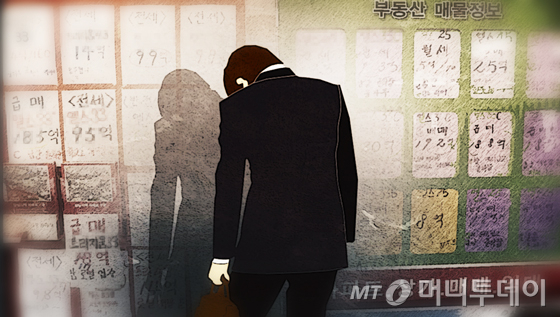
After enduring the grueling life of a job seeker, I finally secured my first job. Yet, anxiety about the future remains. It is difficult to be certain whether I will be able to save enough from my salary to buy a home or how long I can continue working at my current company. Even the belief that hard work leads to a better life is wavering.
Money Today trainee reporters who were recently on the job market also carry similar concerns. The reality seen by those who have just taken their first step into working life is not significantly different from the reality faced by young people in Korea.
Trainee reporters unanimously stated that securing employment, the first hurdle in professional life, is far from easy. Kim Yu-bin, a trainee reporter, said, "To get a full-time job, you work as a contract employee; to get a contract position, you do an internship; and to land an internship, you prepare for extracurricular activities and obtain certifications," adding that the job preparation process itself has become a long-term project. Ko Ji-un, another trainee reporter, noted that "the barriers to employment are becoming increasingly thick" as the cycle of preparing "experience for experience" continues.
The sluggish employment situation among young people is also evident in the statistics. According to the National Data Agency's Korea Statistical Information Service (KOSIS), the average monthly employment rate for those in their 20s (ages 20 to 29) from January to September this year was 59.2%, down by 1.2 percentage points from the same period last year (60.4%). Although it rebounded to 61.2% in 2024 following the COVID-19 pandemic, it has declined for two consecutive years since then. Over the same period, the overall employment rate for those aged 15 and above remained unchanged at 62.8% in both 2024 and this year. This indicates that while economic indicators have improved due to factors such as a semiconductor boom and increased exports, it is difficult to feel a recovery in the youth labor market.
Even after securing a job, anxiety persists. Go Ji-un, an intern reporter, noted, "Looking at friends who recently landed their first jobs, I see them worrying about how long they will be able to stay in their current positions." While the goal during the job search was simply to get hired, once actual work life begins, concerns arise over what kind of experience should be built to survive, and whether one should prepare for a job change or a second career path.
The difficulty of predicting the future amid rapid technological advancement also fuels post-employment anxiety. Kim Wan-ryeol, a trainee reporter, stated that it is difficult to predict what our society will look like in 10 years or what kind of environment he will find himself in as AI (artificial intelligence) technology advances rapidly. He also noted that there seems to be a sense of unease, such as "what if AI turns out to be a bubble," given the situation where governments and companies around the world are pouring investments into AI.
Housing issues fuel anxiety. Na Yu-young, a trainee reporter, said that "a significant portion of one's monthly salary typically goes toward housing costs," making it nearly impossible to save enough money to buy a home in Seoul. She also noted that the intense competition for housing subscriptions has led to a strong perception among young people that securing one's own home ultimately depends on whether their parents can provide financial support.
The belief that one can be rewarded in proportion to one's efforts is weakening. Trainee reporter Noh Hong-gyu examined the disparities arising from whether one owns a home in Seoul or works for a semiconductor company. In a reality where rewards are perceived as being driven more by asset ownership or the boom in specific industries than by individual effort, skepticism is growing that hard work alone is insufficient to narrow the gap.
The easy access to peers' salaries and asset levels through social networking services (SNS) also fuels a sense of relative deprivation. Kim Yu-bin, an intern reporter, noted that the reality of constantly comparing oneself with others contributes to the fatigue experienced by young people.
Changes in employment status also affect young people's social relationships. Trainee reporter Na Yu-young expressed concern that young people who have stopped their job search because they were unable to find a desired position may become estranged socially as well. Trainee reporter Yeo Seung-heon also noted that it is not uncommon for the relationship between friends who have already found jobs and those who have been preparing for employment for a long time to grow distant.
The anxieties of young people identified by the trainee reporters were varied, but their visions for a desirable life were largely similar: a life in which they could work at a stable job, save up their salaries to buy a home, and plan for the future. However, the costs and competition required to achieve this seemingly ordinary life are growing ever larger. Even among those who have cleared the first hurdle of securing employment, there was a lack of confidence that a better tomorrow would come if they simply worked hard.
"It's enough to just try hard" is a lie... "Denial, anger, bargaining, depression, acceptance": The hamster wheel of youth

Behind the large-scale protests unfolding in France lie the grievances and anger of young people. The situation for young Koreans is not vastly different; only the forms of resistance differ. Rather than taking to the streets, an increasing number of young people are delaying or giving up on marriage and childbirth, and stepping back from the competition for employment and asset formation.
What frustrates young people is not merely the reality of a narrow job market and high housing prices. It is also that their belief in the idea that hard study and diligent work can lead to a better life is being shaken. When the perception accumulates that effort does not yield rewards, frustration turns into anger. While some may pin their hopes on a single "big break," if even that proves difficult to achieve, feelings of helplessness can deepen further.
This process can be examined by analogy to Elisabeth Kübler-Ross's five-stage model of "denial, anger, bargaining, depression, and acceptance." While the model does not precisely match the lives of young people, it offers a metaphorical lens through which to observe how young people who had believed in and followed established paths to success come up against the barriers of reality.
◇Negativity: "If I live honestly, it should be fine"... The first misconception before the ladder collapses
Young people face barriers such as wealth inequality and a shortage of jobs when entering society. However, it is difficult to accept this bleak reality. They maintain the belief that by attending a good university and working diligently, they will eventually be able to buy their own home. This represents a stage in which structural societal problems are denied, or expectations have not yet been abandoned.
The high university enrollment rate illustrates this point. According to the "Basic Statistics on Education" published by the Korea Educational Development Institute, the higher education enrollment rate stood at 76.3% as of last year. The university enrollment rate, which remained at 11.4% in 1980, has been steadily rising. It also represents a relatively significant increase compared to 2015 (67.9%). This means that today's young people are following the success formula of the older generation.
◇ Anger: Higher Barriers and Skyrocketing Rents... Frustration Turned into Anger
However, the job market remains unforgiving after university graduation. Last month, employment among young people (aged 15 to 29) fell by 147,000 from the same month a year earlier, marking a 47th consecutive monthly decline. Employment among those in their 20s dropped by 170,000, a stark contrast to the increase of 172,000 in employment among those aged 60 and older. The youth employment rate also fell by 1.1 percentage points from a year ago to 44.0%.
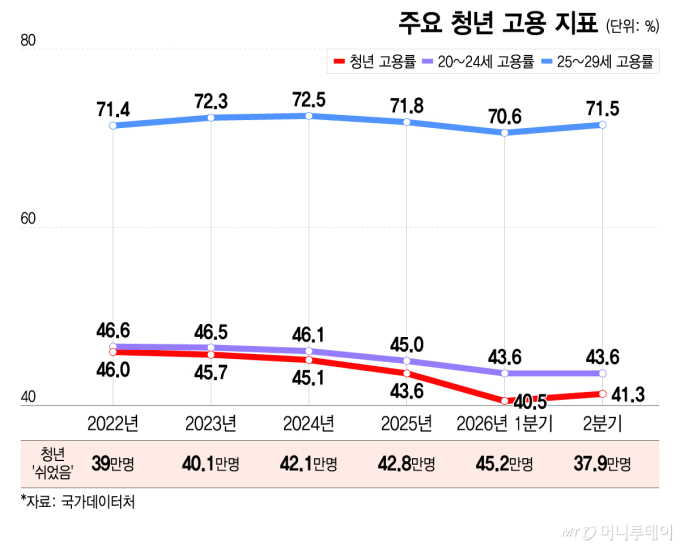
The threshold for employment is rising steadily. The time it takes to secure a first job has increased from 9.5 months in 2010 to 11.2 months this year. As finding employment becomes more difficult, graduates are delaying their graduation. The period required to complete a university degree rose from 48 months to 53.7 months over the same period. In its "Plan for Recovering Youth Employment" released in August, the Ministry of Economy and Finance described the recent situation as a vicious cycle in which young people cannot find jobs because they lack experience, and they cannot gain experience because they cannot find jobs.
Corporate hiring practices also work to the disadvantage of young people. According to the "Results of the 2026 Survey on New Hires" by the Federation of Korean Industries, only 10.2% of companies responded that they conduct regular open recruitment exclusively. The most important evaluation factor in new hiring was cited as "job-related work experience" (67.6%).
The Bank of Korea analyzed this phenomenon in its report, "Increase in Experienced Hires and Youth Employment," released last February, stating that it is a trend arising from the weakening of the concept of lifetime employment on the part of workers and the advancement of required capabilities on the part of companies. The report explained that as the cost burden of educating and training inexperienced candidates has grown, companies have come to prefer hiring experienced workers.
The employment crisis is not merely a matter of difficulty in securing income; it also undermines the very life trajectory of finding a job, accumulating earnings, and eventually purchasing a home and building assets. According to the "Housing Status Survey" conducted by the Ministry of Land, Infrastructure and Transport, 31.6% of young households had rent-to-income ratios exceeding 30% as of 2023. This figure is more than double the average across all age groups (15.8%).
Even when receiving a salary, if a significant portion is spent on rent, it becomes difficult to accumulate assets. As housing prices rise and the starting line varies depending on whether parents provide asset support, it is inevitable that perceptions grow that working diligently alone cannot close the gap. With the ladder from employment and income to housing and asset formation becoming unstable, young people’s frustration turns into anger.
◇Compromise: Coins... The Dangerous "Private Compromise"
Young people who find it difficult to close the gap have turned their eyes to virtual asset investments, aiming for a "one-shot" windfall. According to Dunamu, which operates Upbit, as of December last year, there were 5.48 million accounts in the 20s and 30s age group that had used Upbit. This figure accounts for 44% when compared with the resident population in that age bracket.
Given that the cumulative number of registered accounts has reached 13.26 million, the participation rate among young people is notable. They are placing their hopes in new opportunities to grow their assets, even if it means taking on high risks. However, the likelihood of successfully building wealth through virtual asset investments, which are characterized by high price volatility, is limited. While this may be a private compromise aimed at closing the gap with reality, it could instead lead to increased frustration.
◇Depression and Acceptance: Young People Erased from the Labor Market... The Era of Cynical Acceptance
The anger born from failed compromise turns into collective depression and cynical acceptance. The number of young people aged 15 to 29 who are "not working" stood at 364,000 as of last September. While this is a decrease compared with the 452,000 recorded in the first quarter of this year, it remains at a high level. The "not working" population refers to individuals who are not employed for no particular reason and are taking time off. Some people respond by voluntarily choosing not to have children, a form that can be described as a "birth strike."
Kim Yun-tae, a professor of sociology at Korea University, stated, "Social movements can only be carried out when there is optimistic expectation, but young people in South Korea do not even have the capacity for that." He added, "The abandonment of romance, marriage, and childbirth, along with the surge in depression, are not personal choices but structural social issues."

 in ECONOMY


