

"In the end, only loan regulations stepped in as firefighters, becoming a 'bullet sponge' for all citizens" (Financial sector official)
The Lee Jae-myung administration is expected to unveil its first comprehensive real estate "comprehensive measures" as early as this week. Shortly after taking office, the government introduced strong loan policies through the the 17th measures, but since then, there have been no significant plans for supply or tax reform. While suppressing the real estate market for over a year with only extremely strict loan regulations, frustration among actual homebuyers has exploded. To control housing prices through real estate policy, tighter loan restrictions are needed; however, this time, expectations for easing loan regulations are growing instead.
According to financial sector sources on the 10th, since the Lee Jae-myung administration took office last year, a series of real estate measures have been announced, including the the 27th measures, the 7th measures, the 15th measures, the 19th measures this year, and the 9th measures. However, apart from loan regulations, there were virtually no effective countermeasures. The the 27th measures initially capped mortgage loans at 600 million won, and this year added restrictions limiting total household loan growth to within 1.5% compared to the previous year. It is no exaggeration to say that loan regulations have been the "main character" of real estate policy since the government took office.
While borrowing time for several months with "firefighter" loan regulations, supply measures that should have been introduced earlier ended up as "no-measures." Although large-scale housing supply was promised in Seoul Yongsan (13,500 households) and Taereung (6,800 households), Gyeonggi-do Gwacheon (9,800 households), and other areas, no progress has been made due to conflicts with local governments.
Real estate tax policy implemented a surcharge on capital gains in May, but early this month, the tax reform plan shifted direction toward partial deferral, resulting in "flip-flopping." Moreover, the government drew a line by stating, "Tax policy is about tax equity, not real estate measures." Consequently, market sentiment is overwhelmingly negative, with critics saying, "The policy's direction and clarity of goals have both been lost."
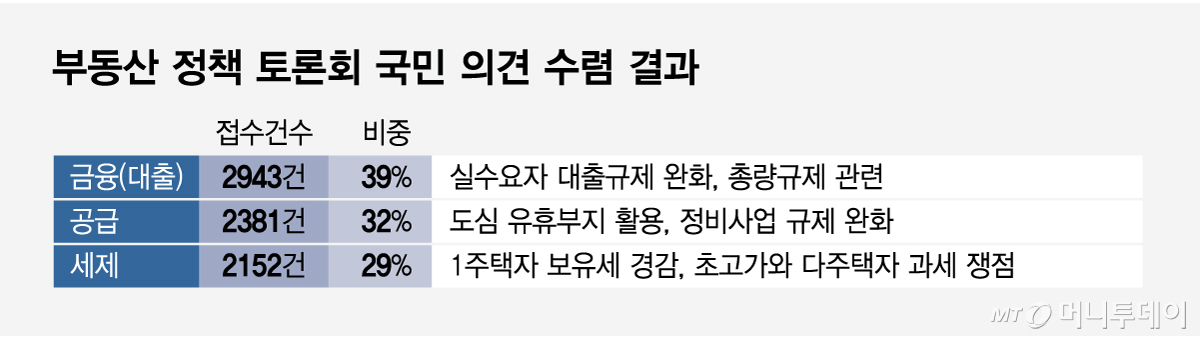
With extremely strict loan regulations continuing for over a year without supply support, the patience of actual homebuyers has reached its limit. At last month's 13th national real estate forum attended by President Lee Jae-myung, survey results showed that among financial, supply, and tax policies, opinions on finance accounted for the largest share at 39% (2,943 cases). These views called for easing loan restrictions such as down payment loans and total loan caps. A banking sector official stated, "Supply should come first, followed by finance, but finance has been prioritized without supply, creating an imbalance." He added, "While tightening loans is necessary to control housing prices, the upcoming measures are expected to focus more on easing loan regulations."
The Financial Services Commission, the ministry responsible for loan policy, now faces a situation requiring solutions to far more complex equations. It must maintain the 600th million won limit on mortgage loans while relaxing limits on down payment and relocation loans, keep the annual 1.5% total loan cap, yet lower barriers for actual homebuyers such as young people and newlywed couples. Although the government has pledged to provide "pinch-point support" for actual homebuyers without changing its stance on extremely strict loan regulations, concerns are rising that the "steps" of loan policy are becoming tangled.
Concerns also arise that as loan regulations become stricter, it will become increasingly difficult for non-homeowners and ordinary citizens to buy homes without loans. A senior financial sector official stated, "Even if immediate supply is not possible, a strong signal must be given that stable supply is achievable." He further pointed out, "Instead of focusing solely on supply volumes, the government should also consider the desires of citizens who want to live in better homes and collaborate with Seoul Metropolitan Government to advance redevelopment and reconstruction projects."

 in FINANCE
