

Mutual financial institutions' personal credit loans are failing to include medium- and low-credit borrowers. Not only is the number of unions and credit unions offering credit loans small, but those that do offer them focus heavily on high-credit borrowers. With individual credit unions and unions bearing the burden of managing delinquency rates, new household loan handling is also restricted, making it difficult to increase credit loans.
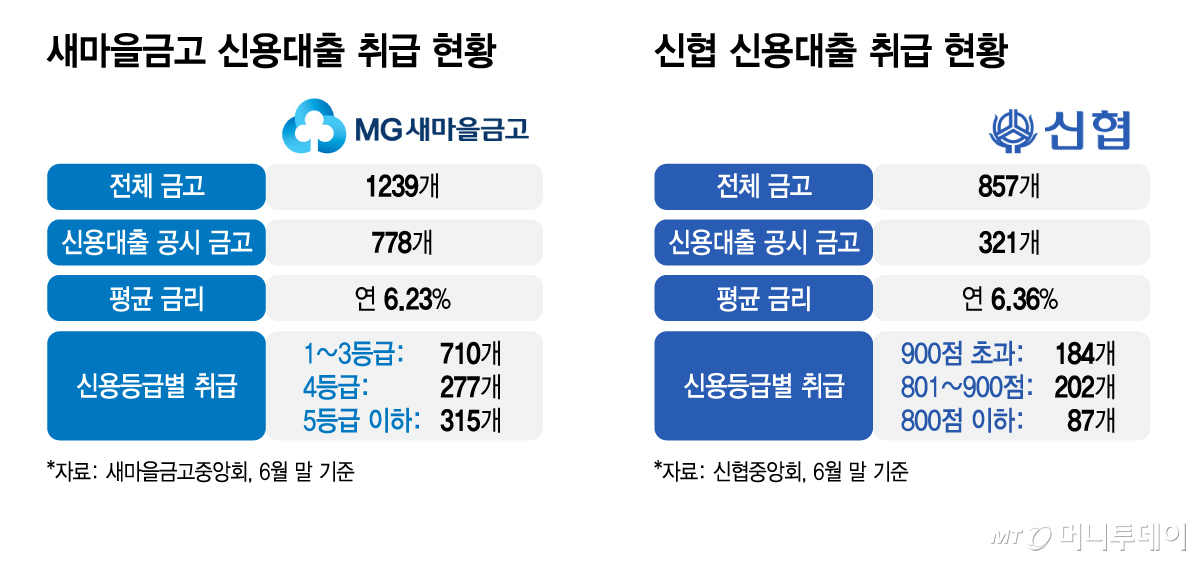
A comprehensive survey and comparison of interest rate disclosures for credit loans at Saemaeul Credit Unions nationwide on the 10th revealed that as of the first half of this year, only 778 out of 1,239 credit unions offered credit loans. The remaining 461 credit unions disclosed a 0% interest rate for credit loans, indicating they have no loan disbursement activity at all.
The simple average interest rate for the 778th individual credit unions offering credit loans is 6.23% annually. Saemaeul Credit Unions divide borrowers' credit into 10 grades from 1 to 10; 710 credit unions handle loans for borrowers in grades 1 to 3. Only 277 credit unions offer loans to grade-4 borrowers, 184 to grade-5 borrowers, and 105 to grade-6 borrowers. Just 26 credit unions serve borrowers below grade 7. There was a clear difference in average interest rates between grades. The average credit loan interest rate for borrowers in grades 1 to 3 is 5.98% annually, while it rises to 8.57% annually for those in grades 8 to 10.
The situation is similar for credit cooperatives. As of the first half of this year, only 321 out of 857 nationwide credit cooperatives disclosed credit loan interest rates. More than half of the cooperatives do not offer credit loans at all. The simple average interest rate was 6.36% annually, similar to that of Saemaeul Credit Unions.
Credit cooperative credit loans are based on NICE Evaluation & Information's credit scores. Only 184 cooperatives offer loans to borrowers with scores above 900, and 202 cooperatives serve those in the 801st–900 range. In contrast, only 83 cooperatives handle loans for borrowers scoring between 701 and 800, and just four cooperatives serve those scoring 700 or below; low-credit borrower segments are virtually nonexistent.
The average interest rates for credit loans at Saemaeul Credit Unions and credit cooperatives are slightly higher than those of major banks but about 8 percentage points lower than those of deposit-taking financial institutions. They fail to serve as a pricing ladder between major banks and deposit-taking financial institutions.
Each regional union and credit union within the mutual financial system operates as an independent management entity. Losses due to delinquency are borne by individual unions and credit unions. This is why they are reluctant to handle credit loans. With new household loan handling restricted this year, this trend can only intensify. Saemaeul Credit Unions and credit cooperatives cannot increase their outstanding household loan balances this year. They must reissue loans within the limits of repaid household loans; under such circumstances, they have no choice but to prioritize high-credit borrowers with low delinquency risks or secured loans.
To address these issues, financial authorities plan to establish a system in which individual unions and central associations share the risks associated with implementing inclusive finance. A mutual financial institution official stated, "We agree that managing credit loans has been difficult due to factors such as delinquency rate control," but added, "Currently, there is a tendency to refrain entirely from offering credit loans due to total household loan volume management."

 in FINANCE
