

With the mandatory disclosure of commissions by large General Agents (GAs) taking effect, Habit Factory's strategy of employing full-time insurance designers is once again drawing attention. Habit Factory has been the only company in the industry to operate with a fully full-time designer workforce, and recently it has further highlighted its strengths by promoting the concept of a 'uniform fee system.'
According to financial sources on the 17th, Signal Financial Lab, the GA subsidiary of insurance-focused fintech Habit Factory, has been running a 'Uniform Fee System Campaign' since last month. The initiative aims to actively inform consumers that its insurance designers receive the same commission regardless of which product they sell.
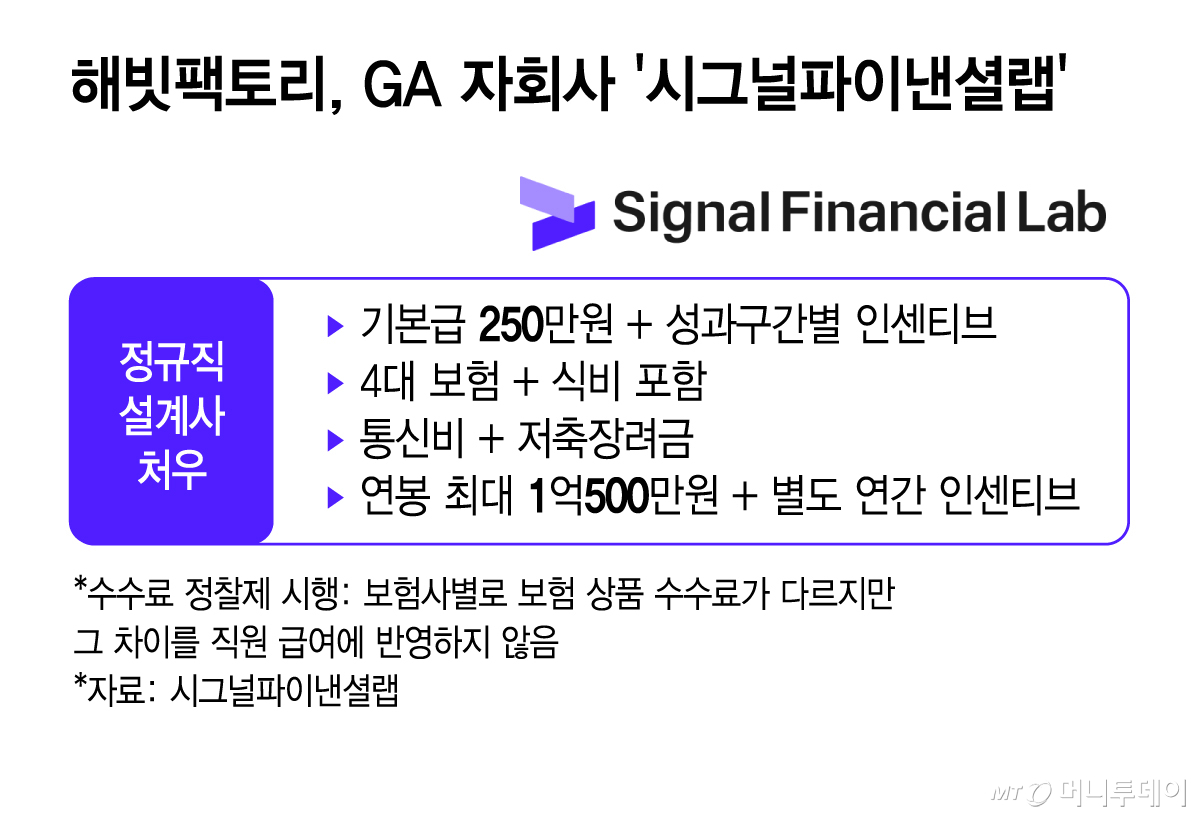
Signal Financial Lab is the only player in the GA industry with a full-time designer model. Its affiliated designers receive a base salary and performance-based incentives. No matter which insurance product a designer sells, differences in commissions do not translate into differences in compensation. Signal Financial Lab also emphasizes on its official recruitment page that while commissions paid by each insurance company vary, the company absorbs these differences rather than reflecting them in employee salaries.
Habit Factory has long emphasized its 'full-time designer' model, but this is the first time it has used the term 'uniform fee system.' Although the two expressions are essentially synonymous, the move is seen as a strategy to approach customers with more relatable language. In particular, with the recent implementation of mandatory commission disclosure by large GAs, Habit Factory's strategy is poised to shine even brighter.
Since last July, large GAs with 500 or more designers have been required to provide customers with additional explanations regarding the commission tier and ranking of insurance products, as well as the reasons for their recommendations. Tiers are classified into five levels based on a comparison with the average of similar product groups, while rankings list products with lower commissions among comparable options first. Since consumers can now see the commission level of the product recommended by the designer, they can also question 'why this particular product is being recommended.'
The fact that consumers become aware of the existence of sales commissions, which they previously did not know about, helps mitigate information asymmetry. However, even if consumers are aware of commission levels, designers still have an incentive to recommend insurance products that offer higher compensation. Habit Factory's concern is that it is difficult to completely eliminate conflicts of interest in insurance product recommendations.
As consumers begin to recognize differences in commissions, Signal Financial Lab's strength—that designer compensation is not determined by the type of product sold—becomes easier for customers to understand. Ultimately, the company wants to emphasize more strongly to customers that it has structurally reduced conflicts of interest in insurance sales through its uniform fee system.
The full-time employment system also holds significance in that it guarantees stable salaries for affiliated designers. The annual salary cap for Signal Financial Lab's designers slightly exceeds 1 billion won. There are cases where designers resign, seeking higher compensation. Nevertheless, many designers express satisfaction with receiving a stable salary every month.
A representative from Habit Factory stated, "The uniform fee system campaign was launched to create an environment where we can focus on finding the most suitable product for customers." The representative added, "While premiums and coverage details inevitably differ from product to product, at least the compensation of the person making the recommendation should not influence the customer's product choice."

 in FINANCE
