

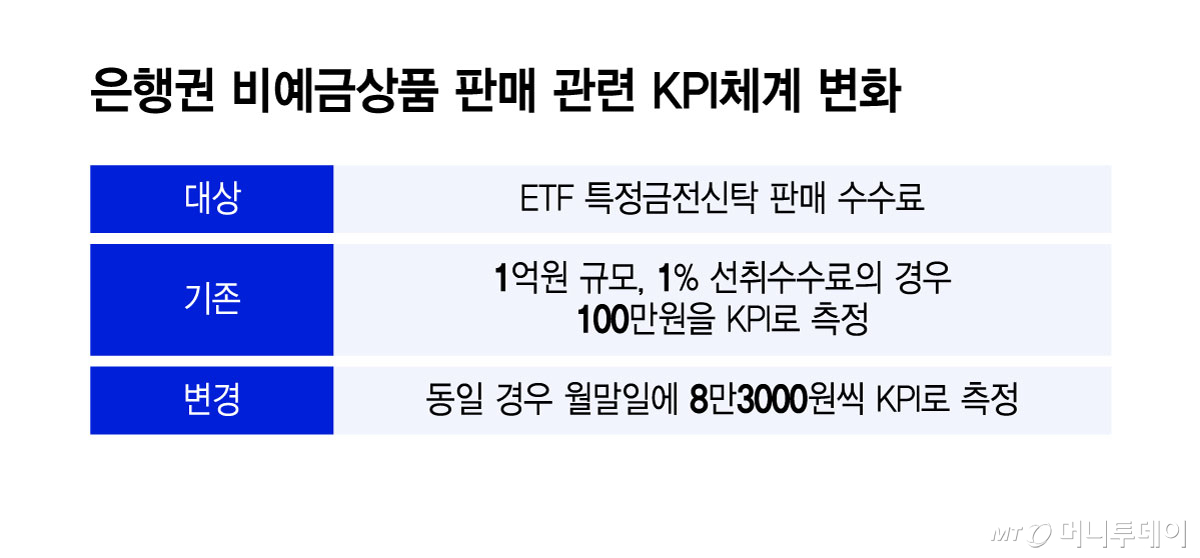
Approximately 90% of exchange-traded fund (ETF) trusts sold through banks were sold using an upfront fee structure, which is disadvantageous for short-term trading. Banks have revised the key performance indicator (KPI) evaluation system, which has been cited as a key factor encouraging customers to choose the upfront fee option. The core of the revision is that upfront fees will no longer be recognized in sales performance all at once, but will instead be deferred and recognized over the contract period.
According to financial industry sources on the 21st, major commercial banks including KB Kookmin Bank, Shinhan Bank, Hana Bank, and Woori Bank revised their second-half KPI system regarding trust product sales in August.
The most critical change is that even when upfront fees are collected, they will not be recognized as a one-time performance credit for bank branch sales staff. In other words, the evaluation method now takes the holding period into account, regardless of the fee collection structure. These banks have decided to retroactively apply the new evaluation criteria to transactions sold in July, prior to the revision.
NH NongHyup Bank has completely excluded ETF upfront fees from KPI evaluations starting this month. The bank plans to apply a similar approach as other banks starting next year, recognizing fee performance in installments based on the holding period.
For example, if a customer enters into a trust contract worth 1 million won and pays a 1% upfront fee, the full 0.1 billion won was previously reflected entirely in the branch employee's sales performance. However, going forward, it will be recognized in installments based on the holding period. Assuming the customer holds the product for one year, only one-twelfth of the fee, or 83,000 won, would be reflected in the KPI at month-end. Alternatively, a daily proration method may be applied. For instance, if the same contract is signed on January 1 and held until June 30, only 490,000 won (one-365th of the fee) would be recognized as performance for that period. Some banks will not reflect sales in their KPIs if the customer's product enrollment date does not fall within the evaluation period, even if the customer continues to hold the product.
Previously, following revisions to internal control guidelines for non-deposit products, KPI recognition for sales performance of non-deposit products with maturity dates—such as equity-linked securities (ELS), equity-linked funds (ELF), and other funds—has been split across evaluation periods until maturity. At that time, ETF trusts were excluded from the scope because they are products without a maturity date. However, this overhaul introduces a similar evaluation method for ETF trust sales.
This measure follows findings from a review by the Financial Supervisory Service of banks' ETF trust sales status, which indicated that most customers were induced to choose the upfront fee payment method. According to the Financial Supervisory Service, among ETF trust transactions sold from January 2025 to May 2026, the upfront fee method accounted for 89.7%.
The issue is that despite the fact that deducting upfront fees is disadvantageous to customers with short holding periods, the majority of contracts were made using the upfront fee structure. Among transactions terminated within six months, 91.7% used the upfront fee method, and even among those terminated within 10 days, 98% were upfront fee contracts. In response, the Financial Supervisory Service has launched on-site inspections targeting banks with high sales volumes. Financial Supervisory Service Chairman Lee Chan-jin stated during a National Assembly audit on the 19th, "We view this as a typical case of incomplete sales."
One of the reasons cited for the banking sector's aggressive promotion of upfront fee products is the KPI system. Analysts point out that an evaluation system in which a fee equivalent to 1% of the sales amount is immediately recognized as performance when a customer chooses the upfront method induced customers to enroll in upfront fee products, regardless of their investment type or target rate of return. A financial industry official said, "To align the interests of banks and customers and encourage long-term investment, it is desirable to move toward a trailing fee structure where fees are paid based on the holding period."

 in FINANCE
