

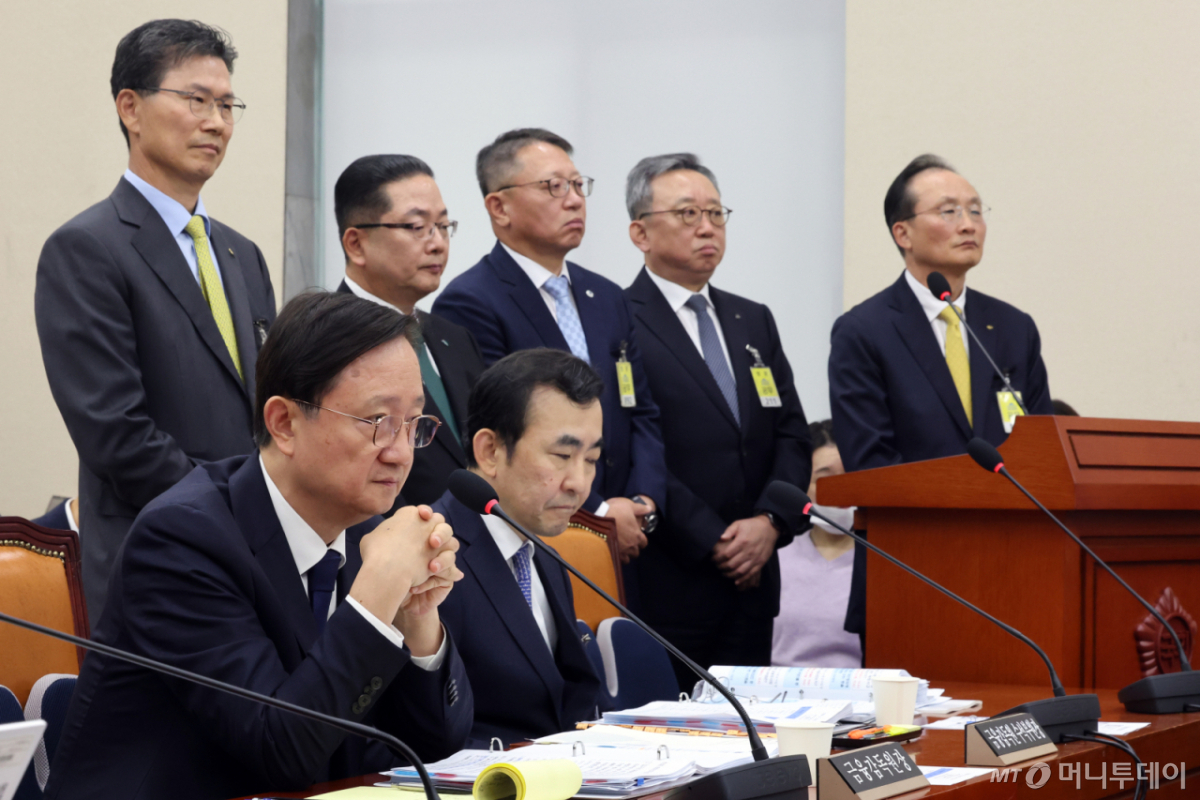
The heads of the five major banks, who appeared as witnesses at the National Audit, bowed their heads to apologize for recent hacking incidents. Alongside measures to prevent recurrence, such as building an AI (artificial intelligence)-based hacking defense system, they promised compensation for customers who suffered data leakage. Financial Supervisory Service Commissioner Lee Chan-jin stated for the first time that he would hold banking industry CEOs accountable for negligence in internal control management regarding this hacking incident, raising the possibility of severe disciplinary action.
On the 19th, during the National Assembly Political Affairs Committee's audit of the Financial Supervisory Service, Commissioner Lee responded to questions about the financial sector's responsibility for recent hacking incidents by stating, "This will likely be a case where the issue of CEO accountability is addressed for the first time regarding cyber security hacking incidents for which there is an obligation to manage internal controls."
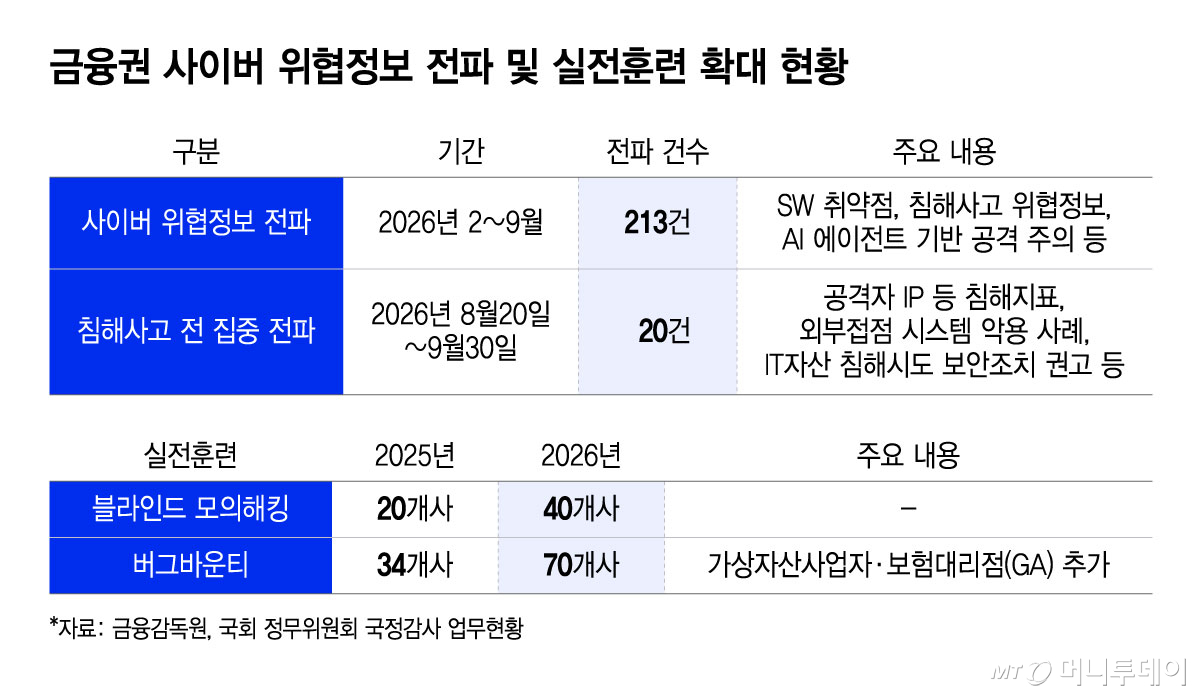
Due to a hacking incident suspected to have been carried out by AI agents, approximately 100,000 pieces of personal information were leaked from 16 financial institutions. Among banks, large-scale leaks of names, contact information, resident registration numbers, email addresses, and income information occurred at KB Kookmin Bank, Shinhan Bank, Hana Bank, and BNK Busan Bank. In the second-tier financial sector, 50,000 records were massively hacked at Yegaram Savings Bank, a subsidiary of Taekwang Group.
According to the Financial Companies Governance Act, the CEO is the person with overall responsibility for internal controls. If they failed to allocate appropriate personnel, budget, and systems, or neglected management and supervision despite recognizing IT and security risks, the possibility of severe disciplinary action cannot be ruled out under "negligence in internal control management obligations." This is the background behind Commissioner Lee's preview that this hacking incident would be the first case of holding banking industry CEOs accountable. In the second-tier financial sector, the CEO of Lotte Card has previously received a severe disciplinary warning of censure.
At the National Audit, Lee Hwan-ju, head of KB Kookmin Bank; Jeong Sang-hyeok, head of Shinhan Bank; Jeong Ho-seong, head of Hana Bank; Jeong Jin-wan, head of Hana Bank; and Kang Tae-young, head of NH NongHyup Bank, attended as witnesses from the five major commercial banks and bowed their heads to apologize regarding the hacking incident. This is the first time in four years since the 2022 National Audit, when financial accidents such as embezzlement and internal controls were issues, that the heads of the five major banks have been selected as audit witnesses.
Lee Hwan-ju, head of Kookmin Bank, stated, "I sincerely apologize for this incident occurring in a financial institution where trust is fundamental," adding, "To prevent recurrence, we will secure sufficient budget and personnel, and make every effort to ensure that the security system can be operated by AI under the premise that AI is conducting the hacking." Jeong Sang-hyeok, head of Shinhan Bank, which had the largest scale of leakage, also bowed his head, saying, "I feel deeply sorry."
Lee Ho-seong, head of Hana Bank, specifically emphasized, "If damage occurs, we will definitely compensate for the entire amount," adding, "We are first proceeding with fee waivers, and once customer consent procedures are completed, we will enroll in financial peace-of-mind insurance to prevent damage." Jeong Jin-hwan, head of Woori Bank, stated, "Woori Bank did not suffer hacking damage, but I think we were lucky this time," adding, "With 200 hacking attempts coming in per day, we will make every effort to ensure no damage occurs." Kang Tae-young, head of NongHyup Bank, also emphasized, "We introduced a next-generation integrated monitoring system in 2022, and we will enhance it to ensure thorough security."
At the National Audit, criticism was raised that some commercial banks had reduced preferential interest rate (adjustment rate) benefits more than add-on interest rates to maintain profitability. Amid criticism that this increased interest burdens on low-income earners, the atmosphere at the audit became tense, with Political Affairs Committee Chairman Yoo Dong-soo shouting after major bank heads evaded answering improvement demands.
Min Byung-deok, a lawmaker from the Democratic Party of Korea, pointed out, "Although the amendment to the Banking Act regarding the exclusion of statutory costs from add-on interest rates has been completed, loan interest rates continue to rise." He stated, "In the case of Kookmin Bank, the add-on interest rate decreased from 3.42% to 3.34%. The preferential interest rate decreased more significantly from 1.96% to 1.65%. NongHyup Bank also reduced its add-on interest rate from 3.6% to 3.34%, and significantly cut the preferential interest rate from 2.19% to 1.58%," questioning, "Did they deceive by lowering preferential interest rates despite knowing the intent of the Banking Act amendment?"
The closure of bank branches also came under scrutiny. Bank heads emphasized that the pace of branch closures slowed around 2023. Jeong Sang-hyeok stated, "Branch closures were significantly reduced until 2021, but afterwards, due to issues of social responsibility and public interest, we have temporarily paused," adding, "We will thoroughly consider and review the concerns raised," while bowing his head.
Opposition party lawmakers held Financial Supervisory Service Commissioner Lee Chan-jin and responsible executives accountable regarding single-stock leveraged ETFs (Exchange-Traded Funds). Kim Jae-seop, a lawmaker from the People Power Party, asked Commissioner Lee, who was a member of the National Pension Fund Investment Committee, "Is it common for the National Pension to postpone rebalancing just before an ETF launch?" while probing the causal relationship between the National Pension's measure to raise its stock target ratio and the launch of single-stock leveraged ETFs. A colleague from the same party, Park Seong-hun (Rep.), pointed out that Commissioner Lee's son is employed at Mirae Asset Asset Management, asking, "Did you grant yourself special privileges?"
Commissioner Lee clarified regarding the so-called self-benefit allegations, stating, "I am not a private interested party and have no job-related connection," while apologizing for the single-stock leveraged ETF controversy by saying, "I am very sorry." In response to a question from Shin Dong-wook, a lawmaker from the People Power Party, asking whether he needed to resign to take responsibility for the situation, he carefully stated, "It is a matter for the personnel authority to decide."

 in FINANCE

