

A controversy has erupted as banks, which have been reducing loan supply under the financial authorities' household loan volume regulation, faced criticism during the National Audit for shrinking preferential interest rates and thereby increasing borrowers' interest burdens. The banking industry counters that changes in the share of different loan products may have affected the decline in the overall average preferential rate.
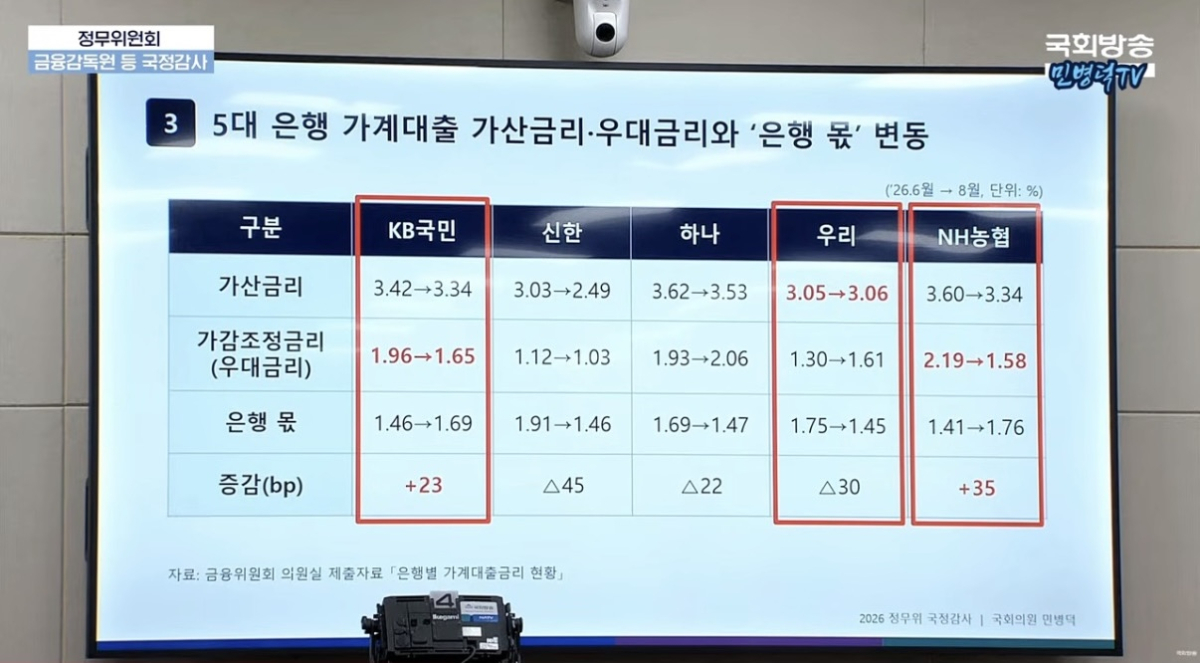
According to the financial sector on the 21st, Democratic Party of Korea lawmaker Min Byung-deok pointed out during the National Audit of the National Assembly Political Affairs Committee on the 19th that banks offset the effect of lowering loan rates by shrinking preferential interest rates instead of reducing add-on interest rates.
The revised Banking Act, which took effect on July 1, prohibits reflecting reserve requirements and deposit insurance premiums in loan interest rates, and stipulates that contributions to guarantee funds may not be reflected in full or in part depending on the type of loan. It also bars reflecting the increased education tax rate in loan interest rates.
According to materials presented by Min (Rep.), KB Kookmin Bank's add-on interest rate fell 0.08 percentage points (P) from 3.42% in June to 3.34% in August. However, it was pointed out that the effect of the add-on rate cut was offset as the preferential rate shrank by 0.31 P, from 1.96% to 1.65%, over the same period.
In the case of NH NongHyup Bank, the add-on interest rate dropped 0.26 P from 3.60% to 3.34%, but the preferential rate shrank by 0.61 P, from 2.19% to 1.58%. Min (Rep.) pointed out that as a result, the share of interest rates retained by the bank actually increased by 0.35 P.
However, voices are emerging in the banking sector cautioning against interpreting such figures as the actual scale of preferential rate reductions. This is because changes in the handling share of different loan products may have affected the overall average. While Min Byeong-deok (Rep.)'s office has not disclosed the specific calculation criteria for the relevant materials ("Status of Household Loan Interest Rates by Bank") submitted by the Financial Services Commission, the banking sector views them as statistics aggregating various household loan products such as mortgages and credit loans.
Generally, mortgages tend to have a wider range of preferential rate application compared to other household loan products. In the case of NH NongHyup Bank, household loan balances exceeded the target by approximately 500 billion won as of the end of June. To comply with volume regulations, the bank significantly reduced the handling of household loans, including mortgages, during July and August. As a result, it managed to keep the increase in household loans within the target range at the end of July and August.
The banking sector raises the possibility that during this process, the share of new mortgage lending—which has a wide preferential rate application—decreased, thereby lowering the overall average preferential rate. It is reported that NH NongHyup Bank maintains that it did not artificially shrink the preferential rate range for loan products during the relevant period.
For example, even if the preferential rate for mortgages remains at 2.5% and for other household loans at 0.5%, if the share of mortgage handling drops from 80% to 50%, the overall average preferential rate falls by 0.6 P, from 2.1% to 1.5%. This means that even without changes in the preferential rate conditions for individual products, a shift in loan composition can make it appear as though the average discount has shrunk.
In addition, banks that adjusted preferential rates on some loan products also state that this is not unrelated to volume management aimed at suppressing household loan demand. In fact, within the banking sector, raising interest rates is frequently used as a means to adjust new demand in situations where household loan supply must be restricted.
A financial industry official said, "They couldn't have told lawmakers from the ruling party that they had no choice but to reduce preferential rates to meet the government's volume regulations," adding, "Adjusting interest rates is partly for profitability, but demand management plays a huge role; however, the reality is that they cannot say such things."
This creates a conflict between policy demands to suppress the growth of household loans and demands to lower loan interest rates. It has been consistently pointed out that due to the authorities' volume regulations, banks have been so preoccupied with suppressing household loan demand that "price competition" (interest rate cut competition) for attracting customers among banks has disappeared.
On the same day during the National Audit, People Power Party lawmaker Cho Jung-hoon stated, "No matter how I look, the Financial Supervisory Service has no legal authority to regulate the total volume of household loans by banks. It is an overreach," adding, "The FSC answered that 'there is no legal basis and banks set targets voluntarily, so it is not a regulation.' Is this really voluntary?"
A commercial bank official stated, "While corporate lending faces competition to the point of negative margins, the core issue is that household lending is prevented from operating under an autonomous competitive system due to the authorities' volume regulations."

 in FINANCE
