

As the net interest margin (NIM), a key profitability indicator for Hana Financial Group and its major subsidiary Hana Bank, has slipped, the shrinking share of low-cost deposits is cited as the primary factor. Hana Financial stated that it anticipates a Q4 NIM rebound as the effects of proactive funding and improved loan yields from rising market rates begin to materialize. The impact of Central Group’s corporate workout is now being fully reflected in asset quality indicators. Amid deteriorating delinquency rates and substandard loan coverage ratios, Hana Financial has resolved to accelerate the sale of non-performing loans (NPLs) by year-end.
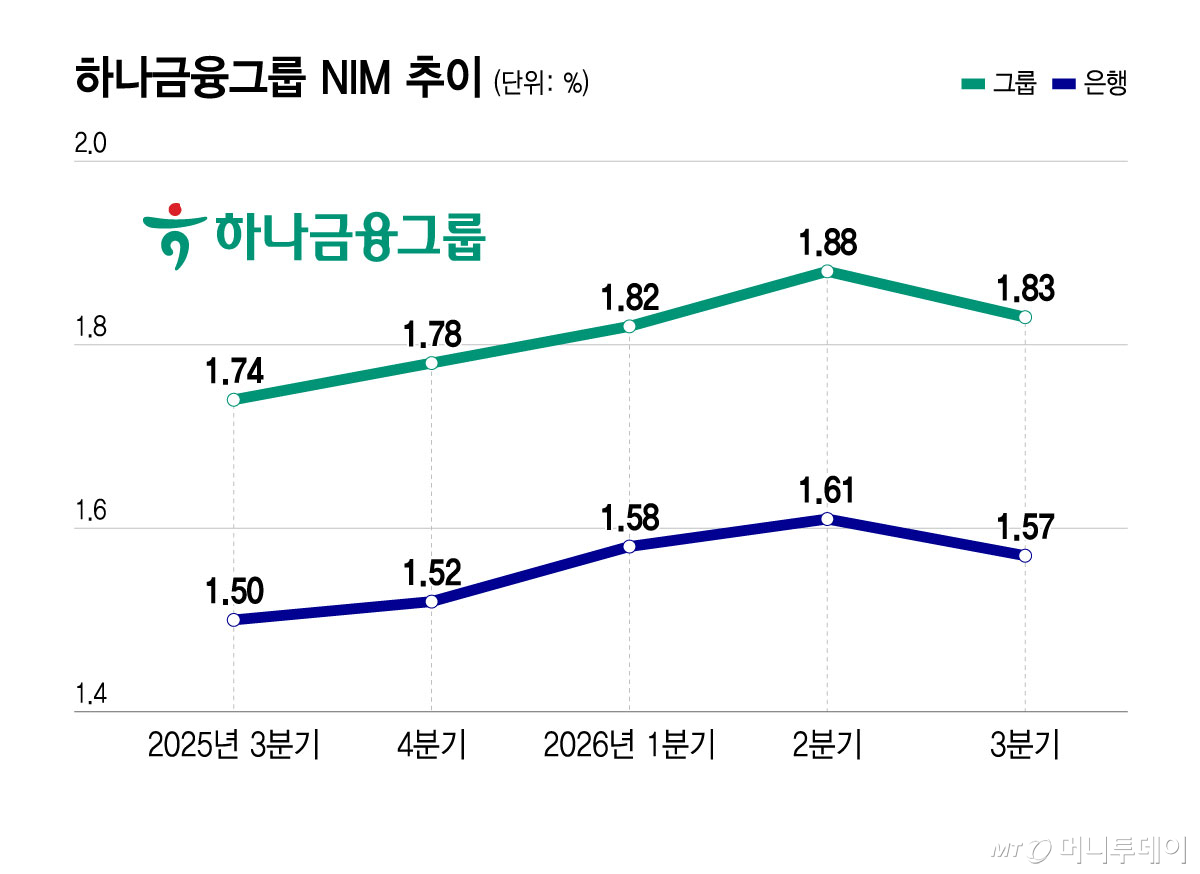
Park Jong-mu, Chief Financial Officer (CFO) of Hana Financial Group, stated during the Q3 earnings announcement conference call on the 23rd that “Hana Bank’s Q3 NIM fell 4BP (1BP=0.01%P) from the previous quarter to 1.57%.” He explained that the main cause was the rise in funding costs due to a decreased share of low-cost deposits, driven by corporate funds flowing into time deposits amid the seasonal decline in core public institutional investor deposits resulting from second-half fiscal execution and the impact of base rate hikes.
Hana Financial Group’s NIM at the end of Q3 fell 5BP to 1.83%, while Hana Bank’s NIM for the same period dropped 4BP to 1.57%. The primary background behind the NIM decline was the reduction in the share of low-cost deposits within funding sources. Core low-interest deposits, such as demand deposits, decreased by 4.4% from the previous quarter to 92.918 trillion won, while relatively higher-interest time deposits increased by 1.9%. In particular, 11.3 trillion won flowed into time deposits with maturities of six to 12 months.
Additionally, regulations that prevent banks from reflecting legal costs such as reserve requirements, deposit insurance premiums, and contributions to the Korea Microfinance Promotion Institute in loan interest rates also had an impact. Hana Bank explained that excluding these legal costs resulted in a 0.7BP negative impact on NIM during Q3 alone, with potential continued effects after Q4.
However, Hana Financial expects NIM to turn around and rise starting from Q4. The company explained that because it had secured funding in advance in preparation for rising market rates, the cost burden will be alleviated in Q4. Jung Young-seok, CFO of Hana Bank, said, “We proactively increased [funding], which pushed up the (funding) cost rate,” adding, “In Q4, the effect of rate increases on assets will fully appear, and the funding cost rate will improve significantly.”
Furthermore, the high proportion of CD-linked loans is a factor expected to contribute to Q4 NIM improvement. CFO Jung stated, “CD-rate linkage accounts for 60% of total won-denominated corporate loans and 30% of total won-denominated loans,” explaining that “the effect of improved operating yields from daily rollovers may become more apparent in Q4.”
The impact of Central Group’s corporate workout is now being fully reflected in asset quality indicators. The delinquency rate rose 11BP from the previous quarter to 0.7%, attributed to Central Group exposure loans being newly classified as delinquent assets starting from Q3.
The substandard loan coverage ratio improved by 3.8%P from the previous quarter but remained below 100% at 90.2%. The credit cost ratio rose by 0.01%P to 0.30%.
In response, Hana Financial has decided to take action on asset quality management through asset sales. Kang Jae-shin, Chief Risk Officer (CRO) of the holding company, stated, “Due to the contraction in the NPL asset sale market, our sufficient sale of substandard assets was lacking until Q3.” He added, “We expect substandard loans to increase within the projected range and aim to bring the coverage ratio up to a normal three-digit number higher than current levels in Q4.” However, he noted that while the credit cost ratio is expected to rise by an additional 5BP or so, it can be managed within the scope of the business plan.
While announcing the largest shareholder return scale in history, the company took a cautious stance on next year’s plans. Hana Financial’s cumulative share buyback and cancellation amount for the first three quarters totaled 949 billion won, marking an all-time high.
CFO Park Jong-mu said, “We are maintaining the value-up program while monitoring opinions from recent shareholders and other investors.” He noted that there are various views, such as the need to expand share buybacks more relative to cash dividends and that the formula for calculating cash dividends should be based on three-year average earnings. He added, “The focus should be on raising ROE while expanding the overall shareholder return pie,” stating that this is an area requiring consultation with management and the board of directors.

 in FINANCE

