

Although insurers' performance indicators improved this year, the business environment for next year remains bleak from the perspective of chief executive officers (CEOs). While net income for the period, contract service margin (CSM) and solvency ratio (K-ICS, KICS) have improved, there is a clear limitation in that these results are underpinned by temporary investment gains/losses and bond valuation gains. Concerns about the insurance industry are growing as the challenge of maintaining soundness becomes more stringent amid insufficient differentiation in products and sales channels.
According to the insurance industry on the 22nd, the Korea Insurance Research Institute held a breakfast seminar titled "Outlook and Challenges for the 2027 Insurance Industry" at the Conrad Seoul Yeouido hotel that morning, presenting key challenges for the insurance sector next year. The institute predicted that the growth rate of premiums received in the life insurance sector would drop sharply from 8.8% this year to 2.3% next year, and that the growth rate of gross written premiums in the non-life insurance sector would fall significantly from 7.2% this year to 4.5% next year.
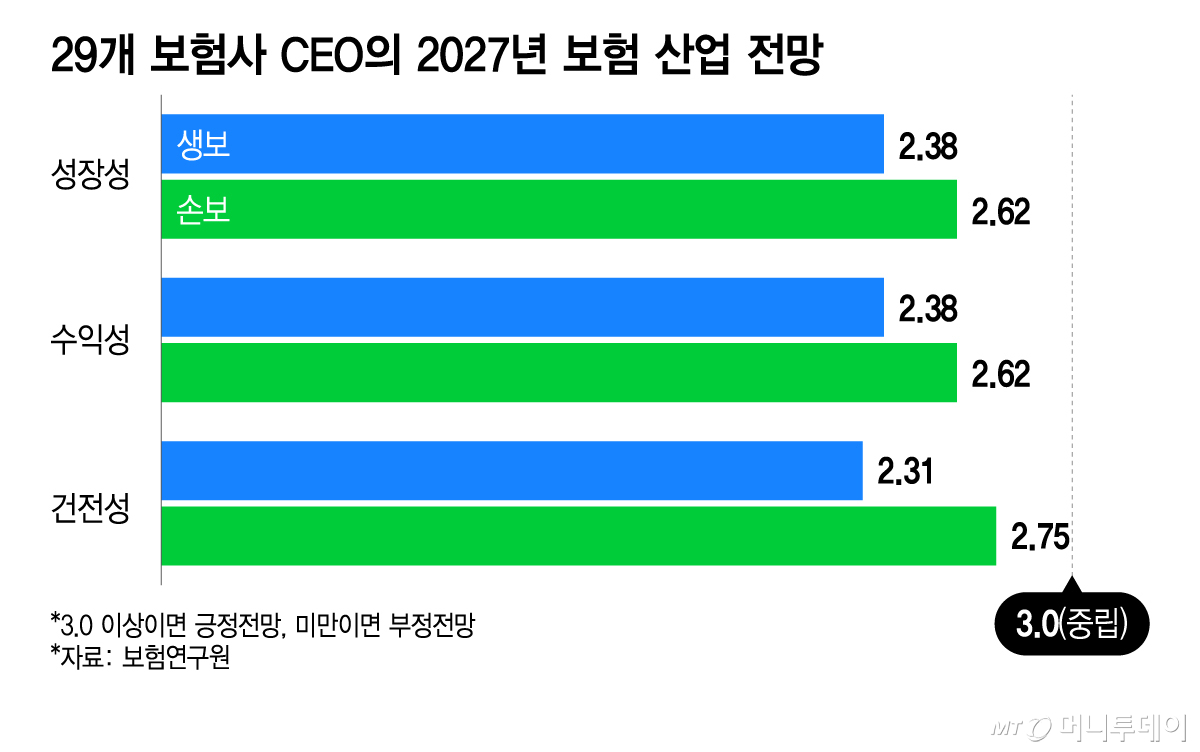
Insurer CEOs also viewed the outlook for the insurance industry next year negatively. Kim Dong-kyum, head of the Financial Market Analysis Division at the Korea Insurance Research Institute, stated, "A survey of 29 insurer CEOs regarding the outlook for the insurance industry next year revealed that all CEOs gave scores in the 2nd-point range, which is lower than neutral (3.0), across three indicators: growth, soundness and profitability."
Regarding this, Kim said, "The recent increase in insurers' net income is a result of relying on temporary improvements in investment gains/losses rather than strengthening competitiveness in core business," adding, "While bond valuation gains due to fluctuations in market interest rates contributed to the improvement in KICS among soundness indicators, this does not mean that insurers' capital strength, such as retained earnings, has been fundamentally strengthened."
In particular, he pointed out the lack of differentiation in insurers' products and sales channels as a structural problem. He noted that both life and non-life insurers are competing in similar product categories, such as health insurance, and that a structure relying on similar channels, such as corporate general agents (GA), has become entrenched during the sales process. He explained that while competition over business expenses, such as sales commissions, has intensified due to selling the same products through the same channels, it has become increasingly difficult for individual companies to secure their own unique competitiveness.
The burden of improving capital quality is also expected to grow next year. If reliance on valuation gains from actuarial assumptions and market volatility increases, capital productivity may decline. Furthermore, if this coincides with stricter regulations related to soundness, it becomes difficult to respond solely by increasing CSM or defending the solvency ratio.
In response, the Korea Insurance Research Institute emphasized the need to strengthen the profit base and reallocate resources to address declines in growth, profits and capital quality. For insurers, this means they must establish a structure that not only improves short-term performance indicators but also stably generates profits from core business and accumulates them as capital.
Gimhae-style Korea Insurance Research Institute Yeon Gu-jo-jeong (Head) stated, "There are limits to absorbing cost increases solely through premium hikes," adding, "It is a policy challenge to simultaneously redesign insurance payouts, sales and operating costs to reflect necessary expenses and prioritize improvements based on the causes of reducible costs."

 in FINANCE
