

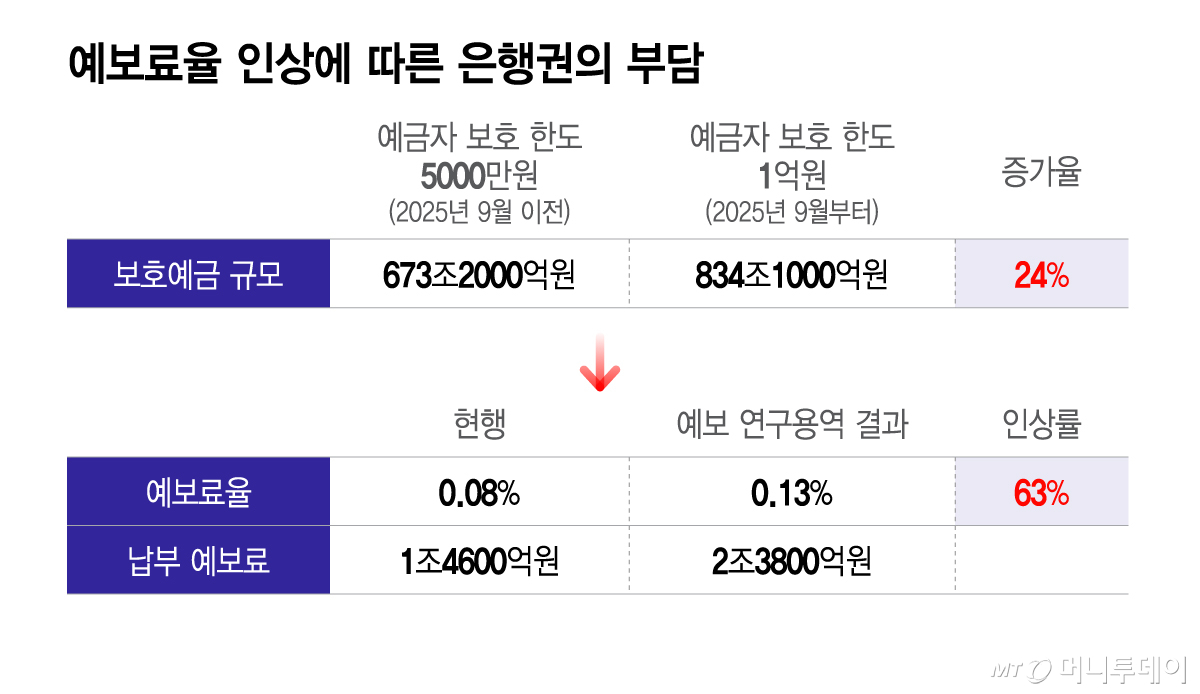
As the deposit insurance coverage limit is raised from 50 million won to 100 million won, deposits eligible for protection within the banking sector are expected to increase by approximately 24%. However, the proposed increase in the deposit insurance premium rate presented by the Korea Deposit Insurance Corporation (KDIC) reaches about 63%, leading to disagreement within the banking industry. The banking sector maintains that, considering the improvement in financial soundness, the current rate of 0.08% should be adjusted to around 0.1%, rather than the 0.13% proposed by the KDIC.
According to the banking sector on the 25th, when applying coverage limits of 50 million won and 100 million won respectively to insured deposits as of the end of 2025, protected deposits increase from 673.2 trillion won to 834.1 trillion won, a rise of approximately 24%. Protected deposits refer to the amount actually guaranteed within the coverage limits per depositor and financial institution, out of the total balance of insured deposits (insured deposits subject to deposit insurance). This is distinct from insured deposits, which include amounts exceeding the coverage limit.
On the other hand, according to a commissioned study conducted by the KDIC for the Korean Financial Association, the banking sector's deposit insurance premium rate would be 0.13%, representing an increase of 63% compared to the current rate (0.08%). Considering that the banking sector paid approximately 1.46 trillion won in deposit insurance premiums last year, it is estimated that the industry will bear an additional annual burden of about 920 billion won in premiums.
The banking sector criticizes the commissioned study for placing weight on past data, including reflecting non-performing loan data from banks during the foreign exchange crisis. They argue that sufficient consideration must be given to the changes in banks' asset soundness and risk management systems.
A bank official stated, "When the coverage limit is raised from 50 million won to 100 million won, the result presented was not based on data regarding changes in protected deposits, but rather suggested raising the rate based on past data." The official added, "Since this has not yet been finalized, we expect it will be adjusted to an appropriate level as opinions are continuously gathered."
In particular, the banking sector maintains that an explanation is needed on how much additional loss risk the increase in protected deposits translates into. This is because the KDIC's expected losses do not increase by the same amount as the scale of increased protected deposits. In fact, the non-performing loan (NPL) ratio, a key indicator reflecting the soundness of domestic banks, has improved over the long term, standing at 1.90% in 2010, 1.80% in 2015, 0.64% in 2020, and 0.57% in 2025.
There is precedent for proposed rate increases from past commissioned studies not being reflected in the actual rates. In 2022 as well, a study suggested raising the banking sector's deposit insurance premium rate to 0.16%, but ultimately, the rate was maintained at 0.08%. Moreover, the banking sector's capital adequacy has improved compared to 2022. The average common equity tier one (CET1) ratio of domestic banks rose from 12.61% at the end of 2022 to 13.51% at the end of 2025, while the total capital ratio increased from 15.29% to 15.83% over the same period.
As an alternative, the banking sector is advocating for adjusting the deposit insurance premium rate to around 0.1%. Even in this case, the rate would be 25% higher than the current level, which is similar to the magnitude of the increase in protected deposits. The KDIC has been holding monthly public-private task force (TF) meetings since last July. A meeting between the KDIC and major banks was also held last August. The banking sector plans to raise the need for adjustment at the TF scheduled for the 30th.
Meanwhile, the KDIC views that the overall burden may decrease as the special contribution fund (0.1% annually), which banks pay separately from deposit insurance premiums to repay public funds injected during the foreign exchange crisis, is set to end in 2027. Even if the deposit insurance premium rate rises to 0.13%, the combined burden rate would be approximately 28% lower than the current 0.18%, resulting in a calculated annual reduction of about 1.0475 trillion won.
On the other hand, the banking sector believes that the already scheduled termination of special contribution fund payments should not be used as a basis for raising deposit insurance premiums. This means that past special contributions and future deposit insurance premiums intended to prepare for financial institution failures serve different purposes.

 in FINANCE
