

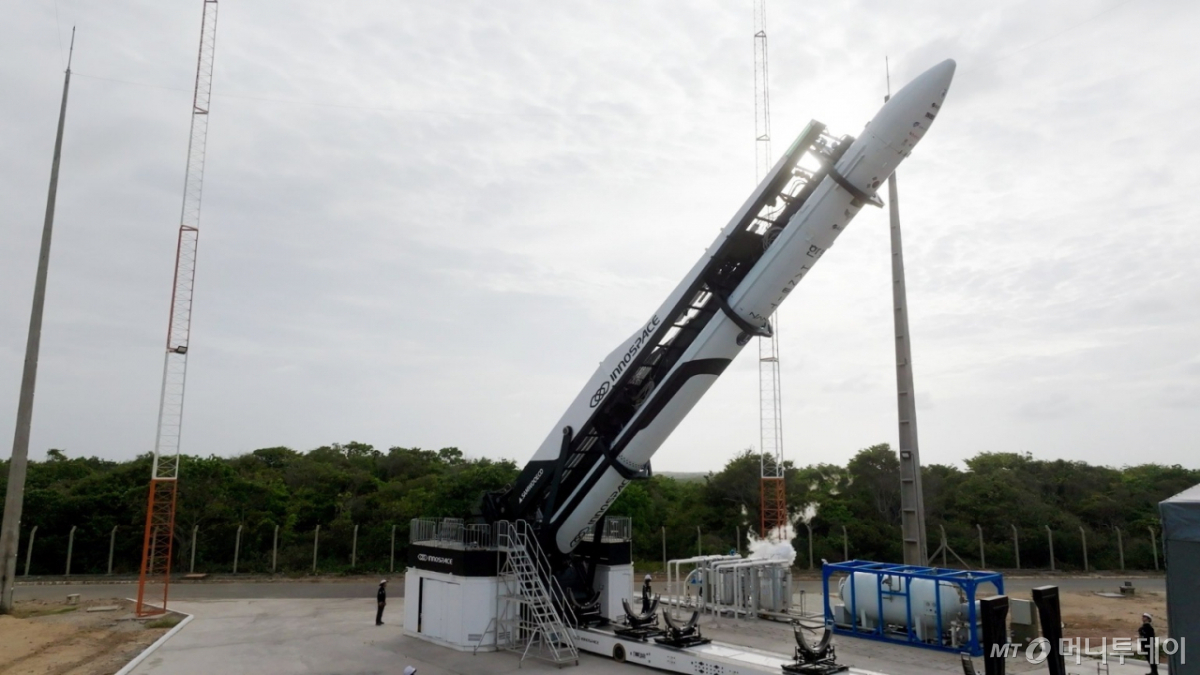
With the first establishment of an upper limit for liability insurance coverage amounts for domestic private space launch vehicles, changes are also expected in the space insurance market. This is because, moving beyond government-led Naro and KSLV-II missions, private companies such as InnoSpace are embarking on commercial launches, which could diversify insurance demand. Attention is turning to whether a new market will open for domestic property and casualty insurers that have underwritten related insurance since the 2009 launch of Naro.
According to the insurance industry on the 1st, Korea AeroSpace Administration recently published a notice draft setting the upper limit for liability insurance coverage amounts applicable when InnoSpace's commercial launch vehicle "Hanbit-Nano" is launched from Brazil at $18 million (approximately 23.8 billion won). This marks the first time an insurance amount standard has been established for private space launch vehicles since the implementation of relevant laws. Previously, a 200 billion won insurance amount was set for state-led launch vehicles such as Naro and KSLV-II.
Launch vehicle insurance is divided into insurance that covers risks arising from assembly until the vehicle is typically mounted on the launch pad, and third-party liability insurance that compensates for personal injury or property damage if the launch vehicle mistakenly falls onto a ship or land while in operation. Under current law, space launch vehicle operators must enroll in liability insurance to prepare for third-party damages caused by accidents.
Insurance amounts are determined by considering factors such as the characteristics and technical difficulty of the launch vehicle, conditions around the launch site, and the scale of expected damage. Although this upper limit is lower than the 200 billion won applied to state-led launch vehicles, the P&C insurance industry also views it as significant because specific insurance standards for private launch vehicles have been established. In Korea, the launch vehicle insurance market has developed primarily centered on Samsung Fire & Marine Insurance.
The history of domestic P&C insurers underwriting launch vehicle insurance dates back to the 2009 Naro launch. At that time, with Samsung Fire & Marine Insurance participating as a secretary, a total of 10 insurance companies underwrote launch vehicle insurance compensating for rocket assembly and transportation risks in collaboration with the Korea Aerospace Research Institute. Since then, Samsung Fire & Marine Insurance has underwritten a total of 12 launch-vehicle-related insurance policies and serves as the lead underwriter for most third-party liability insurance contracts for launch vehicles launched domestically. In particular, Samsung Fire & Marine Insurance also has experience in sole underwriting. DB Insurance has actively participated by underwriting nine policies, and other mid-sized P&C insurers have also jointly engaged in underwriting.
The emergence of private launch vehicle companies is a variable for market expansion. InnoSpace entered the commercial launch market with its self-developed Hanbit-Nano, attempted its first launch in December last year but failed, and is considering a relaunch. If commercial launches by private companies are added to existing demand formed according to government-led launch schedules, insurance enrollment demand may increase.
A P&C industry official said, "There is an expectation that the entire space insurance market will expand," adding, "As this is the first time a market led by private enterprises is opening, insurers plan to proceed in a way that allows the insurance to be operated stably based on the experience they have accumulated over the years."
However, it remains uncertain whether the immediate growth of the private launch vehicle market will lead to an actual expansion of underwriting by domestic insurers. This is because overseas insurers with long-accumulated experience are already securing a foothold in the market. It is also known that InnoSpace enrolled in liability insurance for its first commercial launch through an overseas insurer rather than a domestic one. The argument is that even if new insurance demand arises for private launch vehicles, domestic insurers must accumulate sufficient experience in related conditions such as risk assessment, premium calculation, and reinsurance acquisition before they can underwrite it.
A Samsung Fire & Marine Insurance official said, "We are the lead underwriter for most third-party liability insurance contracts for launch vehicles launched domestically," adding, "While we are not currently underwriting overseas launch contracts, we plan to consider market participation depending on conditions such as future expansion of the overseas market size."

 in FINANCE
