

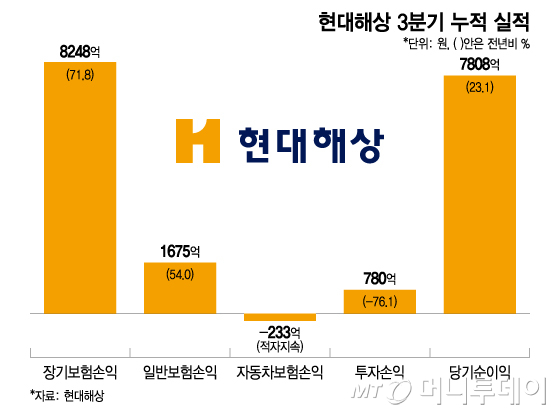
Hyundai Marine & Fire Insurance posted cumulative net profit of 780.8 billion won in the first nine months of this year, up 23.1 percent from the same period a year earlier.
Improved earnings from its long-term and general insurance businesses drove the growth. However, investment earnings plunged due to valuation losses on stocks, bonds and alternative investments.
According to the insurance industry Friday, Hyundai Insurance's cumulative net profit for the first three quarters of the year was 780.8 billion won on a standalone basis, up 23.1% from the same period last year.
The cumulative long-term insurance profit and loss for the first three quarters of this year was 824.8 billion won, an increase of 71.8% from the same period last year.
This was due to the significant improvement in long-term insurance profitability resulting from the continuous narrowing of the deficit in the difference between expected and actual insurance claims.
During the same period, general insurance profit and loss increased by 54.0% from the same period last year to 167.5 billion won. Despite the occurrence of high-value accidents, the overall loss ratio stabilized, contributing to improved insurance profitability.
In contrast, cumulative auto insurance profit and loss for the third quarter recorded a deficit of 23.3 billion won, continuing the deficit from the same period last year. Cumulative reductions in auto insurance premiums and rising compensation costs weighed on profitability.
Cumulative investment gains for the third quarter decreased by 76.1% from the same period last year to 78 billion won. Valuation losses arising from stock, bond, and alternative investment assets are cited as the main cause of the decline in investment gains.
Hyundai Marine plans to improve its return rate through managing an investment portfolio centered on high-quality assets such as corporate loans.
The Contractual Service Margin (CSM) balance was 10.1692 trillion won as of the end of the third quarter, a 14.2% increase from the end of last year.
The solvency ratio (K-ICS) rose by 20.2 percentage points to 210.3% as of the end of the third quarter compared to the end of last year. Factors such as the increase in CSM balance contributed to improved capital soundness.
The single-quarter performance for the third quarter showed a different trend from the cumulative results. Its net profit for the period for July through September was 165.7 billion won, down 9.6% from the same period last year.
Long-term insurance profit and loss for the third quarter increased by 16.2% from the same period last year to 211 billion won. General insurance profit and loss also rose by 85.5% to 65.3 billion won.
In contrast, auto insurance profit and loss recorded a deficit of 13.1 billion won, continuing the deficit. Notably, investment gains for the third quarter recorded a deficit of 27.8 billion won, turning into a loss compared to the same period last year.
"The sluggishness in investment gains is due to decreased investment income from valuation losses resulting from factors such as rising interest rates, while debt interest expenses increased," a company official said. "The improvement in the difference between expected and actual claims appears to be influenced by reduced losses in the third quarter's medical insurance."

 in FINANCE
