

Banks that sold high-risk investment products such as DLF (Derivative-Linked Funds) and private equity funds and subsequently compensated for losses are increasingly obtaining regulatory approval to exclude these from their calculation of RWA (Risk-Weighted Assets).
For instance, Shinhan Bank excluded Lime Fund-related losses from its operational risk, resulting in a reduction of approximately 1 trillion won in RWA. Consequently, the banks’ CET1 (Common Equity Tier 1) ratio, which indicates lending capacity, is also expected to improve. Starting next year, applications to exclude operational risks related to Hong Kong H-Index ELS (Equity-Linked Securities) will also be possible.
According to financial industry sources on Tuesday, Woori and Hana Bank recently received approval to exclude operational risk loss incidents related to Lime Funds and DLFs, reflecting this in their settlements starting from the third quarter of this year. In the case of Hana Bank, it is known that the reduction in operational risk RWA through this measure exceeds 1 trillion won.
Shinhan Bank also received approval to exclude operational risk loss incidents related to the sale of Lime Funds, with its operational risk RWA estimated to decrease by approximately 1 trillion won.
According to the Enforcement Rules for Banking Supervision, banks must reflect their loss experience in the calculation of operational risk-weighted assets.
The loss factor is calculated by multiplying the average annual operational risk loss amount over the past 10 years by 15, and an internal loss multiplier is derived based on this. Therefore, compensation costs for improper sales or administrative fines resulting from sanctions are recognized as operational risk losses, affecting RWA aggregation for the next 10 years.
However, the banking sector requested the specification of exception provisions to allow the exclusion of losses unrelated to their business operations from RWA. Accordingly, the authorities included relevant content in the Capital Regulation Rationalization Plan in April this year.
If an application is submitted meeting the requirements—such as the net loss amount being 5% or more of the bank’s average annual operational risk net loss, the loss factor being reflected for a minimum of three years, and the establishment and implementation of recurrence prevention measures—the related losses can be excluded from RWA with the approval of the Governor of the Financial Supervisory Service.
Accordingly, banks applied to exclude risks related to DLFs and Lime Funds, for which loss compensation was completed more than three years ago, from their RWA, and the financial authorities accepted this. This is the first time approval has been granted to exclude specific loss incidents from RWA.
Moves are expected starting next year to exclude losses related to Hong Kong H-Index ELS from operational risk RWA as well. Banks began compensating for ELS losses in April 2024, and banks that recognized these losses at the time will meet the three-year period requirement in the first half of next year.
An official from the Financial Supervisory Service explained, “Applications are possible once three years have passed since the initial recognition of the loss,” adding, “If approved, since administrative fines were imposed this year, they can be excluded starting from three years after that point.”
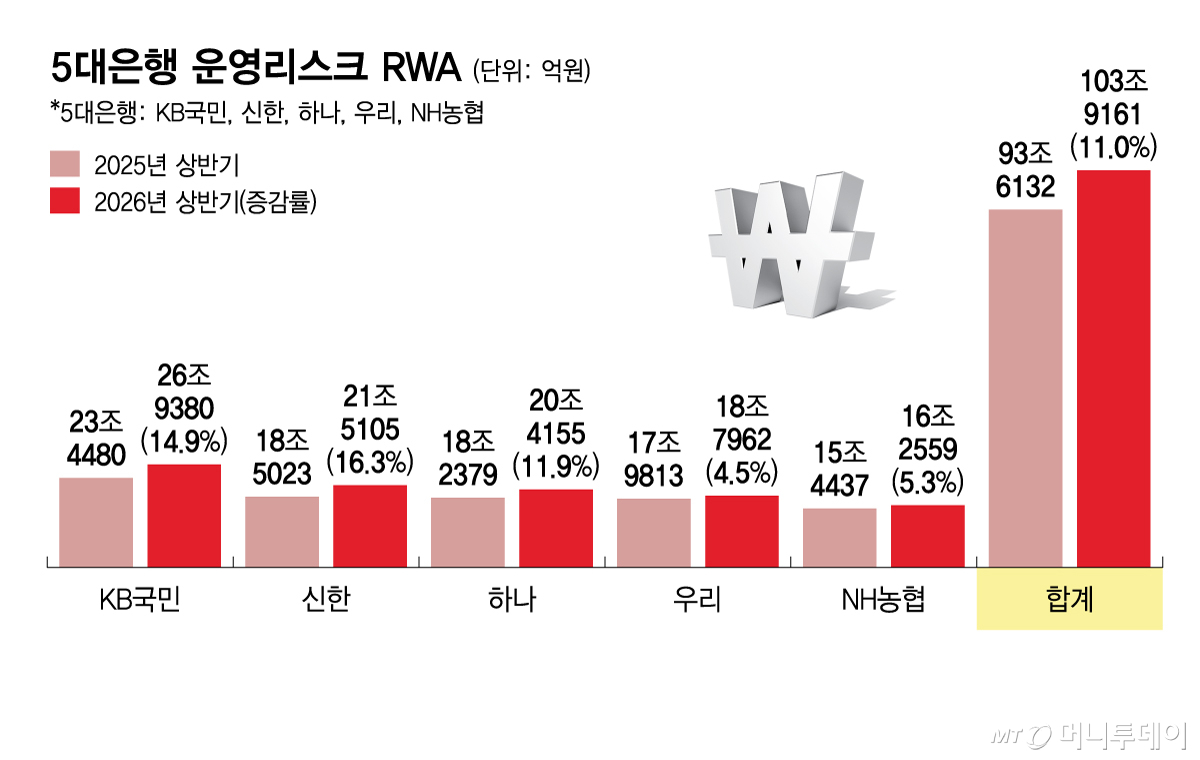
Recently, operational risk RWA in the banking sector has risen sharply. According to the first-half business disclosures of the top five banks—KB Kookmin, Shinhan, Hana, Woori, and NH Nonghyup—the total operational risk RWA for these banks was 103 trillion 916.1 billion won as of the end of June, an 11% increase year-on-year.
Through this measure, by excluding losses reaching the trillions of won, indicators such as the CET1 ratio are expected to improve. Even if the scale of common equity capital remains the same, a reduction in RWA decreases the denominator, thereby raising the capital ratio. It also has the effect of expanding banks’ lending supply capacity.
Increasing loans raises credit risk-weighted assets, creating downward pressure on the CET1 ratio; however, with reduced RWA, banks can maintain their target capital ratio without securing additional capital while simultaneously handling new loans.
A financial industry official said, “Banks have been requesting the rationalization of regulations, and this achievement aligns with the government’s demand for expanding productive finance,” adding, “The CET1 ratio at the holding company level will improve and is scheduled to be disclosed through quarterly reports.”

 in FINANCE
