

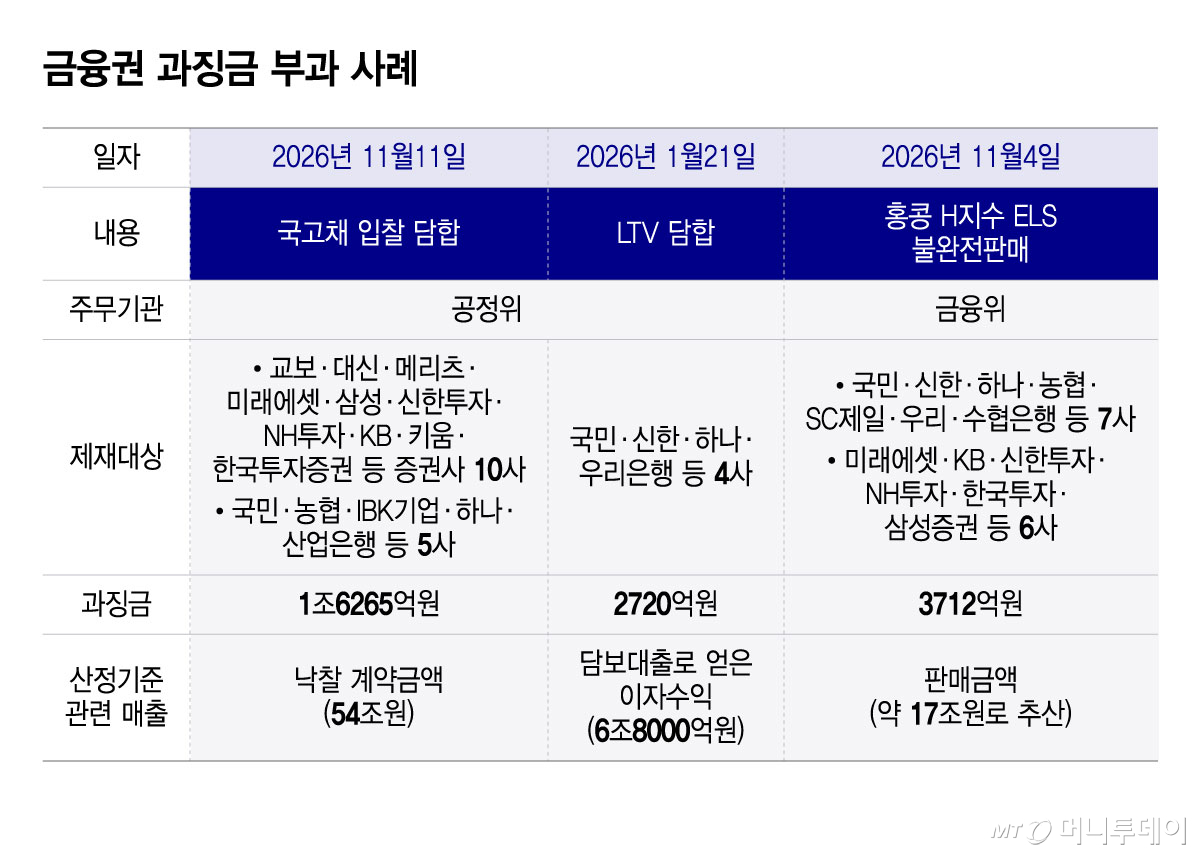
As a wave of fines targeting the financial sector continues, controversy has erupted over the appropriateness of the criteria used to calculate these penalties. In the early-year cartel involving the exchange of information on loan-to-value (LTV) ratios, the Fair Trade Commission used interest income as the benchmark, but in the government bond bidding cartel case, it used the total winning bid amount as the standard, prompting criticism that its approach lacks consistency. Given that there was also controversy over the calculation criteria in the earlier sanctions related to Hong Kong H-Index ELS (equity-linked securities), voices are calling for measures to enhance predictability.
According to financial industry sources on the 15th, the Korea Fair Trade Commission imposed a total fine of 1.6265 trillion won on 15 institutions—10 securities firms including Kyobo, Daishin, Meritz, Mirae Asset, Samsung, Shinhan Investment, NH Investment, KB, Kiwoom, and Korea Investment & Securities, and five banks including KB Kookmin, NH Nonghyup, IBK Industrial Bank of Korea, Hana, and the Korea Development Bank—on charges of colluding in government bond bidding. This is the largest fine ever imposed.
Financial institutions not only reject the Korea Fair Trade Commission’s determination that a cartel existed but also raise issues with the criteria used to calculate the fines. Under the Fair Trade Act, “operating revenue” is generally deemed relevant revenue in standard cartels. Accordingly, financial firms argued during their explanation process that the actual operating revenue derived from government bond transactions should be used as the benchmark. However, the Korea Fair Trade Commission viewed this case as a purchasing cartel and applied the special provision for bidding cartels, calculating the relevant revenue at 54 trillion won based on the size of the “winning bid contracts.”
The financial sector has expressed doubts about the consistency of the fine imposition criteria. In the early-year LTV information exchange cartel case, the commission calculated relevant revenue based on interest income rather than the principal of home loans handled by banks, yet in this instance, it used the total bond purchase amount rather than the actual profits earned by financial institutions as the benchmark. Moreover, critics point out that viewing winning bid amounts as relevant revenue is inconsistent with economic substance, as these funds are utilized to purchase government bonds.
Some even suspect that the Korea Fair Trade Commission used the winning bid size as a benchmark because it was unable to determine the scale of profits gained by financial institutions. The commission stated that it faces limitations in identifying the capital gains obtained by financial firms and that calculating monetary unjust gains is also difficult.
The controversy over fine calculation criteria is not limited to this case. Although the matter fell under the jurisdiction of the Financial Services Commission rather than the Korea Fair Trade Commission, interpretations diverged in the incomplete sale of Hong Kong H-Index ELS products over whether the fine should be based on “investment principal” or “fees.” This was because financial institutions sold approximately 19 trillion won worth of ELS, but the actual fee income earned by these firms amounted to only one-tenth of that figure. The Financial Services Commission held a legal interpretation review committee and decided to use the full investment principal as the benchmark, but controversy persisted throughout the process.
In the financial sector, there are ongoing calls to enhance the predictability of fine calculation criteria, as fines can lead to burdens on financial soundness beyond being a one-time cost. If fines are reflected as provisions or expenses, it will not only reduce net income but also affect the Common Equity Tier 1 (CET1) ratio over the long term. A decline in banks’ capital ratios leads to a reduction in lending capacity, which inevitably deals a blow to productive finance and inclusive finance initiatives being promoted by the government.
A financial industry official said, “It seems that the social atmosphere calling for strict enforcement has been reflected in the imposition criteria,” adding, “Although government sanctions have concluded, if similar cases arise in the future, what benchmark should be used for calculating fines could once again become a point of controversy.”

 in FINANCE
