

[For more diverse corporate information on startups mentioned in this article, please visit the Unicorn Factory big data platform 'Data Lab'.]

"Regulation is not merely an object to be responded to; it can become part of corporate strategy."
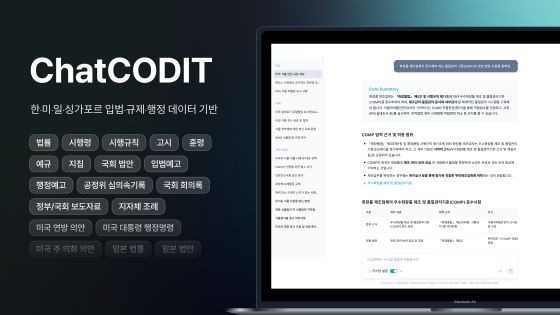
Jung Ji-eun, CEO of CODIT, recently met with MoneyToday's startup media platform 'Unicorn Factory' and stated, "In fact, there is a significant difference in business performance between companies that read and respond to regulations in advance and those that do not." CODIT builds and operates an AI-based data platform that enables companies to proactively respond to complex legal, regulatory, and policy environments. Previously, policy information was scattered across government ministries, the National Assembly, and various institutional investors, requiring companies to collect and analyze it individually. However, CODIT integrates and structures this data to provide real-time access.
The background for Jeong (CEO) launching this business lies in their experience at international organizations. While serving as a UNESCO policy consultant, an OECD policy analyst, and a senior consultant for global partnership education under the World Bank, they recognized the importance of data but also felt the limitation that it often took too long for policy data to be utilized in actual decision-making.
Jeong (CEO) stated, "At UNESCO and OECD, the necessary data arrived late, limiting its use in actual decision-making. This is why we created a service that analyzes policies based on real-time data."
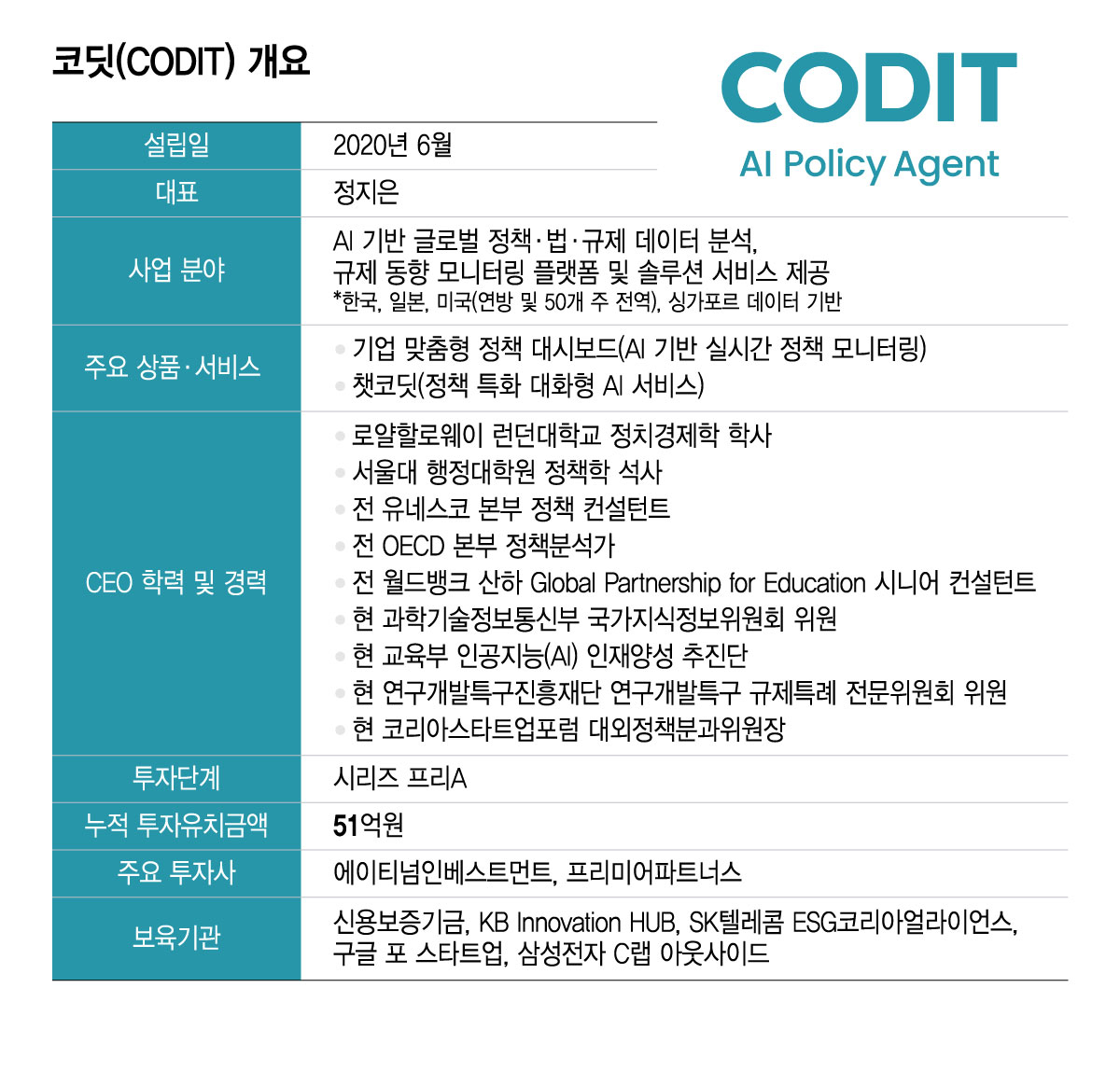
Based on over 1 billion global data points and 16 domestic and international patents, CODIT has developed two services. First, the dashboard-type service is suitable for organizations such as legal departments, compliance teams, and external relations teams that must continuously monitor policies.
By setting a specific company or industry, users can instantly view the status of related bill proposals, legislative progress stages, policy changes, and more. In addition to this, various information including major news, AI-based policy summaries, National Assembly meeting minutes, press releases, seminar schedules, and CODIT insights are provided together. For practitioners who already understand policy trends, this approach is considered the most efficient.
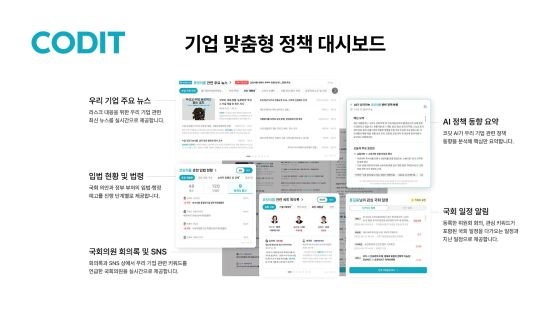
The other pillar is 'ChatCODIT', an AI-based query service. When a user asks about a specific policy or regulation, the AI summarizes key points and provides country-by-country regulatory comparisons and response points. For example, if asked "How will the Basic AI Act affect our company?", users can simultaneously check the core of relevant policies, their direction of change, and measures the company should take. The differentiating factor is that it goes beyond simple information provision to suggest 'what needs to be done'. Jeong (CEO) said, "Users who find it difficult to check every policy detail, such as foreign companies or executives, tend to prefer a question-based chatbot interface."
CODIT collects and processes policy and legal information based on official data from governments worldwide. It covers various countries including South Korea, the United States, Japan, Singapore, and Taiwan. In the case of the U.S., it reflects data from all 50 states as well as the federal government. Particularly for some countries where information is provided in unstructured formats such as PDFs rather than APIs, significant time was invested in collecting and structuring this data. Jeong (CEO) explained, "While developing the service itself took about one year, even more time was spent on data collection and organization."
Currently, CODIT's main customers are large corporations and global companies. The platform has approximately 9,000 subscribers, including domestic and international large enterprises, government institutional investors, national research institutions, and associations. Typically, legal departments and external relations teams use it to track legislative trends and the National Assembly's discussion processes.
Recently, interest from startups and small-to-mid-sized companies is also expanding rapidly. This is because there are many cases where products are recalled or production resumes due to failure to recognize regulatory changes. Jeong (CEO) stated, "Companies that have experienced losses once realize the importance of responding to regulations. Recently, more companies are subscribing to our service like an insurance policy."
CODIT's differentiation is clearly evident compared to existing legal AI services. While existing services focus on legal practice such as case law searches or contract reviews, CODIT concentrates on analyzing the flow of policies and regulations themselves. Jeong (CEO) emphasized, "CODIT is a service that tracks policy changes that will affect companies in the future, rather than analyzing past data."
Building this system also relied heavily on the expertise of the internal team. The team includes Yeon Ju-hwan, Executive Vice President for Global Business Development, who has over 16 years of experience in policy and external relations at domestic and international companies such as Netflix, Uber, and Kakao; Song Hae-young, Director of the Global Policy Verification Institute, with over 25 years of activity in diplomacy and public sectors; Jeon Seo-hyeong Jeong Chaek (Team Lead), who has over 10 years of experience in public sector policy legislation; and Moon Young-chan, Head of Legal Affairs, with over eight years of expertise in corporate regulations and policy issues.
Jeong (CEO) anticipates that perceptions regarding regulations will change rapidly in the future. They stated, "The era of responding to regulations after the fact is over. Companies that read policies first and formulate strategies will gain competitiveness." They added, "CODIT will continue to grow as a platform that helps companies make correct decisions even within complex regulatory environments."
[MoneyToday startup media platform Unicorn Factory]

 in FUTURE


