

First-half venture investment hits 8.9 trillion won, a record high… regional investment surges by 105%
[For more diverse company information on the startups mentioned in this article, please visit Unicorn Factory’s big data platform ‘Data Lab’.]
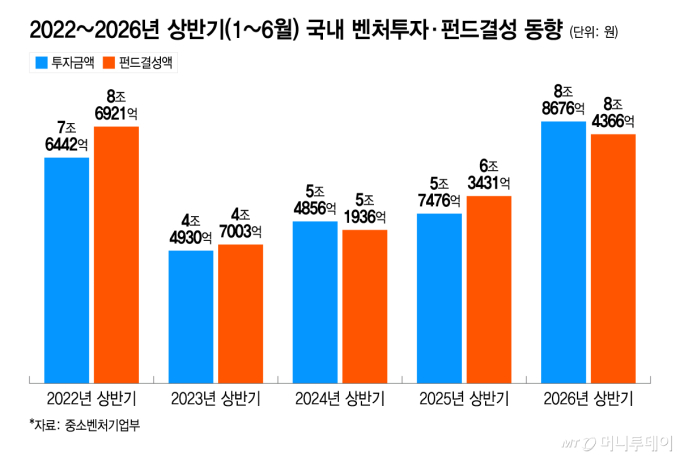
Domestic new venture investment reached a record high of 8.8676 trillion won in the first half of this year. Notably, non-metropolitan area investment surged by 104.7%, outpacing the 49.9% growth seen in metropolitan areas. Early-stage investment, which had been contracting, also rose by 56.4%, signaling a favorable trend across the entire market.
The Ministry of SMEs and Startups announced on the 18th the findings of its '2026 First-Half New Venture Investment and Venture Fund Formation Trends' report. Based on first-half data, new venture investment hit a peak of 7.6442 trillion won in 2022 before plummeting to around 4 trillion won in 2023 due to factors such as interest rate hikes. Since then, it has shown gradual recovery and has now surpassed the previous record high.
Notably, venture investment in non-metropolitan areas grew significantly. Analysis of investment criteria by venture investment companies and partnerships revealed that the growth rate for non-metropolitan venture investment reached 104.7%, double the average growth rate. The share of non-metropolitan investment also rose to 23.5%, up 4.9 percentage points from 18.6% in the previous year.
The Ministry of SMEs and Startups explained that this was "the result of deep tech startups in aerospace, bio, and precision chemistry securing major investments in Daejeon and North Chungcheong Province." Although the performance of new technology finance companies and partnerships is not included in this statistical data, the Ministry believes the results would not differ even if they were combined.
Investment in early-stage startups with three years or less of operation also showed signs of recovery. The investment amount reached 1.8282 trillion won, a 56.4% increase, while the number of companies securing investment rose by 28.9% to 643 firms. This is attributed to an increase in deep tech startups in fields such as AI, semiconductors, and robotics, many of which secured major investments exceeding 100 billion won from their inception.
Kim Bong-deok, Director of Venture Policy at the Ministry of SMEs and Startups, stated, "Once policy funds such as Fund of Funds (Korea Venture Fund) and the National Growth Fund begin full-scale investment in the second half of the year, venture investment performance is expected to continue its upward trajectory for some time." He added, "We will continue to support efforts to ensure that expanded venture investment leads not only to innovation-driven growth in the venture and startup sectors but also to job creation and regional economic revitalization."
Record-breaking venture investment led by AI and deep tech… favorable trends expected to continue into next year
The background behind domestic new venture investment nearing 9 trillion won and setting a record high in the first half of this year lies in increased investments in AI (artificial intelligence) and deep tech sectors. Particularly, massive investments in the trillions of won were made consecutively in fields such as AI semiconductors and humanoid robots, driving the overall investment market.
According to the '2026 First-Half New Venture Investment and Venture Fund Formation Trends' released by the Ministry of SMEs and Startups on the 19th, the industry with the largest share in venture investment this first half was ICT services, accounting for 21.0% (1.86 trillion won) of total investments. This was followed by electrical machinery and equipment (17.3%), bio and medical (17.0%), and ICT manufacturing (12.9%).
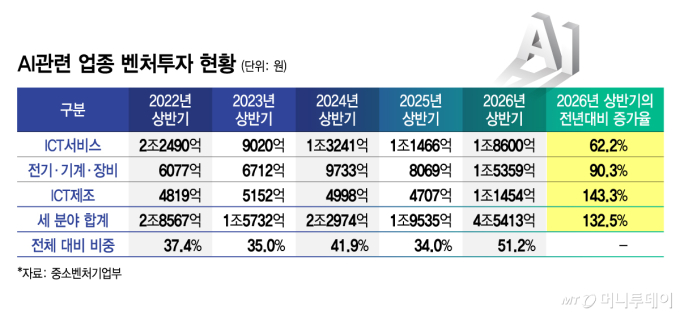
Among these sectors, three areas excluding bio and medical—ICT services, electrical machinery and equipment, and ICT manufacturing—are mostly technology companies linked to AI, such as AI agents, AI semiconductors, and humanoid robots. Investment in these fields totaled 4.5413 trillion won, representing 51.2% of the total.
Investment in AI-related fields was recorded at an 87.3% increase (2.1171 trillion won) compared to the same period last year. This was influenced by numerous cases of ultra-large investments exceeding 100 billion won. Notable examples include Rebellion, which received 640 billion won, and Exina, which secured 200 billion won. Upstage (180 billion won) and Holiday Robotics (155 billion won) also secured ultra-large investments in the first half of this year.
The overseas venture investment market showed similar trends. According to Preqin, a global asset management information provider, approximately 70% of the 515th billion dollars in global venture investment in the first half was invested in IT sectors such as AI and semiconductors. Particularly in the global market, AI startups such as Anthropic and Prometheus consecutively secured ultra-large investments in the range of 10 billion dollars (15 trillion won).
Beyond AI, investments concentrated on deep tech fields including aerospace, life sciences, and precision chemistry. Kim Dae-hyun, CEO of Kiwoom Investment, who attended the Ministry of SMEs and Startups briefing to convey the situation in the venture investment industry, stated, "Recently, venture investment has clearly been focused on deep tech." He added, "Even if companies have no revenue or are operating at a loss, they receive high corporate valuations and attract significant investments."
The deep tech investment boom has expanded to non-metropolitan area venture investment. Based on venture investment companies and partnerships, non-metropolitan investment surged by 104.7% compared to the same period last year, exceeding the average growth rate. Investments flowed into Daejeon and North Chungcheong Province, mostly targeting deep tech startups in aerospace and bio fields based on R&D (research and development) infrastructure.
This investment trend is expected to continue in the second half of this year as startups leveraging AI technology are being launched, and venture capital (VC) firms are also focusing their investments on AI and deep tech sectors.
According to the Ministry of SMEs and Startups, the amount of venture funds formed, which will serve as future sources for venture investment, reached 8.4366 trillion won in the first half of this year, marking the second-highest level ever recorded. This represents a 33% increase compared to the same period last year. Particularly, in the second half, a 1.8 trillion won Fund of Funds (Korea Venture Fund) Phase 1 and a 5.5 trillion won National Growth Fund Phases 1 and 2 are scheduled to be established, so the annual fund formation scale is expected to grow even larger.
Yoon Geon-su, CEO of DSC Investment, stated, "The scale of fund formation will likely increase further in the second half of this year or next year." However, he added, "Given that exit markets such as KOSDAQ are blocked and there are negative factors such as the possibility of interest rate hikes, measures to activate exits must be implemented alongside venture investment to ensure sustainable growth without creating a bubble."
[MoneyToday Startup Media Platform Unicorn Factory]

 in FUTURE


