

[For more diverse corporate information on the startups mentioned in this article, please visit the Unicorn Factory big data platform 'Data Lab'.]
Although venture investment this year has nearly reached 9 trillion won, setting a new record high, the mood in the venture capital (VC) industry remains gloomy. This is because the KOSDAQ IPO market, the core channel for cashing out investments, has frozen solid. Warnings are even being issued that if investment expansion does not lead to timely exits, the recent surge in investment could become a seed of a 'bubble' that shakes the entire market.
According to the Ministry of SMEs and Startups' recently released "Trends in Venture Investment and Venture Fund Formation for the First Half of 2026," new venture investment totaled 8.8676 trillion won in the first half of this year, a 54.3% increase compared to the same period last year. This surpasses the record high of 7.6442 trillion won set during the venture boom period in the first half of 2022. New fund formation also increased by 33% to 8.4366 trillion won, marking the second-highest amount on record for a first-half period.
Conversely, the exit market has fallen deeper into depression. According to data from Korea Exchange released on the 25th, only 20 companies (excluding SPACs) listed on KOSDAQ between January and July 2026, less than half of the 41st companies listed during the same period last year.
Critics also point out that a severe bottleneck is worsening, with investments pouring in while exit routes remain blocked. A VC representative stated, "If you keep feeding food to someone suffering from severe indigestion, they will inevitably get sick," adding, "While the criteria for 'multi-death' (eliminating weak companies) have become stricter, the path to 'multi-birth' (producing high-quality companies) has narrowed."
The investment industry agrees that while funds flowing into large KOSPI stocks is a factor, higher listing thresholds and delayed reviews are the primary causes. According to analysis by Heungkuk Securities, the average time from application for preliminary review to approval for listings this year was 115 days, about 20 days longer than the historical average of 97 days.
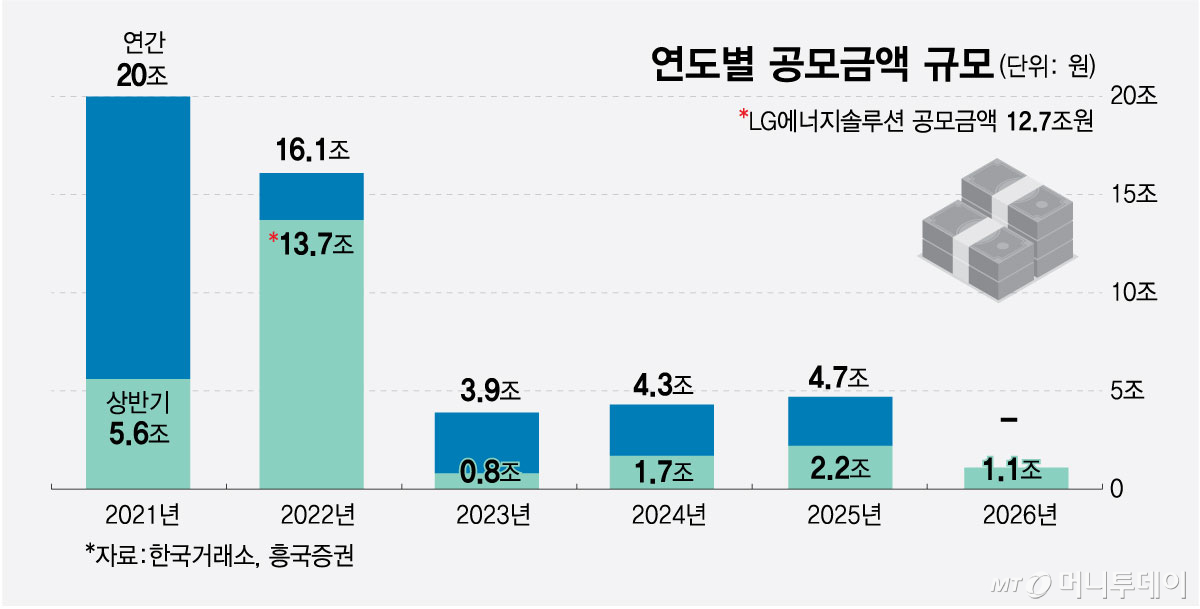
Even after overcoming the difficult listing threshold, the structure makes it hard to sell shares in a timely manner to recover investments, which is also cited as a problem. In principle, VC shares held for more than two years from the date of application for preliminary review are excluded from mandatory holding (lock-up) requirements. However, if Korea Exchange deems it necessary, it can set a mandatory holding period ranging from a minimum of one month to a maximum of two years. Even for VC shares not subject to mandatory holding, there is an established practice of voluntarily setting lock-ups for about 1 to 3 months, reflecting requests from the exchange and the issuing company.
A VC reviewer explained, "VCs often set up voluntary lock-ups even when they already meet exit conditions because they are wary of the exchange's stance." He added, "Retail investors sell immediately after listing, but VCs can only watch helplessly as stock prices plummet due to voluntary lock-ups."
Concerns about this asymmetry between investment and exits were also raised during the Ministry of SMEs and Startups' briefing on "Trends in New Venture Investment and Venture Fund Formation for the First Half of 2026" held on the 19th. Yoon Geon-su, a representative of DSC Investment who attended the event, argued, "In the past year, only two companies among new KOSDAQ listings had a market capitalization of over 5 trillion won, while 74% traded below their IPO price." He warned, "If exit channels are not opened, investment expansion could become an opportunity to inflate a bubble."
There are also opinions that the side effects of investments concentrating in deep-tech fields such as AI (artificial intelligence) must be considered. Kim Dae-hyun, a representative of Kiwoom Investment, stated, "The deep-tech sector still lacks successful exit cases, leading to significant concerns about valuation due to concentration." He emphasized, "To ensure sustainable investment, concrete guidelines for exits such as IPOs must be established."
[MoneyToday startup media platform Unicorn Factory]

 in FUTURE

