

[For more diverse corporate information on startups mentioned in this article, please visit the Unicorn Factory big data platform 'Data Lab.']

/>Concerns are mounting within the venture investment industry ahead of the introduction of a promotion-and-relegation system that would divide the KOSDAQ market into 'Premium' and 'Standard' segments. With most newly listed companies expected to fail in entering the Premium tier, an inevitable chain reaction is anticipated: contraction of IPOs for small- and mid-sized startups and stagnation of the recovery market.
/>According to the financial investment industry on the 25th, the Korea Exchange is set to reveal detailed plans for the KOSDAQ promotion-and-relegation system as early as next month. Under this system, high-quality companies will be classified as Premium, while others will fall under Standard, with grades adjusted based on whether they meet specific criteria. The move aims to enhance KOSDAQ's credibility and attract institutional investors and foreign capital.
/>The problem lies in the fact that most newly listed companies will inevitably start in the Standard tier. According to analyses by major securities firms such as Mirae Asset and NH, only 70 to 80 companies are expected to qualify for the Premium tier under current 'KOSDAQ Global Segment' standards. This is because they must meet stringent requirements, including a market capitalization of at least 500 billion won or ranking within the top 7% by market cap, and an average operating profit of 30 billion won or revenue of 300 billion won over the last three fiscal years.
/>According to the Korea Exchange, among the 20th companies that newly entered KOSDAQ from January to July this year (excluding SPACs), not a single one exceeded a market capitalization of 500 billion won. Given the nature of venture companies listing under technology-specific exemptions, meeting the operating profit requirement of 30 billion won is also unlikely.
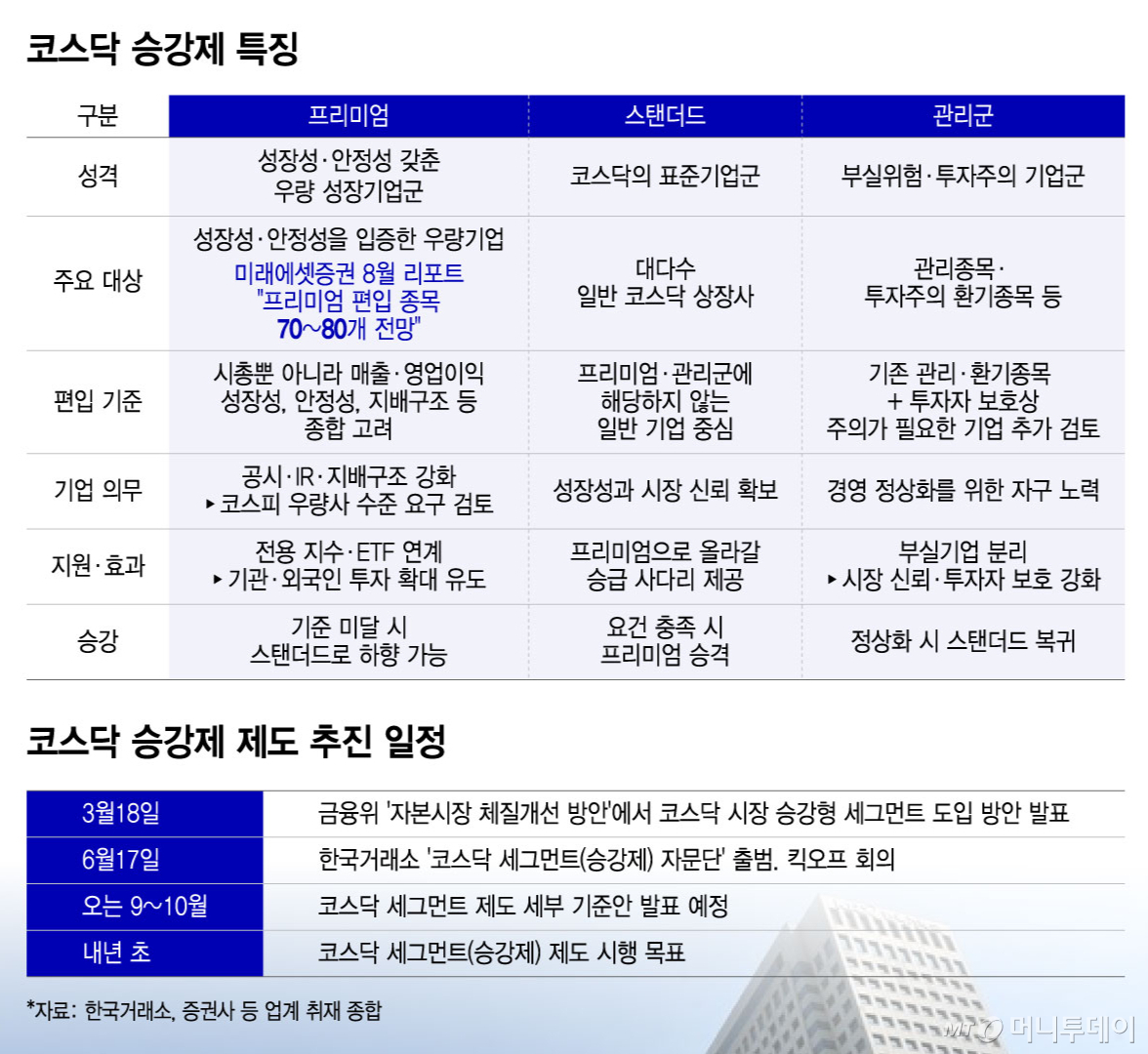
/>If most newly listed companies are classified as Standard, they will struggle to avoid the stigma of being labeled 'subpar companies.' An analyst at a major securities firm stated, "Currently, institutional investor funds are concentrated in KOSDAQ150. If the Premium tier narrows to just 70–80 companies, capital concentration will intensify further." The Venture Company Association also expressed concern that Standard-tier companies would suffer from a double burden of insufficient liquidity and undervalued corporate valuations.
/>This could lead to underwriters avoiding IPOs for small- and mid-sized stocks. Venture capitalists (VCs) are also likely to urge portfolio companies to delay listing and grow larger before going public. A VC representative noted, "Exit proceeds can only be secured if stock prices rise after listing, allowing reinvestment. If portfolio companies are inevitably stigmatized as Standard-tier post-listing, more cases will emerge where firms postpone listing to focus on growth."
/>Some experts argue that restoring market trust should take precedence over artificial tier divisions. An industry insider remarked, "Restoring market confidence through stricter delisting criteria and harsh penalties for unfair trading practices should come first. Artificially dividing KOSDAQ into tiers via a promotion-and-relegation system will only disrupt the flow of venture capital."
/>[MoneyToday Startup Media Platform Unicorn Factory]

 in FUTURE

