

As battery fires have occurred consecutively in electric vehicles and data centers, industry demand for "non-flammable batteries" is growing. Consequently, all-solid-state batteries, which replace the liquid electrolyte of lithium-ion batteries with a solid one, are drawing attention. The currently used liquid electrolytes are highly flammable and are cited as the primary cause of fires. While solid electrolytes can significantly reduce this risk, the problem is not solved by the electrolyte alone. This is because cathode materials, which determine battery performance, do not match well with solid electrolytes. If existing cathode materials are used as-is in all-solid-state batteries, their lifespan rapidly decreases with repeated charging and discharging cycles.
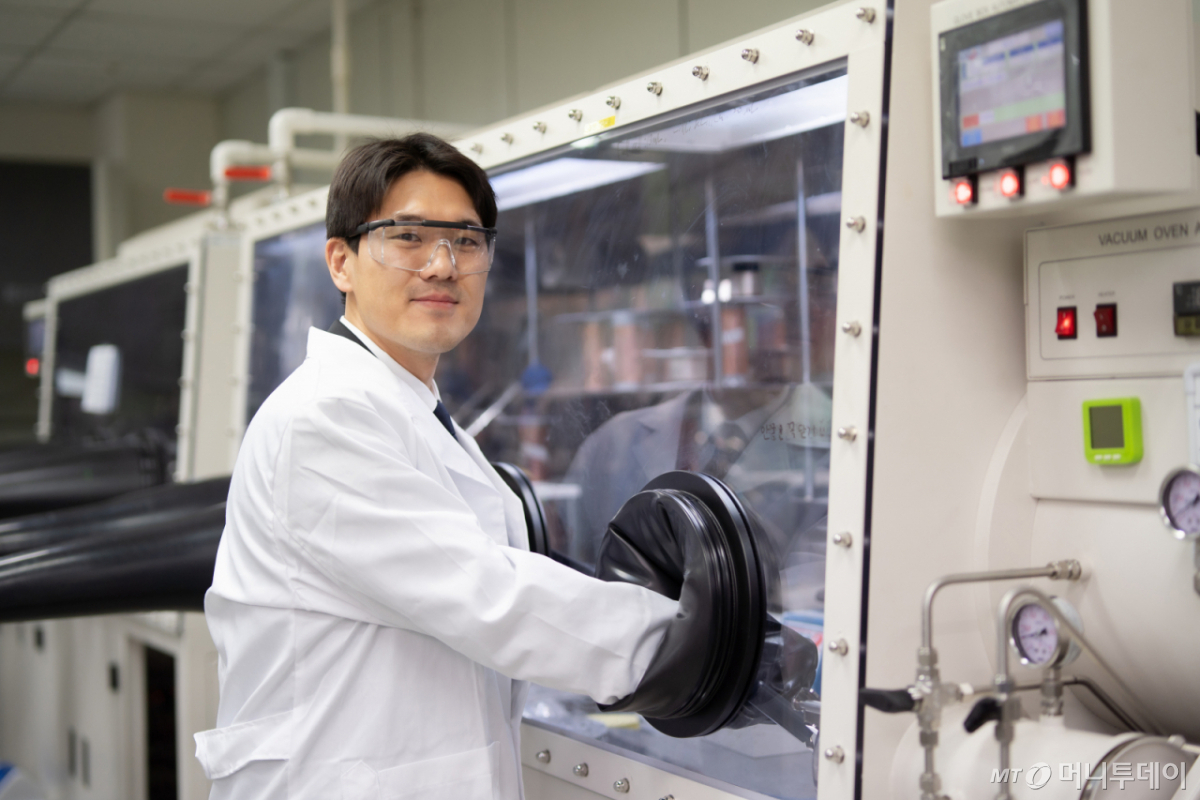
To solve this problem, Kim Woon-hyuk's research team at Daegu Gyeongbuk Institute of Science and Technology (DGIST) EnerJi Gong-hak-gwa (Prof.) developed a cathode material design technology tailored for all-solid-state batteries. Professor Kim explained, "The method involves creating the outermost surface of cathode particles with nano-sized crystals to block microcracks, which are the cause of lifespan degradation," adding, "A key feature is that it can be applied without significantly modifying existing cathode production equipment." Professor Kim's research team will directly introduce this technology at the "2026 K-Premier Deep Tech Festa" (Registration: https://vvd.bz/buvX) to be held on the 29th at COEX in Seoul.
Professor Kim's Ji Do (Prof.) is Professor Sun Yang-gook of Hanyang University. In 2022, Professor Sun transferred approximately 40 cathode material patents to LG Chem, which is considered the largest technology transfer by a domestic university in history. The transfer amount is known to be 25 billion won. Professor Kim is expanding this research into cathode materials for all-solid-state batteries.
Cathode materials expand and contract in volume with each charge and discharge cycle. When this process repeats, microcracks form in the particles. Professor Kim stated, "Due to microcracks, lifespan decreases; a battery that initially lasted 10 hours can only last 8 hours after two years." In lithium-ion batteries, even if cracks form, the liquid electrolyte seeps into the gaps, allowing lithium to continue moving. However, solid electrolytes and solid cathode materials do not move relative to each other and cannot fill the gaps.
Professor Kim said, "Since both the electrolyte and the cathode material are solid, once a part breaks, that portion becomes unusable capacity," adding, "Using general cathode materials leads to much more severe lifespan degradation in all-solid-state batteries."
The research team began its study based on the hypothesis that composing the surface of cathode particles with small nano-sized crystals would disperse the stress caused by volume changes. Experimental results confirmed actual performance improvements. Professor Kim stated, "If you change the electrolyte, you must create a new cathode material to match it," adding, "We obtained results showing that a structure where the outer surface of spherical cathode particles is composed of nano-crystals is suitable for all-solid-state batteries."
All-solid-state batteries are more expensive than lithium-ion batteries due to the high cost of solid electrolytes. The research team plans to prioritize markets where safety is more important than price. Their first target is the BBU (Battery Backup Unit) in AI (Artificial Intelligence) data centers. A BBU is a small battery that supplies power when a server experiences a power outage.
Professor Kim said, "If a fire breaks out in a BBU, all expensive GPUs (Graphics Processing Units) burn," adding, "We must target markets where there are customers who can afford the high price." He further noted, "Humanoid robots are also used in households, so they are an area where fires absolutely cannot occur," and cited drones and the defense sector as other target markets.
Commercialization preparations have progressed to the prototype stage. The research team is conducting process verification with a goal of reaching Technology Readiness Level (TRL) 6-7. Professor Kim stated, "No matter how good a technology is, if it is difficult to implement, companies hesitate to adopt it," adding, "We are focusing on creating entirely different cathode materials by adding just a little of our technology to existing equipment."
He continued, "Battery material companies such as L&F, EcoPro BM, POSCO Future M, and LG Chem can license this technology and supply it to cell manufacturers," noting, "If applied to electric vehicles, Hyundai Motor, OEM companies that manufacture drones, or companies that make BBUs could find this technology extremely useful."
Professor Kim expects this technology will also contribute to the competitiveness of the domestic battery material supply chain. Most of the precursors, which are raw materials for domestic cathode materials, are dependent on China. He emphasized, "Secondary batteries are directly linked to energy security," adding, "Korea must secure a super-gap in next-generation cathode materials to avoid ceding the market to China and to preemptively capture the North American and European markets."
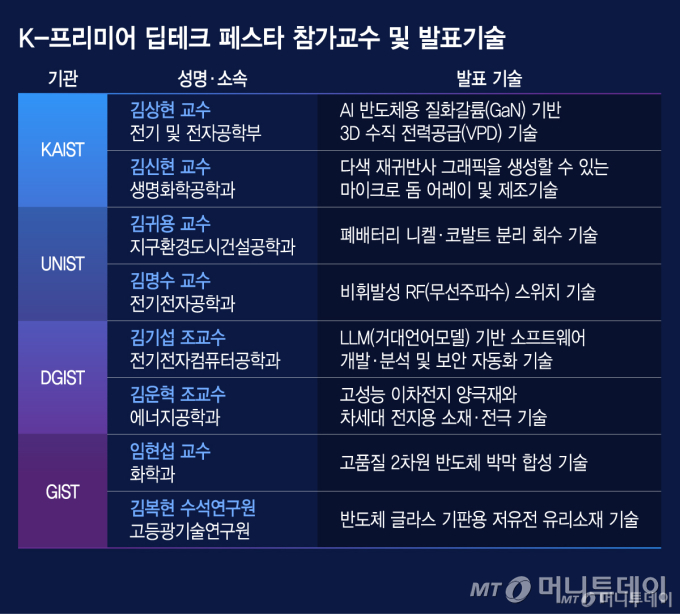
<Registration for 'K-Premier Deep Tech Festa (Technology Transfer & Commercialization)'>
- Date: October 29, 2026 (Thu) at 1:00 PM
- Location: Hall B PLUS STAGE, COEX, Seoul Samsung-dong
- Participants: Companies considering technology transfer, joint research, or new businesses; family companies of government-funded research institutes; investment firms
- Fee: Free (Pre-registration required)
- Hosts: Ministry of Science and ICT, KAIST, GIST, DGIST, UNIST, MoneyToday Unicorn Factory
- Sponsors: Korea Institute of Science and Technology Information (KISTI), Commercialization Promotion Agency for Small and Medium Technology (COMPA)
- Application: https://vvd.bz/buvX
[MoneyToday startup media platform Unicorn Factory]

 in FUTURE

