

[For more diverse corporate information on the startups featured in this article, visit the Unicorn Factory big data platform 'Data Lab '.]
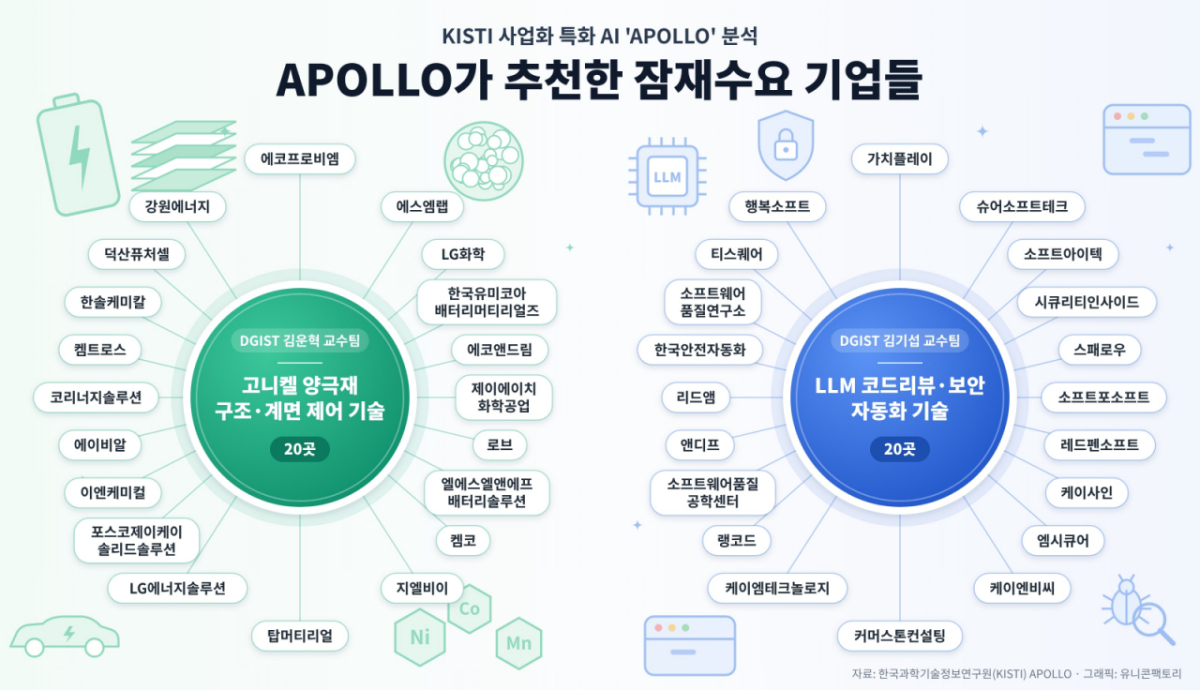
According to an analysis conducted by Apollo, a technology commercialization-specialized AI from the Korea Institute of Science and Technology Information (KISTI), Kim Un-hyeok (Prof.) team's "Technology for Structure and Interface Control of Nickel-based Cathode Materials for High-Energy-Density Secondary Batteries" at the Daegu Gyeongbuk Institute of Science and Technology (DGIST) can generate business synergies with cathode material companies such as Ecopro BM and LG Chem.
The same institution's Kim Gi-seop (Prof.) "Technology for Software Development, Analysis, and Security Automation Based on Large Language Models (LLMs)" was analyzed to be applicable by software verification and security companies such as SureSoftTech, Sparrow, and Soft4Soft.
According to the KISTI Technology Commercialization Research Center on the 15th, Apollo, a technology commercialization-specialized AI they developed, analyzed the technologies of the two professors in this manner. Apollo is an AI that analyzes which companies require a specific technology and the likelihood of synergy when technical data is input. It was developed by learning from 37,000 technology transfer and commercialization data points accumulated by KISTI over more than 10 years.
Apollo focused on the fact that Kim Un-hyeok (Prof.) team's technology can reduce the chronic cracking problem in high-nickel cathode materials. High-nickel cathode materials store a large amount of energy, but repeated charging and discharging cause particles to expand and contract, leading to cracks that degrade the performance and lifespan of all-solid-state batteries. Professor Kim's team's technology strengthens cathode material particles and crystal structures and stabilizes surfaces, enabling simultaneous improvement in the energy density and lifespan of all-solid-state batteries.
Potential domestic demand companies for this technology include Ecopro BM, SM Lab, LG Chem, Umicore Battery Materials Korea, Eco Dream, JH Chemical Industry, Rob, LSL&F Battery Solution, Kemco, GLBI, Top Material, LG Energy Solution, POSCO JK Solid Solution, EN Chemical, ABRL, Corenergy Solution, Kemtrox, Hansol Chemical, Deuk San Future Cell, and Gwangwon Energy.
Among these, Rob is particularly noted for holding a registered patent on doping hetero-elements into NCM (Nickel Cobalt Manganese) precursors, indicating a concrete connection with Professor Kim's team's doping and particle structure control technology. LG Energy Solution was classified as a demonstration demand entity that evaluates performance at the cell level, while POSCO JK Solid Solution was categorized as a joint demonstration partner for all-solid-state composite cathodes.
The global cathode material market is projected to grow from approximately 37.8 billion dollars in 2025 to approximately 65.2 billion dollars by 2030, at an annual average growth rate of 11.5%. The domestic secondary battery cathode material and precursor market expanded from approximately 6 trillion won in 2021 to approximately 9.28 trillion won last year.
Kim Gi-seop (Prof.) team's technology received high praise for its ability to automate code review and security checks as a single process. This technology analyzes the structure and surrounding context of code to grasp modification intent and error possibilities, and automates code quality evaluation and security vulnerability detection and correction by combining evaluation results from multiple LLMs with security expertise. Existing code reviews have relied heavily on manual work by developers, while automated evaluation methods have limitations in grasping the actual accuracy of code and modification intent.
Apollo recommended domestic potential demand companies such as Value Play, SureSoftTech, SoftiTek, Security Inside, Sparrow, Soft4Soft, Red Pen Software, Ksign, M-Secure, KNBC, Commerce Stone Consulting, KM Technology, Langcode, Software Quality Engineering Center, Andip, Lead M, Korea Automation for Safety, Software Quality Research Institute, T Square, and Happiness Soft.
Sparrow and Soft4Soft, which possess static analysis tools, were seen as able to immediately apply Professor Kim's team's technology to their core functions. SureSoftTech, which operates a test automation platform, was analyzed to be able to add code review and security analysis features.
Meanwhile, DGIST's Kim Un-hyuk and Kim Gi-seop (Prof.) will present related technologies at the "2026 K-Premier Deep Tech Festa (Registration: https://url.kr/kpy365 ) " to be held at Seoul COEX on the 29th. Following this, they plan to conduct individual consultations with companies interested in Proof of Concept (PoC), technology transfer, or commercialization.
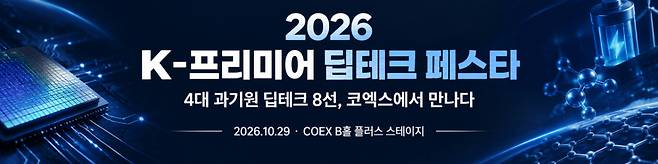
<Registration for 'K-Premier Deep Tech Festa (Technology Transfer and Commercialization)' >
- Date: October 29, 2026 (Thu) at 1:00 p.m.
- Location: Hall B PLUS STAGE, COEX, Samsung-dong, Seoul
- Participants: Companies considering technology transfer, joint research, or new business; family companies of government-funded research institutes; investment firms
- Participation fee: Free (pre-registration required)
- Hosts: Ministry of Science and ICT, KAIST, GIST, DGIST, UNIST, MoneyToday Unicorn Factory
- Sponsors: Korea Institute of Science and Technology Information (KISTI), Korea Commercialization Agency for Science and Technology (COMPA)
[MoneyToday startup media platform Unicorn Factory]

 in FUTURE

