

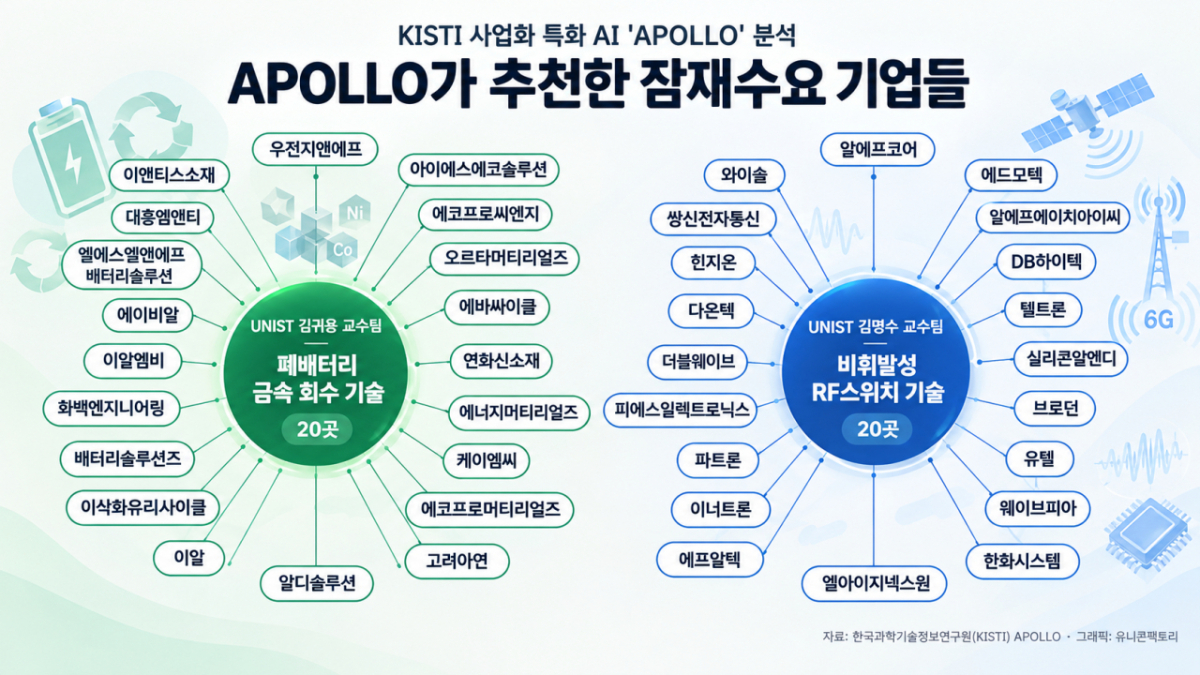
Korea Institute of Science and Technology Information (KISTI)'s technology commercialization-specialized AI (artificial intelligence), "Apollo," identified Ujeon G&F, Ecopro CN, ISECO Solution, Orta Materials, and others as companies that could generate business synergies by applying the spent battery nickel-cobalt separation and recovery technology developed by Kim Ki-yong, a professor in the Department of Earth Environment and Urban Construction at UNIST.
It analyzed that the non-volatile RF (radio frequency) switch technology developed by Kim Myung-soo, a professor in the Department of Electrical and Electronic Engineering at the same university, could yield synergies if utilized by companies such as RF Core, Edmotec, DB Hitek, Hanwha Systems, and LIG Defense & Aerospace.
According to KISTI's Technology Commercialization Research Center on the 14th, Apollo analyzed the technologies of the two professors in this manner. Apollo is an AI that analyzes which companies require a specific technology and the likelihood of synergy when technical data is input. It was developed by learning from 37,000 instances of technology transfer and commercialization data accumulated by KISTI over more than 10 years.
Apollo first noted that Kim Gwi-yong (Prof.)'s team's technology can extract nickel and cobalt with high purity and recovery rates while omitting the "solvent extraction" process, which generates wastewater from spent batteries. It analyzed that this would significantly improve refining efficiency for battery recycling companies and increase the added value of recycled metal production.
Specific demand companies identified include Ujeon G&F, Ecopro CN, Orta Materials, Ecopro M, and Korea Zinc, which are currently engaged in metal recovery businesses from spent batteries. Apollo analyzed that the recommended companies "hold patents or technical papers on fundamental technologies related to metal recovery" and "have a demand for process efficiency and improvement." It also viewed fast-follower companies such as Aqua Metals and Ascend Elements in the United States as potential demand companies.
According to Apollo, the global spent battery recycling market is projected to grow from 18.6 billion dollars in 2026 to 50 billion dollars by 2033, at an annual average growth rate of approximately 15.2%. This is due to the increase in spent battery generation as electric vehicles and energy storage systems (ESS) expand, along with growing demand to secure core metals such as nickel and cobalt stably. Consequently, it analyzed that demand for high-efficiency metal recovery technology is also increasing in the global market.
Regarding Kim Myeong-su (Prof.)'s team's non-volatile RF switch technology, strengths cited include its ability to operate quickly with low power, maintaining on/off states without standby power, and handling 67GHz ultra-high frequency signals. Apollo analyzed that "this will be widely utilized in the development of low-power, high-efficiency RF modules for 5G/6G (5th/6th generation) millimeter-wave communications, beamforming antennas, radar, and satellite communications."
Demand companies identified include telecommunications component and equipment development firms such as RF Core, Edmotec, FR Tech, Waisol, and Parton. It also viewed final demand companies for RF semiconductors, such as Hanwha Systems and LIG Defense & Aerospace, as having potential for internalizing the technology through technology transfer and other means. Finally, it selected DB Hitek and others as demand companies that could apply the solution process utilized by Kim Myeong-su (Prof.)'s team in developing the RF switch.
Meanwhile, Kim Ki-yong and Kim Myeong-su (Prof.) from UNIST will present related technologies at the '2026 K-Premier Deep Tech Festa' (Registration: https://url.kr/kpy365) to be held at Seoul COEX on the 29th. Following this, they plan to conduct individual consultations with companies interested in proof of concept (PoC), technology transfer, or commercialization.
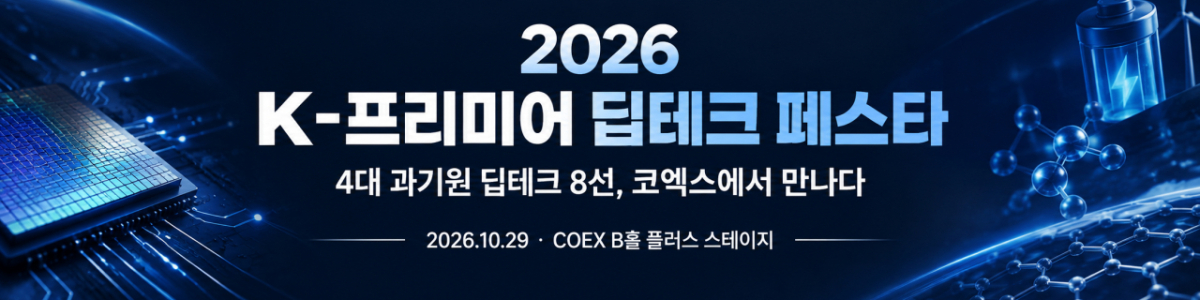
<Registration for 'K-Premier Deep Tech Festa (Technology Transfer and Commercialization)'>
-Date: October 29, 2026 (Thu), 1:00 PM
-Location: Hall B PLUS STAGE, COEX, Samsung-dong, Seoul
-Target Participants: Companies considering technology transfer, joint research, or new business ventures; family companies of government-funded research institutes; investment firms
-Participation Fee: Free (Advance registration required)
-Hosts: Ministry of Science and ICT, KAIST, GIST, DGIST, UNIST, MoneyToday Unicorn Factory
-Sponsors: Korea Institute of Science and Technology Information (KISTI), Korea Commercialization Agency for Science and Technology (COMPA)
-Application: https://url.kr/kpy365
[MoneyToday Startup Media Platform Unicorn Factory]

 in FUTURE

