

[For more diverse corporate information on the startups featured in this article, please visit the Unicorn Factory big data platform 'Data Lab '.]

"We wanted to change the reality where fault judgments vary depending on who is looking at the same traffic accident. Our goal is to objectively reconstruct and analyze the situation at the time of the accident using AI (artificial intelligence), thereby automating the complex process from accident investigation to loss assessment and insurance payout."
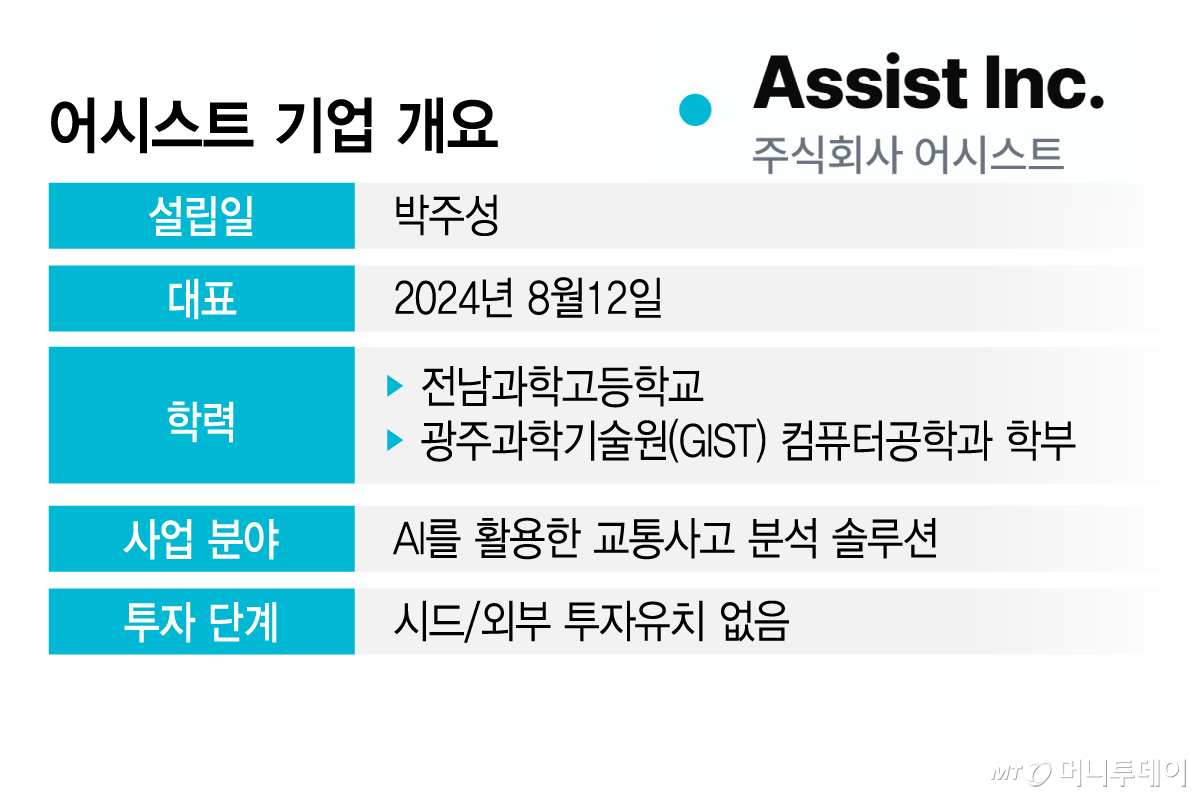
Park Ju-seong (CEO) of Assist, a student-founded startup from Gwangju Institute of Science and Technology (GIST), recently met with Money Today's startup-specialized media platform 'Unicorn Factory' and said the following.
When a traffic accident occurs, black box or CCTV (closed-circuit television) footage must be analyzed to determine the circumstances of the accident and the fault ratio. However, black box footage has limitations in accurately grasping the actual accident situation due to shooting angles and distortion caused by wide-angle lenses. Schematic diagrams drawn from memory of the accident scene may also involve the writer's subjectivity. The process from accident analysis to report writing can take as little as eight hours or as long as more than one week.
Assist is a deep tech startup aiming to resolve the subjectivity and inefficiency in this accident analysis process with AI. It is developing technology that analyzes black box or CCTV footage to classify accident types and reconstructs vehicle movements and collision situations in a three-dimensional (3D) virtual environment.
The startup idea originated from traffic accident prediction research conducted by Park (CEO) at GIST. He explained, "We judged that if the technology for predicting accidents in advance is applied in reverse, it can objectively reconstruct accidents that have already occurred."
Initially, the company intended to apply its technology to police traffic accident investigation work, but expanded its business area after identifying AX (AI transformation) demand in the insurance industry. Park (CEO) stated, "It is difficult to create a clear revenue model with traffic accident analysis technology alone," adding, "We must combine expertise in insurance, automobiles, and AI to develop services that can be utilized in the actual market."
3D reproduction of accident scenes using black box footage… Conducting PoC with major insurance companies
Assist analyzes traffic accidents in two main ways. One method involves reproducing vehicle movements and collision situations at the time of the accident in detail in a three-dimensional (3D) virtual environment. The other method involves AI analyzing relevant information such as vehicle speed and location from accident footage to quickly provide the accident type.
In the 3D reproduction method, when black box or CCTV footage is input, AI recognizes vehicles and lanes and extracts information necessary for accident analysis, such as vehicle position and movement. Based on this, it reproduces the accident scene in a virtual space using 'Unreal Engine,' a 3D graphics production tool used in game development, among other fields.
In the process of quickly determining the accident type, AI analyzes the time of the accident, vehicle direction of travel, movement, and other factors to derive fault diagram results according to the specific accident type. It is designed to present not only the judgment result but also its basis so that personnel can review it.
Assist recently verified the accuracy and processing speed of an AI module for analyzing traffic accident types through a proof of concept (PoC) conducted with a major insurance company.
Assist's ultimate goal is to build an AI platform connecting the entire process from traffic accident occurrence to insurance payout. The plan is to implement a 'Zero-Touch Compensation' system where, once accident footage and vehicle driving information are secured, AI analyzes the accident type and basis for fault judgment, writes a report, and links it to insurance intake and compensation procedures.
However, since fault judgment is a sensitive area leading to insurance payouts and legal disputes, the current structure involves AI presenting analysis results while humans conduct final reviews. Park (CEO) stated, "We provide not only the judgment result but also the basis for the judgment so that reasons for errors can be verified," adding, "Once analysis accuracy is sufficiently verified, we plan to expand the scope of automation."
Meanwhile, the company will participate as the representative of GIST student-founded teams in the finals of the '2026 K-Deep Tech Startup King of the Kings,' held on the 30th at Hall B Plus Stage, COEX, Seoul Samsung-dong (Spectator registration: https://forms.gle/McNBqdiBts8RJazVA).
Now in its fifth year, the King of the Kings is organized by Money Today's startup media platform 'Unicorn Factory' and co-hosted by KAIST (Korea Advanced Institute of Science and Technology), DGIST (Daegu Gyeongbuk Institute of Science and Technology), UNIST (Ulsan National Institute of Science and Technology), GIST (Gwangju Institute of Science and Technology), POSTECH (Pohang University of Science and Technology), and KENTECH (Korea National University of Education).
The jury includes deep tech investment and commercialization experts from Samsung C Lab Outside, GS Vendors, Ecopro Partners, L&S Venture Capital, LB Investment, Blue Point Partners, Series Ventures, CNTech, Korea Technology Holdings, and the R&D Special Zone Promotion Foundation.
Participants range from large corporate CVCs (corporate venture capital) to deep tech-specialized VCs, early-stage investment ACs (accelerators), and public technology commercialization institutional investors, comprehensively examining the commercialization potential and investment attractiveness of the technologies.
The finals feature a total of 12 teams, with six each from the faculty and student startup categories. The event proceeds in the format of actual investment recruitment IR (investor presentations), with 10-minute presentations and 10-minute Q&A sessions for each team. Evaluation is based on a total score combining technology (30 points), marketability (20 points), business viability (40 points), and team capability (10 points).
The grand prize will be awarded to one team from each of the faculty and student startup categories. The two grand prize-winning teams will receive the Minister's Award from the Ministry of Science and ICT, which is the Deputy Prime Minister's award, along with a prize money of 3 million won. Four excellent prize-winning teams will receive the R&D Special Zone Promotion Foundation Lee (President) Award and 1 million won in prize money, while six encouragement prize-winning teams will each receive the Money Today CEO Award and 500,000 won in prize money.
Winning teams will be provided with benefits such as linkage to CVC open innovation and bonus points when participating in the Global Digital Innovation Network (GDIN) overseas expansion program. Regardless of winning status, all 12 finalist teams will receive support for a one-year follow-up scale-up program, including corporate promotion, expert consulting, and investor networking.
<Registration for attending the 5th K-Deep Tech Startup King of the Kings >
- Date: October 30 (Fri) 9:30~17:00
- Location: COEX Hall B PLUS STAGE, Seoul
- Target: Deep tech field startups and investment VC reviewers
- Hosts: KAIST, DGIST, UNIST, GIST, POSTECH, KENTECH, Money Today Unicorn Factory
- Application : https://forms.gle/McNBqdiBts8RJazVA
[Money Today Startup Media Platform Unicorn Factory]

 in FUTURE

