

[For more diverse corporate information about the startups featured in this article, please visit the Unicorn Factory big data platform 'Data Lab'.]
Pharmaceutical company Borling has entered the space business. It aims to secure a leading position in the space medicine ecosystem by researching new drugs utilizing the microgravity environment of low Earth orbit (LEO). As industries far removed from satellite communications or Earth observation, like Borling, turn their eyes toward space, interest in low Earth orbit is heating up.
However, the fact that satellite launches are increasing and investment funds are pouring in does not immediately mean that companies are making money. What can actually be sold in low Earth orbit, and who will pay for products and services created there?
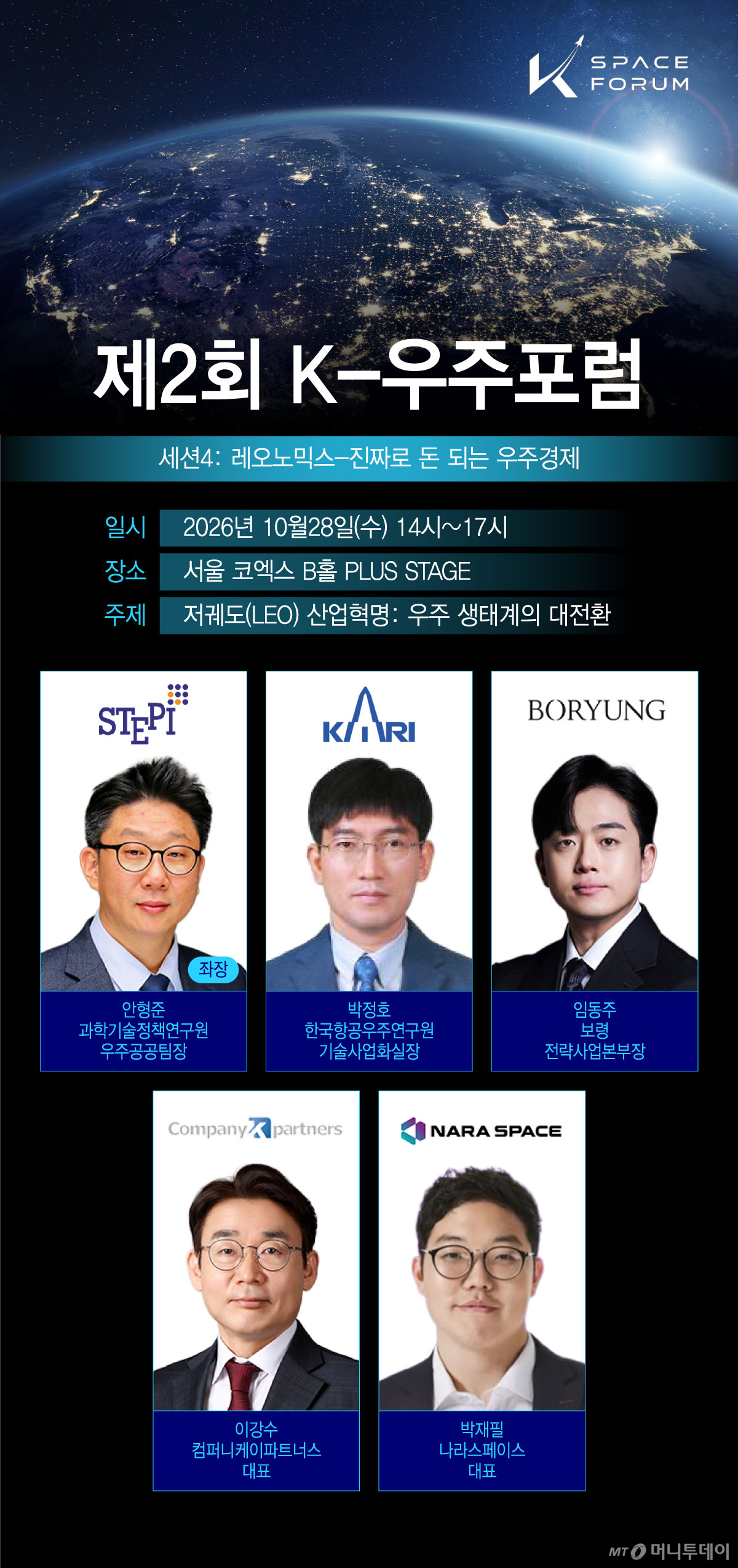
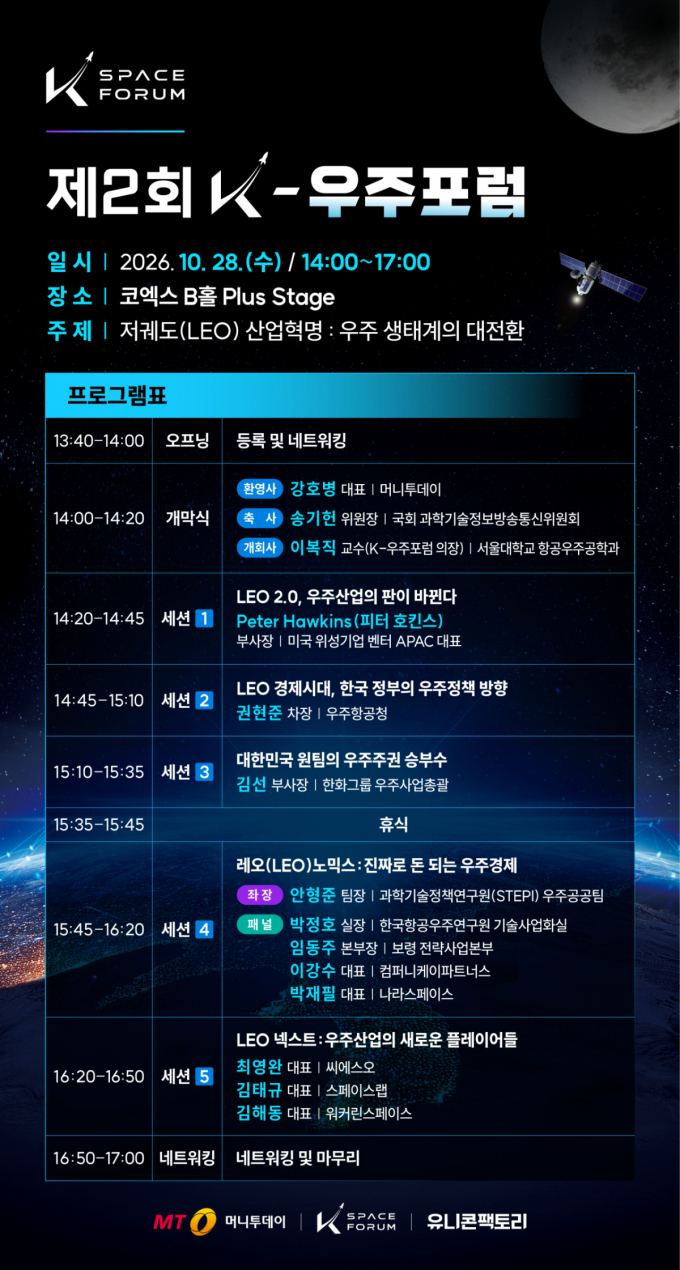
Experts will discuss these questions at "Session 4 LEO-Nomics: The Space Economy That Actually Makes Money" of the "2nd K-Space Forum" to be held at Seoul COEX Hall B on October 28. This forum, themed "The Low Earth Orbit Industrial Revolution – The Daejeon of the Space Ecosystem," will analyze the most realistic question: "the profitability of low Earth orbit."
"Borling, Nara Space, KARI, and Company K" to join discussion
The session chair will be Woo Ju-gong-gong (Team Lead) from the Science and Technology Policy Institute (STEPI). The panel will include Borling's Im Dong-ju, who is seeking new drug research opportunities in space; Park Jae-pil (CEO) from Nara Space Technologies, which provides video and AI analysis services; Park Jung-ho, Head of the Technology Commercialization Office at the Korea Aerospace Research Institute (KARI), which connects research institutional investor technology to business; and Lee Gang-su (CEO) from venture capital firm Company K Partners, who will judge whether to invest in these businesses.
The session will first hear about the movements of industrial change by examining what business opportunities companies like Borling and Nara Space have identified in low Earth orbit. It addresses the question, "Why must it be space?" The discussion will cover what problems cannot be solved by terrestrial methods and which industries are moving proactively. This will be followed by a debate on the barriers to commercialization.
Perspectives from technology and capital will also be heard. The session will address which technologies are being focused on for low Earth orbit businesses and how helpful they are in actual field operations. It will also explore which aspects of various low Earth orbit projects investors are concentrating on.
"Understanding the reality of low Earth orbit and seeking economic possibilities"
An Hyeong-jun (Team Lead), who will lead the session, is a space policy expert who has served as a think tank for South Korea's space development. In this session, he plans to thoroughly question and draw out answers regarding the realities faced by companies, investors, and research institutional investors in the market. Through this, the plan is to derive insights into the reality and future of the low Earth orbit industry.
Team Leader An said, "The core of the low Earth orbit economy lies not just in how many assets are placed in low Earth orbit, but in what value is created in that space and who will pay for that value." He added, "I expect the panel discussion to be an opportunity to understand not only the possibilities of the low Earth orbit economy but also the reality of actual business sites."
[MoneyToday startup media platform Unicorn Factory]

 in FUTURE

