

Development of "Light Technology" That Paints Masterpieces Without Pigments… "It Does Not Fade Over Time"
Kim Shin-hyun, Professor, Department of Biological and Chemical Engineering, Korea Advanced Institute of Science and Technology (KAIST)
[For more diverse corporate information on the startups mentioned in this article, please refer to the Unicorn Factory big data platform ‘Data Lab’.]
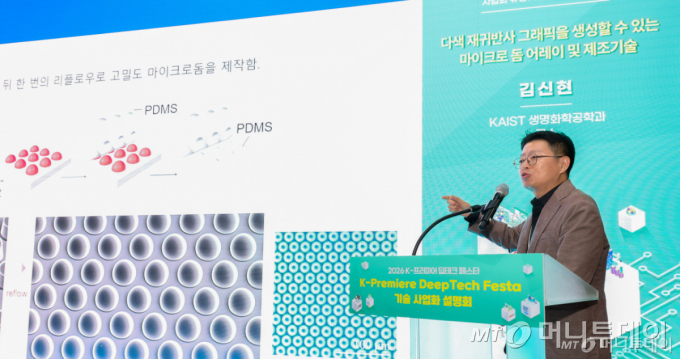
"Chemical dyes fade over time and have a significant environmental impact during the synthesis process, but structural color is a sustainable technology that permanently retains its original color as long as the microstructure is maintained."
Kim Shin-hyun, a professor in the Department of Biological and Chemical Engineering at the Korea Advanced Institute of Science and Technology (KAIST), made this statement while introducing his independently developed next-generation structural color technology based on microdomes at the 2026 K-Premier Deep Tech Festa held on the afternoon of the 29th at Hall B Plus Stage in COEX, Gangnam-gu, Seoul.
He introduced the technology as an innovative material that enables mass production by combining semiconductor lithography and molding processes without using any chemical pigments or dyes. He further emphasized its potential for broad industrial expansion, ranging from anti-counterfeiting security labels to premium packaging and the creation of artworks intended for permanent preservation.
At the technology evaluation held that day, Professor Kim's team was awarded an encouragement prize among the research achievements of the four major science and technology institutes (KAIST, DGIST, UNIST, and GIST), with its technological innovation and commercialization potential recognized.
Structural color is a technology that produces color by exploiting the microstructure of a material, rather than using chemical pigments. While conventional paints and inks display color through the absorption or reflection of light by pigments, structural color utilizes the principle of light reflecting from and interfering with one another within a material’s microstructure. Unlike pigments, its defining characteristic is that the color does not fade as long as the structure is maintained.
However, existing structural color technology has the limitation that it is difficult to mass-produce over large areas because it requires uniformly aligning ultra-fine patterns on the scale of hundreds of nanometers (nm).
In contrast, Professor Kim's research team lowered the manufacturing difficulty by placing hemispherical microstructures called "microdomes," approximately 10 micrometers (µm) in size, on a transparent substrate instead of using nanostructures. The principle relies on light being reflected multiple times from both the inside and outside of the rounded dome surface, which enhances specific wavelengths of light; by precisely controlling the diameter and arrangement density of the domes, they create diverse color combinations. Professor Kim explained that this approach is more advantageous for future mass production than existing methods that utilize nanostructures.
In particular, the team significantly improved mass production capability by integrating photolithography (exposure) processes, a core element of semiconductor manufacturing, with molding replication technology. The process was simplified to enable continuous replication onto transparent substrates by first erecting micro-pillars using an ultraviolet-sensitive polymer, deforming them into dome shapes through heat treatment, and then stamping them onto the substrate like a mold. In practice, the research team integrated approximately 200,000 micro-domes onto a substrate measuring 1 centimeter in width and 1.3 centimeters in length, precisely reproducing the Joseon Dynasty masterpiece "Ilwolobongdo" (Sun, Moon, and Five Peaks) without dyes. They also implemented famous Western paintings such as "Girl with a Pearl Earring" and "Impression, Sunrise" using the same method.
This technology can be immediately applied in the field of anti-counterfeiting. Like the security features on banknotes, it can be engineered so that colors change depending on the viewing angle, and hidden patterns or encrypted information that can only be identified through special filters can also be embedded. Because precise replication is virtually impossible with conventional printing processes, the technology is highly regarded for its potential use in authentication tags for luxury goods and high-value consumer products.
Professor Kim emphasized, “It is a new optical material that has not been used before, and it enables high-level encryption through micro-texts, making technical replication difficult.” He added, “Its optical property of responding only to specific polarization is also a strength that is hard to imitate with existing printing technologies.”
It is also possible to extend the technology into contact-detection sensors. This approach leverages a physical principle in which, when an external object touches the surface of a microdome, the light reflection conditions change and the color disappears; once the contact is removed, the original color returns. By applying this principle, it can be implemented as a high-sensitivity sensor capable of detecting the shape of complex curved surfaces or the presence of minute physical contact.
One of the representative application areas that Professor Kim is focusing on is the art industry. The concept involves creating permanent preservation paintings by incorporating structural colors in place of traditional pigments, ensuring that the colors do not fade over time, and expanding these works into special exhibitions or collectible artworks.
Professor Kim stated, “We are moving beyond traditional painting with conventional pigments and replacing it with structural color, which does not fade and can be preserved permanently.” He added, “If we have the opportunity to collaborate with various artists, I would like to hold an exhibition as well.”
The company is also considering entering the premium packaging and high-end interior materials markets. Professor Kim explained, “The material’s outstanding aesthetic qualities can translate into a luxurious emotional value,” adding that it has potential for application in various fields such as premium packaging, brand protection, and interior design. He further noted, “Because the molding process allows for the repeated replication of microstructures, mass production is entirely feasible.” However, he added, “Since this technology was not developed specifically for a particular industry, expanding actual demand channels will be a key challenge going forward.”
“For future AI development, we must understand and improve upon the ways it fails”
Professor Kim Ki-seop, Department of Electrical, Electronic and Computer Engineering, Daegu Gyeongbuk Institute of Science and Technology (DGIST)
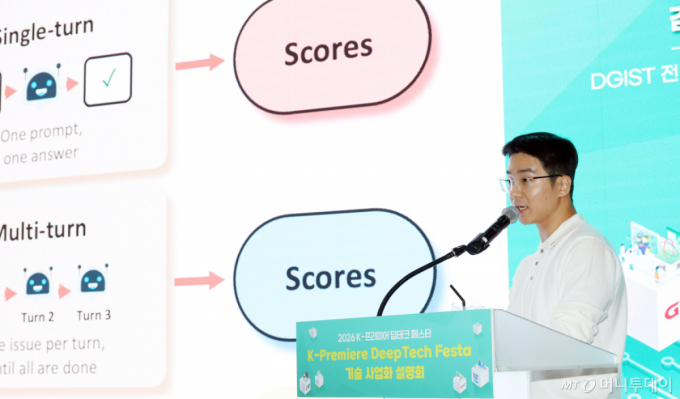
"The fact that AI is good at coding and the fact that we trust that code 100% are two different things."
Professor Kim Ki-seop of the Department of Electrical, Electronic and Computer Engineering at DGIST (Daegu Gyeongbuk Institute of Science and Technology) made this statement while presenting research results verifying the reliability of coding AI at the "2026 K-Premier Deep Tech Festa" held on the 29th at COEX in Seoul Samsung-dong. The study found that AI systems evaluating code reversed their judgments when the order of presentation or screen display was altered, even for identical code, while AI systems tasked with fixing code only corrected the specific issue instructed, ignoring other problems present in the code. Professor Kim emphasized that understanding when and why AI fails is essential to properly enhancing its performance.
Professor Kim observed that when a vision-language model (VLM) capable of understanding images was asked to evaluate which code snippet is more readable by looking at screenshots of the code, changing the order of the code altered the evaluation method. The professor noted that judgments were reversed even when only visual presentation elements such as dark mode, font, and color were changed while the actual code content remained identical. "AI can evaluate code, but it must be confirmed through further verification when its judgments are consistent and what factors influence them," Professor Kim explained.
In the case of AI that modifies code, previous evaluations focused solely on how well a single issue was fixed. Real-world software often contains a mix of various problems, such as unnecessary code, outdated syntax, and flawed logic. The research team has newly developed an evaluation dataset called "CompoundBench," which features approximately 600 functions collected from actual open-source projects, each containing multiple simultaneous code quality issues.
The study applied three methods to nine large language models (LLMs): fixing one issue at a time, making multiple iterative corrections, and correcting issues after being informed of their locations. When instructed to fix only one problem, the AI did indeed correct just that single issue. Professor Kim stated, "The problems arise because these models are too good at following instructions." The more intelligent the model, the more faithfully it adhered to the specific instruction, resulting in a lower overall score for resolving all issues. While iterative corrections improved performance to some extent, costs increased two to three times proportional to the number of iterations.
The most effective approach was to specify the location and type of the problem. When a code inspection report containing line numbers and suggested fixes was provided, the top-performing frontier model perfectly fixed approximately 93% of the functions. A method involving assigning specialized AI models for each problem type was also tested, but the approach of accurately reporting the issues identified by analysis tools proved superior. Professor Kim stated, "Simply choosing a good model is not enough; it is equally important to instruct what should be fixed and what information should be presented."
The research team also examined the internal workings of AI systems that evaluate and modify code. To determine whether specific neurons within a large language model (LLM) are dedicated to individual programming languages such as Python, Java, and C++, they identified and deactivated neurons associated with five different languages. The method proposed by the research team selected approximately 70% fewer neurons than existing approaches while maintaining about 91% of the impact on the target language compared to those methods. However, the negative impact on other languages remained at approximately 93%. This indicates that neurons critical for a specific language are not used exclusively for that language.
There were changes that could not be seen from performance scores alone. When some neurons were turned off, the success rate of C++ code generation dropped by only about 1.8 percentage points, but syntax and compilation errors increased by about 11 percentage points. By keeping the neurons common to multiple languages intact and adjusting only the rest, the effect on the target language was largely maintained while performance loss in other languages was reduced by about 55%. This is a result that can be utilized to preserve already acquired Java skills while additionally training an AI on Python.
Professor Kim said, “Going forward, AI research must move beyond merely achieving high performance toward understanding when, why, and how AI fails, and using that understanding to improve performance.”
Meanwhile, the event featured presentations of key research achievements from four major science and technology institutes: KAIST, DGIST, UNIST, and GIST. In addition to technical presentations, one-on-one consultations and counseling sessions were held between demand-side companies and professors and researchers from each institute.
“Signal Maintained Even During Power Outage”: Development of “Ultra-Low-Power RF Switch” for 6G and Satellite Communications
Professor Kim Myung-soo's team from the Department of Electrical and Electronic Engineering at Ulsan National Institute of Science and Technology (UNIST)
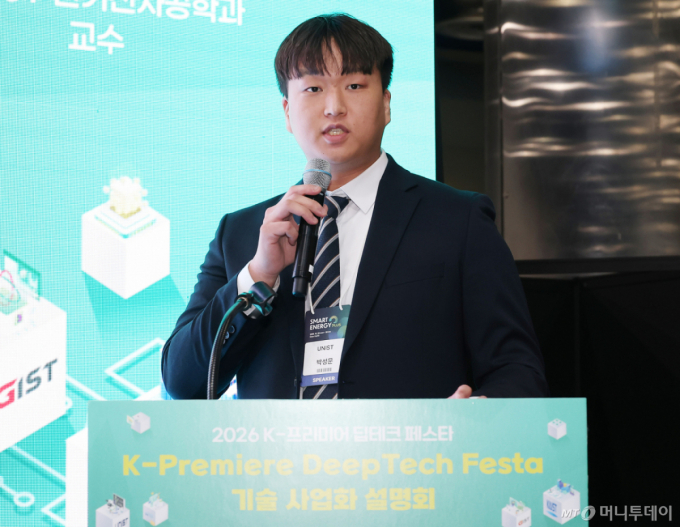
"The core of the technology lies in overcoming the large-area processing limitations of existing two-dimensional molybdenum disulfide (MoS₂) materials through solution processing, and repurposing vacancies—previously dismissed as material defects—as low-voltage switching channels."
Park Seong-min, a researcher at Ulsan National Institute of Science and Technology (UNIST), made the statement while unveiling next-generation non-volatile radio frequency (RF) switch technology for communications at the "2026 K-Premier Deep Tech Festa" held on the 29th at COEX in Seoul Samsung-dong. Park, who is part of Professor Kim Myung-soo's team in UNIST's Department of Electrical and Electronic Engineering, served as a proxy presenter on that day. Professor Kim's team was awarded an encouragement prize after being recognized for the technology's level of completion and commercialization potential in the research performance evaluation of the four major science and technology institutes (KAIST, DGIST, UNIST, and GIST).
RF switches are core components that select or block the path of wireless signals in smartphones, as well as mobile communication base stations, communication satellites, and phased array antennas. With the rapid increase in wireless data transmission driven by the recent spread of AI (artificial intelligence), autonomous driving, and the Internet of Things (IoT), the importance of ultra-low-power RF switches that minimize signal loss and significantly reduce power consumption is growing.
Conventional commercial RF switches have limitations in energy efficiency, as they must continuously draw power to maintain a specific path or require high drive voltages. In contrast, the non-volatile RF switch developed by the research team changes paths with short electrical pulses on the nanosecond scale and maintains that state without any additional power supply.
The research team implemented a switching device by placing molybdenum disulfide, a two-dimensional semiconductor material, between copper and gold electrodes. In particular, rather than eliminating the micro-gaps and sulfur atom vacancies within the thin film as defects, they leveraged them to form copper conduction pathways. This approach significantly reduced the operating voltage and improved device uniformity.
The team also confirmed the potential for large-area production. They applied a solution process in which molybdenum disulfide was formulated into an ink and coated onto a substrate. As a result, they achieved an in-plane uniformity of 94.4% and demonstrated the possibility of forming uniform thin films on wafers measuring six inches or larger.
The performance metrics also met the requirements of next-generation communication standards. At a maximum frequency of 67 GHz (gigahertz), signal loss was recorded at 0.1 dB (decibels) or less, successfully transmitting 97.72% of the input signal. The isolation, which indicates signal blocking performance, also achieved more than 35 dB.
The switching speed was 64 nanoseconds (ns) for turn-on and 76 ns for turn-off. The energy required for switching was only 2.38 nanojoules (nJ) and 1.57 nJ, respectively. At room temperature, the device maintained its state for over 1 million seconds, and more than 2,000 repeated operations were also confirmed.
No performance degradation was observed even after bending more than 1,000 times on a flexible polyimide substrate. The research team applied the device to antenna transmission and reception path control circuits and phase control circuits, completing an assessment of its applicability to communication modules. It is expected to contribute significantly to extending battery life and improving communication efficiency in future 6G communication equipment, low-power satellite communication systems, and high-density antennas.
Meanwhile, the event featured presentations of key research achievements from four major science and technology institutes: KAIST, DGIST, UNIST, and GIST. In addition to technical presentations, one-on-one consultations and counseling sessions were held between demand-side companies and professors and researchers from each institute.
Extracts 99% of nickel from spent batteries... "Eco-friendly recycling" that completely removes chemical wastewater
Kim Ki-yong, Professor, Department of Earth, Environment, City and Construction Engineering, Ulsan National Institute of Science and Technology (UNIST)
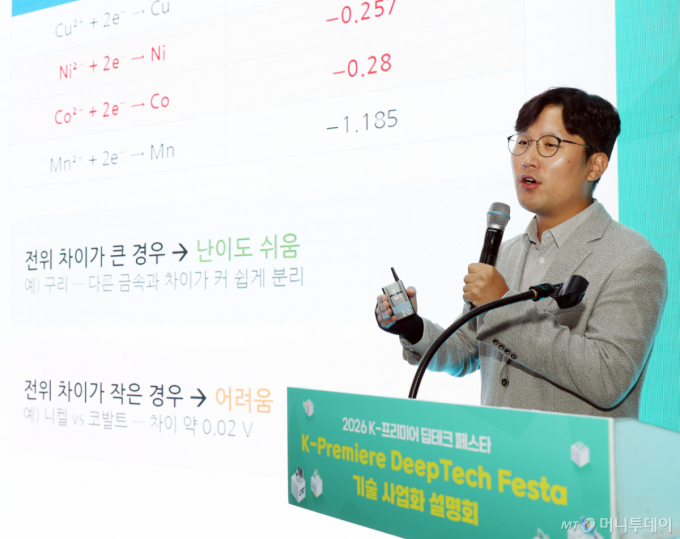
"This will be a sustainable, eco-friendly process that minimizes the use of chemical substances and enables precise control using only electricity. We will collaborate with various companies to rapidly apply it in real industrial settings."
Kim Ki-yong, a professor in the Department of Earth, Environment, and Urban Construction Engineering at Ulsan National Institute of Science and Technology (UNIST), made this statement while introducing his independently developed technology for separating valuable metals from spent batteries at the "2026 K-Premier Deep Tech Festa" held on the 29th at COEX in Seoul. The technology, which uses a special solvent instead of water and passes electricity through it to sequentially recover nickel and cobalt, was awarded the Grand Prize, the highest honor at the event, in recognition of its process innovation and eco-friendliness.
Existing battery recycling processes typically involved a solvent extraction method in which black powder obtained by crushing batteries was dissolved in acid, and specific metals were then separated using organic solvents. However, this process consumed large quantities of chemicals and generated substantial amounts of toxic wastewater containing high concentrations of sodium sulfate during pH adjustment, resulting in a significant environmental burden.
The research team found a solution using an "electrodeposition" method, in which electrodes are inserted into a solution containing dissolved metals and an electric current is passed through to selectively precipitate only the desired metal. Until now, nickel and cobalt had almost no difference in reduction potential in aqueous solutions, making their electrical separation nearly impossible. The team resolved this challenge by introducing a "deep eutectic solvent (DES)" composed of choline chloride and ethylene glycol instead of water. In this solvent, a property is induced in which nickel adheres to the electrode before cobalt, enabling the two metals to be separated sequentially.
The experimental results showed a nickel recovery rate of 99% and a purity of 99.1%. Cobalt also exceeded 95% in both recovery rate and purity. The research team succeeded in raising the final metal purity to over 99.9% through a purification process involving repeated electroplating.
High process efficiency and environmental friendliness were also confirmed. Unlike conventional solvent extraction methods, the chemical composition of the solvent remains largely unchanged even after metal recovery, enabling repeated reuse. The research team demonstrated that there was no performance degradation in four consecutive reuse tests. In addition, they established a resource circulation system that captures chlorine components generated during the process, regenerates them into hydrochloric acid, and reintroduces the acid into the spent battery leaching process.
The recovered metals can be obtained in the form of a "sulfate solution" by applying a reverse voltage to the electrodes and re-dissolving them through a simple process, allowing for immediate use in manufacturing battery cathode precursors. This secures a high-value-added distribution channel that enables direct sales to cathode manufacturers without the need for separate complex post-processing.
The economic viability assessment also confirmed its potential. The cost of electrical energy accounted for approximately 0.6% of the value of the recovered nickel and cobalt. The primary cost was the eutectic solvent, which comprised about 40.6% of the total production cost. Analysts predict that the cost ratio will decrease significantly as the number of solvent reuse cycles increases in the future.
Professor Kim said, “It will be an eco-friendly process that minimizes the use of chemical substances and can be controlled using only electricity,” adding, “We will collaborate with various companies to apply it in real industrial settings.”
Meanwhile, the event featured presentations of key research achievements from four major science and technology institutes: KAIST, DGIST, UNIST, and GIST. In addition to technical presentations, one-on-one consultations and counseling sessions were held between demand-side companies and professors and researchers from each institute.
[Money Today Startup Media Platform Unicorn Factory]

 in FUTURE


