

[For more diverse corporate information on the startup featured in this article, please visit the "Data Lab" section of the Unicorn Factory big data platform 'Data Lab'.]

Robots must go through millions of trial-and-error cycles before they can finally master a single movement. The problem is that these failures cannot be tolerated in the real world. If a humanoid robot worth hundreds of millions of won falls over, its hardware may break and an operator standing nearby could get injured.
For this reason, the approach of first placing robots in virtual worlds is gaining attention in the field of physical AI (artificial intelligence). This involves using simulations that are rendered to look like reality to knock them down thousands of times, and only allowing them to step onto factory floors after verification is complete. At this point, what determines success or failure is not the simulation itself, but the 'objects' that fill it.
However, simply having objects that 'look similar to reality' is not enough. This is because actual physical laws of reality, such as mass, friction, material, structure, and collision range, must be applied to each object. Consequently, the importance of three-dimensional (3D) data with physical properties, known as 'SimReady assets,' has grown significantly.
A domestic startup that has precisely targeted this field is drawing attention. After spending a long time delving into 3D CAD (Computer-Aided Design) engine technology, it is now rising as a data infrastructure company in the physical AI sector by creating a 'virtual training ground for robots.' The company is 'NdotLight'.
Park Jin-young, CEO of NdotLight, stated, "While LLMs (Large Language Models) can begin learning from text and images publicly available on the internet, there is almost no 3D data that robots can immediately use for learning, even for something as simple as a water cup." He added, "A market is opening up where every object in this world must be recreated in SimReady form."
From CAD for 3D Printers to Physical AI Data
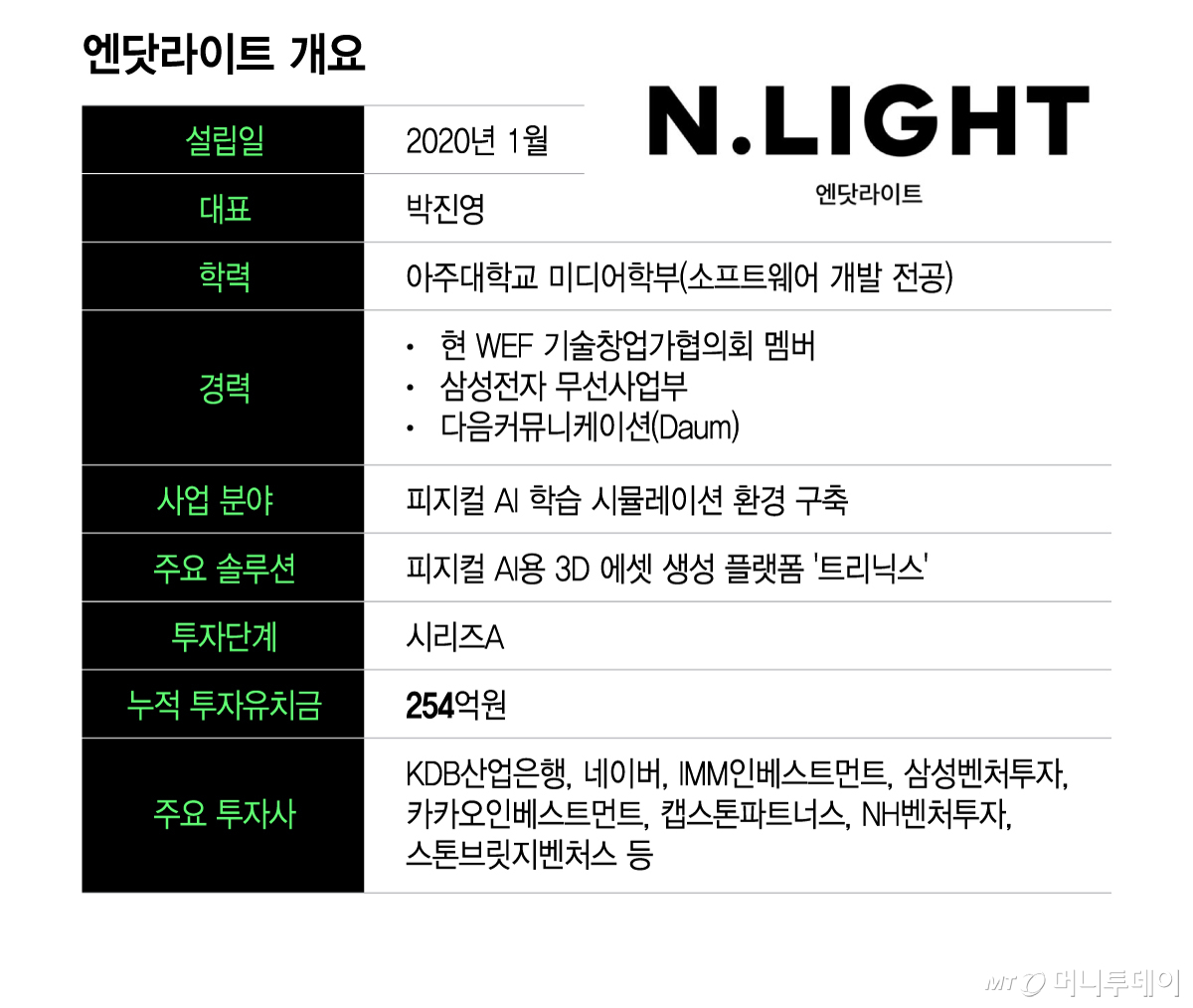
NdotLight's starting point was not robotics. Park Jin-young, who worked as a software developer at Samsung Electronics, participated in an initial task force (TF) of about 30 people for the Galaxy S and developed the launcher framework. This is an area where the screen appears two-dimensional, but 3D graphics technology operates behind the scenes.
Subsequently, he moved to Daum Communications, gaining experience in company-wide strategy based on UX (User Experience), before launching his startup. His co-founder and husband, CTO (Chief Technology Officer) Kim Sun-tae, is a graphics expert who developed AI and 3D engines at Naver and Samsung Electronics, among others.
NdotLight's initial target was the home 3D printer market, which had high growth expectations when the company was founded in 2020. The judgment was that CAD tools that could be easily used without specialized knowledge would be necessary for anyone to print desired objects at home.
However, the home 3D printer market did not grow as expected. Turning toward the enterprise CAD market proved difficult, as it was a red ocean already dominated by global companies such as Autodesk and Siemens.
The turning point was the rise of physical AI. By combining generative AI with 'NdotCAD,' its proprietary 3D CAD engine developed over a long period, and automatically assigning physical properties to CAD data, NdotLight created data that could be immediately used for robot simulation.
CEO Park said, "Rather than abandoning our existing business to start a new one, it was more like the technology we had accumulated for nearly 10 years encountered the market of physical AI." He continued, "We built our technical capabilities with NdotCAD in the early stages, and upon finding the market where the value of that technology could be maximized, we launched TRINIX."
"Robots Cannot Learn from 3D Models That Only Resemble Reality on the Surface"

NdotLight's main solution, TRINIX, automatically generates SimReady assets required for simulation by taking text, images, or existing 3D CAD data as input. The core of this is not just implementing the external shape of an object in 3D, but also inferring and incorporating physical properties such as mass, friction, material, and joint structure.
For example, for a robot to learn how to open a laptop, it cannot simply know the laptop's appearance. It must understand that the screen and body are connected by a hinge, which direction the hinge moves, and how much force is required to open it.
Similarly, if a beverage bottle is represented as a single lump including both the bottle and the cap, the robot cannot open the cap. The bottle and cap must be distinguished as separate parts, and information such as the connection relationship between parts and friction is needed for the robot to learn manipulation similar to reality.
CEO Park explained, "Mesh data created by photographing objects with cameras or scanners is advantageous for quickly implementing external appearances, but it is difficult to grasp internal part structures or design information." He added, "We assign physical properties based on CAD data that includes parts, dimensions, and connection relationships."
He further added, "Manufacturing companies can utilize existing CAD data to create digital twins of factories or production equipment, and repeatedly verify movement, manipulation, and collision avoidance in a virtual environment before deploying actual robots."
When done manually by a person, it usually takes 8 to 9 hours to process a single asset for simulation, but TRINIX aims to handle this 'within 3 minutes.' He stated, "We will make it so that work requiring a skilled 3D designer to spend an entire day can be completed in the time it takes a designer to brew a cup of coffee."
Following Hyundai Motor and LG Electronics, Humanoid Demonstration at Shipyard
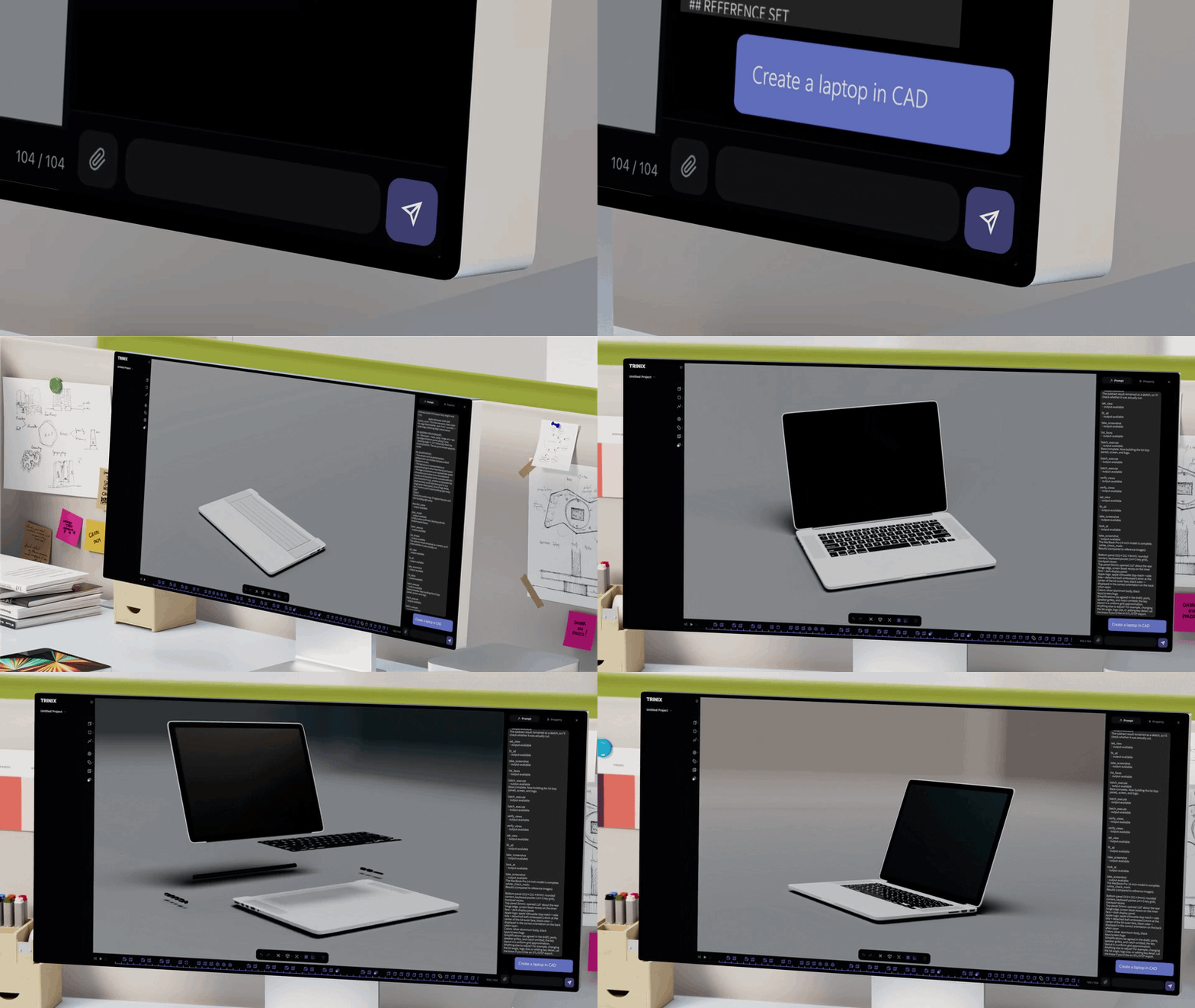
Amid the emergence of various SimReady companies worldwide, NdotLight emphasized that it has a different 'character' from these firms. While most competitors apply physical property information to mesh data obtained through 3D scanning, NdotLight generates 3D CAD data distinguished at the part (component) level.
CEO Park said, "We data-ize the 'objects' that robots will perform actions on, rather than the robot's movements themselves." He explained, "We implement details such as where to grab a box passing through a conveyor belt so it does not slip, how much it deforms when force is applied, and in which direction a refrigerator door opens."
NdotLight's technical capabilities were first recognized by global players. At NVIDIA GTC held in Taiwan last June, NdotLight was listed as a 'Physical AI Ecosystem Partner' in the keynote by CEO Jensen Huang.
TRINIX is integrated with NVIDIA's 3D development platform 'Omniverse' and its robot simulation platform 'Isaac Sim.' Recently, it also joined the 'DexBench' project, a global humanoid dexterity evaluation benchmark jointly developed by NVIDIA and RLWRLD.
NdotLight is currently participating as a data supplier in physical AI projects being promoted by major corporations such as Hyundai Motor and LG Electronics. It also supplies AI training data to humanoid and robot foundation model companies such as Holiday Robotics, Airobot, and RLWRLD.
It has also participated in 'Team REX,' the robotics partnership formed by Samsung SDS for Robot Transformation (RX). Expanding its application scope to the shipbuilding industry, it is conducting on-site demonstration of humanoid robots targeting Hanwha Ocean together with Airobot.
CEO Park emphasized, "The physical AI ecosystem is at a stage where no one has paved the way, and even NVIDIA is forging a path without knowing the answer." He added, "It appears that the winner of the SimReady market will be determined within three years. We are striving to be number one in this market."
[MoneyToday startup media platform 'Unicorn Factory']

 in FUTURE


