

[For more diverse corporate information on the startup featured in this article, please visit 'Data Lab' on the Unicorn Factory big data platform.]
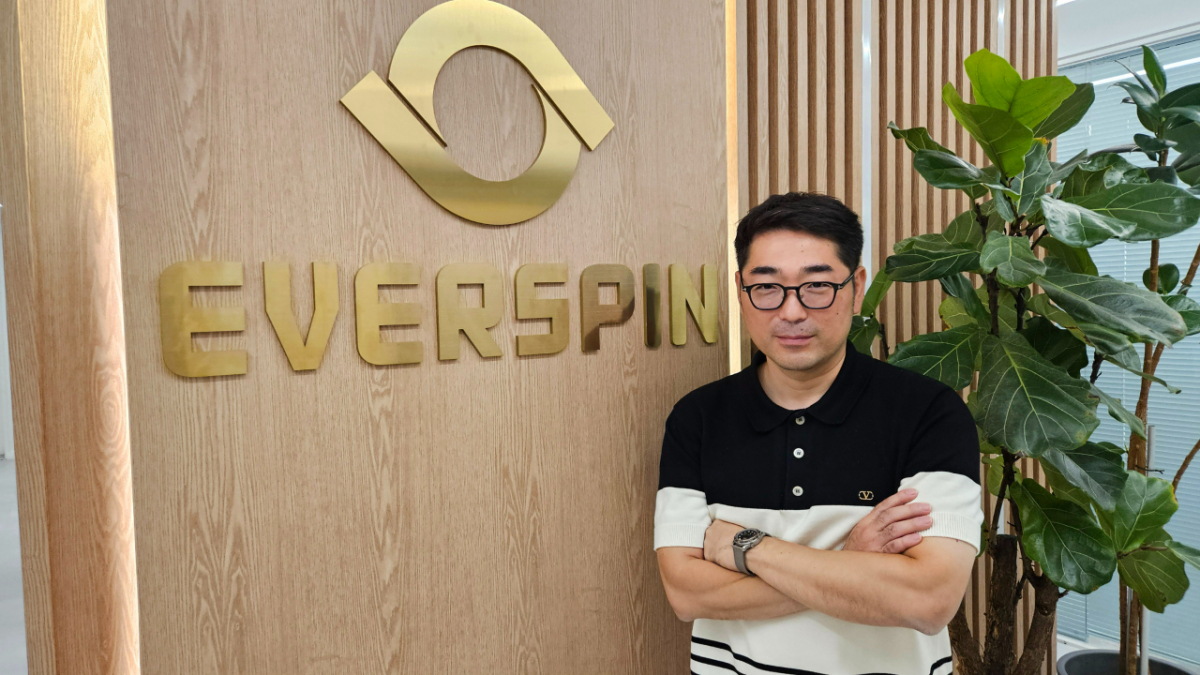
No matter how complex a security code is, if hackers are given enough time, they can eventually analyze it. So what if the code itself were changed before the hacker finishes their analysis?
AI-based cybersecurity firm 'Everspin' started with this shift in perspective. Instead of raising fixed walls, it protects web and mobile apps using 'MTD' (Moving Target Defense) technology, which constantly changes the structure of the walls.
Ha Young-bin, CEO of Everspin, said, "By making security codes change continuously, as if providing hackers with a new maze every day, analysis results from the previous day become useless the next day." He added, "We determined that continuously changing security is safer than complex but static security."
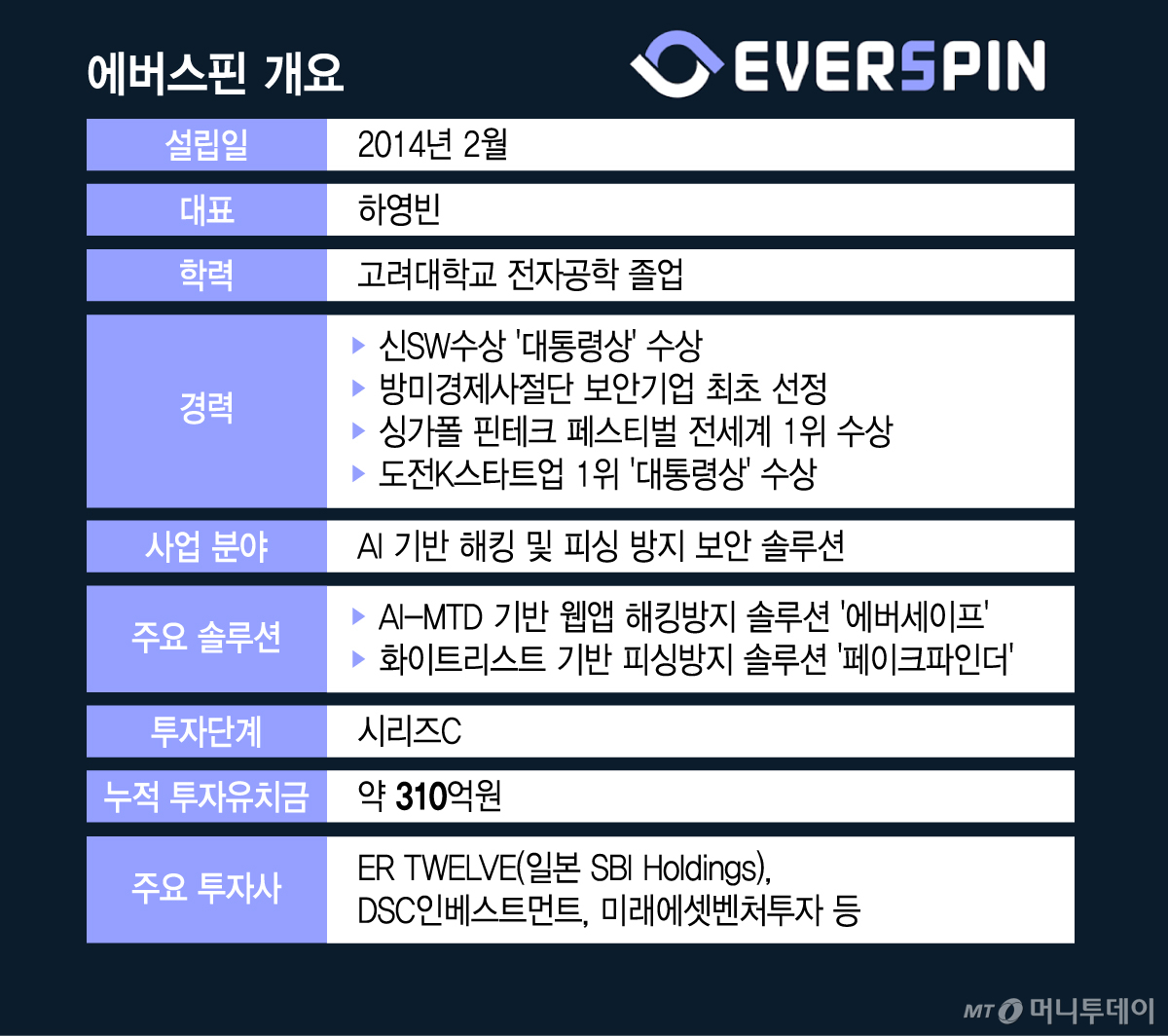
Founded in 2014, Everspin operates anti-hacking solutions such as 'EverSafe,' anti-phishing solution 'FakeFinder,' and identity theft prevention solution 'IDefender.' Based on references built in the domestic financial sector, it has expanded its business scope to the Japanese and Indonesian markets.
Performance is also on a growth trajectory. Last year's revenue was 13.4 billion won, with an operating profit of approximately 4.9 billion won. The operating profit margin jumped from 6.3% in 2024 to 36.3% last year. This year, it is aiming for annual revenue to surpass 20 billion won.
Continuously Changing 'Security Codes' to Block Hacking
The areas Everspin protects are not internal corporate networks or employee PCs. They are web and mobile apps directly exposed to customers, i.e., 'service channels.' Key defense targets include web and app tampering/forgery, session hijacking, unauthorized scraping, macros, and phishing using malicious apps.
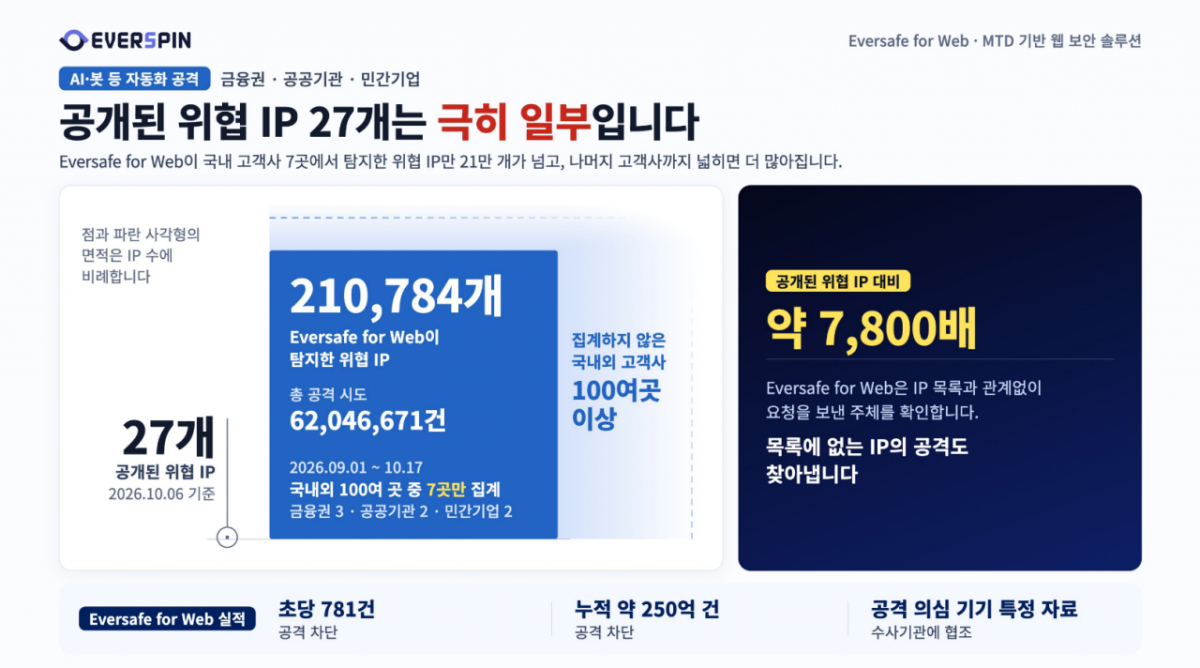
The representative solution, EverSafe, uses AI-MTD technology to continuously change security modules. While static security codes can be analyzed by hackers, if the form and placement of security modules change continuously, attackers are forced to repeat their analysis.
As cases increase where AI generates large-scale bots to indiscriminately explore and attack vulnerable websites, EverSafe responds not only to tampering/forgery or session hijacking but also to automated attacks such as scraping and macros.
The anti-phishing solution FakeFinder uses an approach opposite to existing blacklists. While the blacklist method registers malicious apps that have already caused incidents in a DB (database) to block them, FakeFinder identifies tampered or forged apps based on normal apps.
The competitiveness of this method comes from the DB. FakeFinder collects and databases over 22 million apps released normally worldwide, identifying fake apps disguised as normal apps, apps modified from normal apps, and abused remote control apps.
CEO Ha stated, "Malicious apps can bypass blacklists by slightly changing their form and redistributing them, but by using the original form of normal apps as a standard, newly emerging forged apps can also be found." He added, "To implement a whitelist in a B2C environment, a massive DB of normal apps must be continuously collected and managed."
Targeting Top Financial Institutions with an Annual Subscription Model
All of Everspin's products are supplied as annual subscription licenses. It did not adopt the method of the existing security industry, which sells solutions once and then only charges maintenance fees at a level of 8 to 10% of the contract amount.
CEO Ha pointed out, "In a structure centered on one-time revenue, new customers must be acquired every year just to maintain existing revenue." He added, "If reckless low-price orders are repeated, R&D (Research and Development) capacity decreases, leading to a vicious cycle where technical competitiveness weakens again."
He continued, "Security is not a business that ends the moment a product is installed. Because attack methods and IT environments keep changing, new technology must be provided every year." He added, "We built a structure from the beginning where customers evaluate the value of the technology and choose it again every year."
The market entry strategy also differs from typical security companies. Instead of securing small and medium-sized customers first and then moving up to large customers, it targeted top domestic financial institutions from the start. While verification for adopting security solutions is rigorous at financial institutions, passing the verification of a top-tier financial institution itself becomes a powerful reference.
CEO Ha said, "I didn't think we needed to start from 200th place in the market and climb up." He added, "Because I was confident that we were technically superior to existing products, we knocked on the doors of top 10 financial institutions from the beginning. If the highest-level customers recognize us, the next market opens naturally."
Pursuing General Listing Instead of Technology Special Case

The method verified in Korea has been applied to Japan and Indonesia as well. In Japan, it secured approximately 70 customer companies through SBI Everspin, a joint venture established with SBI Holdings. In Indonesia, it supplied EverSafe and FakeFinder to Bank Jago, Bank Mandiri, DKI Bank, BNI Securities, and Bank Sumut, among others.
Last year's overseas revenue was 5.247 billion won, a 3.8-fold increase from the previous year, and the proportion of overseas in total revenue rose to 39.1%. CEO Ha said, "We are improving both the quantity and quality of revenue," adding, "We are recreating the method proven in Korea and Japan in Indonesia."
Everspin's next market is the area of verifying the safety and reliability of AI itself. This is because threats different from existing information security, such as prompt injection, abuse of authority, and data leakage, are emerging with the spread of generative AI and AI agents.
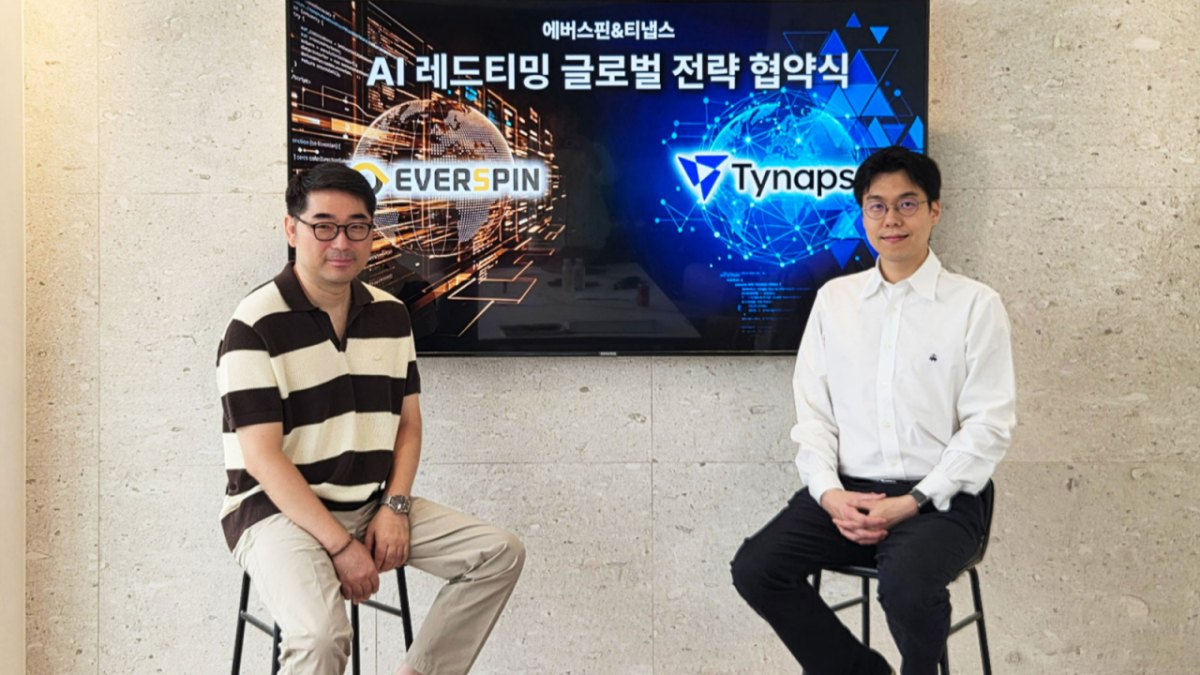
Currently, it is cooperating in the field of AI red teaming and reliability verification with AI safety company Tinaps. The plan is to expand the portfolio into a business that checks safety from the design to the operation stage of AI systems, going beyond web/app hacking and phishing prevention.
Recently, it also launched a demonstration of 'KYA (Know Your Agent) Trust Gateway' with KB Kookmin Card and SBI Holdings to verify the identity and delegated authority of AI agents. This is technology that confirms who an AI performing reservations and payments on behalf of users has been delegated authority by, and up to what scope it can transact.
Meanwhile, Everspin is re-pursuing a KOSDAQ listing. At the time of its first IPO (initial public offering) attempt in 2021, revenue was around 600 million won. While technical capability was recognized, it was insufficient to prove actual market scalability and profit generation ability. Instead of forcing a listing under unsatisfactory conditions, it chose to withdraw.
This time, it has chosen the general listing track rather than the technology special case. The strategy is to be evaluated for corporate valuation based on stable profits, subscription-based revenue, and the growth potential of overseas business.
CEO Ha said, "Since we already have a financial structure that allows us to continue the business without external investment, we will use the listing as a means to enhance trust and partnerships in the global market." He added, "IPO funds will be invested in expanding overseas markets, new R&D, and M&A (mergers and acquisitions) of technology companies."
He emphasized, "Although we started in Korea, we will become pioneers entering the global security market with MTD and whitelist technology." He added, "Beyond competing in a market created by others, we will establish a new benchmark where we create the market and other companies can play within it."
[MoneyToday startup media platform 'Unicorn Factory']

 in FUTURE


