

HL Group’s robotics specialist HL Robotics is launching its autonomous parking robot at the United Kingdom’s second-busiest airport. In Korea, a demonstration project at Gimpo Airport and supportive regulatory measures are underway, suggesting that commercial deployment of parking robots will accelerate, primarily targeting airports and large-scale commercial facilities.
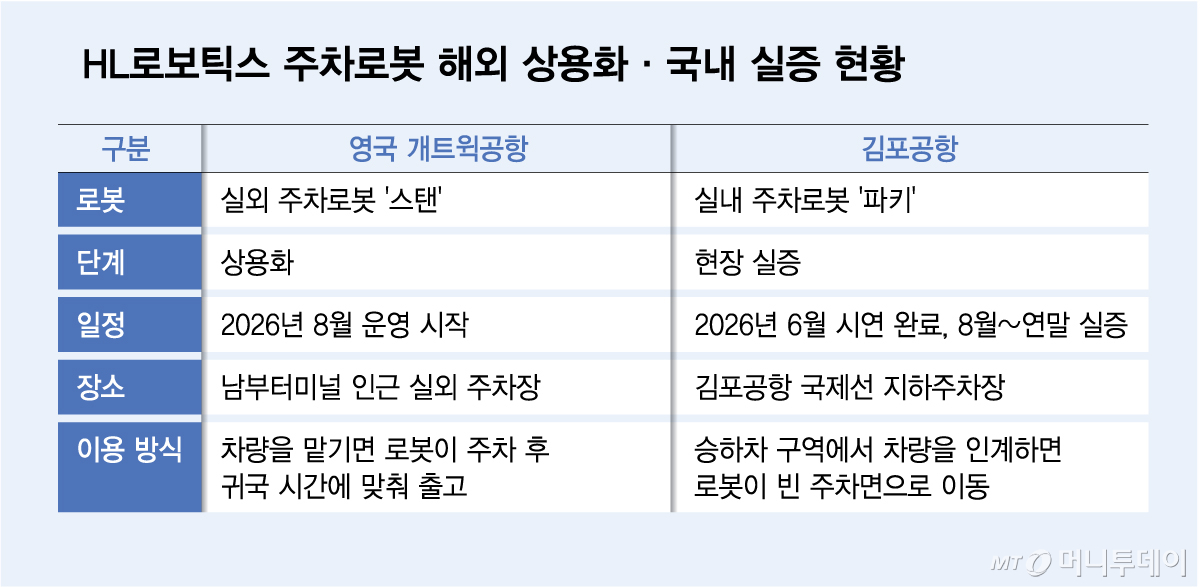
According to industry sources on the 28th, London Gatwick Airport in the UK will begin operating a robot-based parking service developed by Stanley Robotics, HL Robotics’ French subsidiary, starting next month. This marks the first time a robot parking service has been introduced at a UK airport.
Passengers park their vehicles in a dedicated area near the South Terminal of Gatwick Airport, confirm their reservation details, and exit the vehicle. An autonomous parking robot then lifts the car by its tires and transports it to an available parking space. There is no need to hand over keys; passengers can proceed directly to their destination.
Flight information for return journeys is also integrated into the service. The parking robot pre-transports vehicles from the parking area to a designated pickup zone in advance, timed to match passengers’ arrival at the airport. This reduces the time spent searching for available parking spots or locating one’s vehicle after returning home.
The robots deployed at Gatwick Airport are Stanley Robotics’ outdoor autonomous parking robot named “Stan.” The system operates by sliding under vehicles, lifting them via their tires, and moving them to designated parking spaces. It can transport vehicles weighing up to 3 tons (t). Designed for 24-hour operation, the robot is built to withstand outdoor conditions including rain and snow.
Previously, HL Robotics invested 32.2 billion won to acquire a 74.1% stake in Stanley Robotics and incorporated it as a subsidiary last year. Since commercializing its parking robot at Lyon-Saint Exupéry Airport in France in 2018, Stanley Robotics has expanded its business scope to include airports and finished-vehicle logistics hubs across Europe and North America.
The expansion into Gatwick Airport is significant as it represents a new commercialization milestone for major European airports. Gatwick is the UK’s second-largest airport, handling an annual passenger volume of 43 million. Stanley Robotics anticipates that Gatwick will utilize its robots while expanding parking capacity to accommodate growing passenger numbers.
HL Robotics is advancing commercialization in Korea with its indoor autonomous parking robot named “Paki.” Paki concluded a demonstration at the international terminal parking lot of Gimpo Airport on the 22nd of last month and is scheduled for actual deployment from next month through year-end. The company plans to validate operational stability and space utilization efficiency at Gimpo Airport, where vehicle usage is frequent and average parking lot occupancy rates reach 80–90%.
While Stan is specialized for large-scale outdoor spaces such as airports and finished-vehicle logistics hubs, Paki targets indoor areas including underground parking lots. By eliminating the need for drivers to park manually, Paki reduces the space required for opening car doors and can increase parking capacity by over 30% within the same area.
Regulatory foundations have also been established. The Ministry of Land, Infrastructure and Transport has implemented safety and inspection standards for automated parking systems, including parking robots, effective from the 1st of this month. These measures provide concrete guidelines for installing and operating parking robots in real-world settings such as airports and commercial facilities, moving beyond previous demonstration-focused initiatives.
An industry official stated, “With overseas airport commercialization achievements and domestic regulatory improvements aligning, discussions on introducing parking robots are expected to expand, particularly among airports, hotels, department stores, and large-scale residential complexes that require additional parking space.”

 in INDUSTRY
